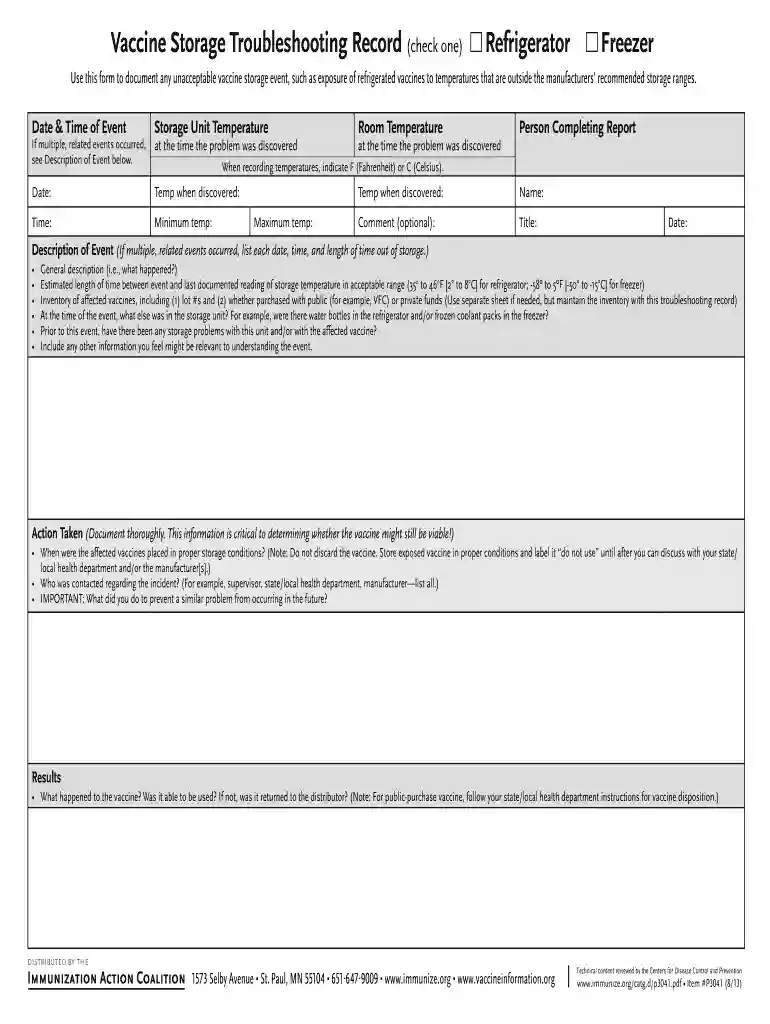
Vaccine Storage Troubleshooting Record check one 2026

Get Form
Vaccine Storage Troubleshooting Record check one Preview on Page 1

Here's how it works

01. Edit your form online
Type text, add images, blackout confidential details, add comments, highlights and more.

02. Sign it in a few clicks
Draw your signature, type it, upload its image, or use your mobile device as a signature pad.

03. Share your form with others
Send it via email, link, or fax. You can also download it, export it or print it out.

Definition & Purpose

The "Vaccine Storage Troubleshooting Record check one" is a crucial form used to document events where vaccine storage conditions deviate from recommended practices. This record captures detailed information about temperature excursions, actions taken, and results on vaccine viability. Proper documentation ensures that vaccines remain safe and compliant with health regulations, emphasizing the importance of maintaining correct storage conditions to prevent compromised vaccine efficacy.

Key Components

The form consists of several sections designed to thoroughly record any storage discrepancies. Critical components include:

  • Event Details: Captures the date, time, and nature of the storage incident. Clear documentation of this information aids in quick identification and rectification of the problem.
  • Temperature Records: Documents specific temperature ranges outside recommended levels and the duration for which the vaccines were exposed to these conditions.
  • Corrective Actions & Results: Outlines corrective measures implemented and their impacts on the vaccine's viability. Such measures might include adjusting refrigeration settings or consulting with health authorities for guidance on vaccine use.

Steps to Complete the Vaccine Storage Troubleshooting Record

  1. Document the Incident: Begin by noting the exact time and nature of the storage problem. Include details such as equipment malfunctions or human errors that contributed to the incident.
  2. Record Temperature Data: Accurately log the temperature ranges and duration of exposure to non-compliant conditions for a comprehensive understanding of the incident's severity.
  3. Implement Corrective Measures: Detail the steps taken to restore proper storage conditions. This may involve technical repairs, adjustments to storage protocols, or liaising with equipment specialists.
  4. Evaluate Vaccine Viability: Following corrective actions, assess the vaccines' condition and determine whether they remain usable or require disposal.
  5. Communicate with Health Authorities: Share the troubleshooting record with relevant regulatory bodies to ensure compliance and gather advice on further steps if needed.

Who Typically Uses the Vaccine Storage Troubleshooting Record

This form is essential for healthcare professionals responsible for managing vaccine storage and inventory, such as:


  • Clinical Pharmacists: They ensure medications and vaccines are stored appropriately to retain their effectiveness.
  • Public Health Officials: Given their role in regulating and monitoring vaccine distribution, these professionals rely on accurate records for compliance and quality assurance.
  • Healthcare Facility Managers: They oversee the entire vaccine management process, including inventory, storage, and record-keeping, ensuring facilities adhere to health standards.
decoration image ratings of Dochub

Importance of Proper Documentation

Comprehensive record-keeping on this form serves multiple vital functions:

  • Ensures Vaccine Safety: By documenting temperature deviations and solutions, the form helps maintain vaccine potency, directly impacting public health outcomes.
  • Facilitates Compliance: Accurate records are critical for meeting both federal and state regulatory requirements, avoiding penalties and maintaining trust with oversight bodies.
  • Enhances Accountability: The form encourages responsible vaccine management by highlighting areas for improvement in storage practices.

Key Terms and Their Relevance

Familiarity with important terms is crucial for effectively completing the form. Key terms include:

  • Temperature Excursion: Any deviation from the recommended storage temperature range that could impact vaccine safety.
  • Corrective Action: Steps implemented to rectify storage issues, ensuring swift return to optimal conditions.
  • Viability Assessment: Evaluates whether vaccines remain effective and safe for use after a storage incident.

Examples of Using the Form in Practice

Consider scenarios where the "Vaccine Storage Troubleshooting Record check one" proves invaluable:

  • Power Outages: During unexpected power failures, this form helps document affected batches and corrective actions, such as using backup generators or transferring vaccines to alternate storage.
  • Equipment Malfunctions: When refrigeration units fail, thorough records outline repair timelines, alternate storage utilization, and consultation with suppliers or health authorities for advice on handling affected vaccines.
  • Human Errors: In cases where staff mistakenly adjust temperatures, the form tracks error rectification processes, including retraining staff and revising protocols.

Software Compatibility

While the form can be filled out manually, many organizations may prefer digital solutions for efficiency:

  • Digital Completion Tools: Platforms like DocHub can simplify form completion, allowing for digital temperature logging and instant sharing with relevant parties.
  • Integration with Inventory Systems: Compatibility with systems like QuickBooks or pharmacy management tools ensures seamless synchronization of vaccine data across platforms.

By leveraging both traditional and digital tools, healthcare facilities can improve the accuracy and responsiveness of their vaccine management processes.

See more Vaccine Storage Troubleshooting Record check one versions

We've got more versions of the Vaccine Storage Troubleshooting Record check one form. Select the right Vaccine Storage Troubleshooting Record check one version from the list and start editing it straight away!
Versions Form popularity Fillable & printable
2018 4.8 Satisfied (159 Votes)
2013 4.4 Satisfied (50 Votes)
be ready to get more

Complete this form in 5 minutes or less

Get form

Got questions?

We have answers to the most popular questions from our customers. If you can't find an answer to your question, please contact us.
Contact us
Many vaccines must be maintained in the range from 2 C to 8 C to retain product potency. Objectives: We have tested the performance of two type of household refrigerators to determine if these refrigerators are
If vaccines are not stored correctly within their cold-chain temperature, range the potency of the vaccine can be effected. Once vaccines have lost their potency, this cannot be reversed and as a result, vaccines can become spoiled and ultimately unusable for patient administration.
Temperature Ranges Refrigerators should maintain temperatures between 2 C and 8 C (36 F and 46 F)*. Freezers should maintain temperatures between -50 C and -15 C (-58 F and +5 F). Ultra-cold freezers should maintain temperatures between -90 C and -60 C (-130 F and -76 F) .
Never use a vaccine that has been contaminated or has expired! If an expired vaccine even 1 day expired is administered to a patient, the dose must be repeated. Vaccine should always be stored in the middle of the refrigerator or freezer never in the doors.
Stock information systems are most effective when updated immediately upon ordering and receipt of vaccines and at the end of clinical sessions where vaccines have been administered. Vaccine stock should be checked and records updated at least every month.

Security and compliance

At DocHub, your data security is our priority. We follow HIPAA, SOC2, GDPR, and other standards, so you can work on your documents with confidence.

Learn more
ccpa2
pci-dss
gdpr-compliance
hipaa
soc-compliance
be ready to get more

Complete this form in 5 minutes or less

Get form