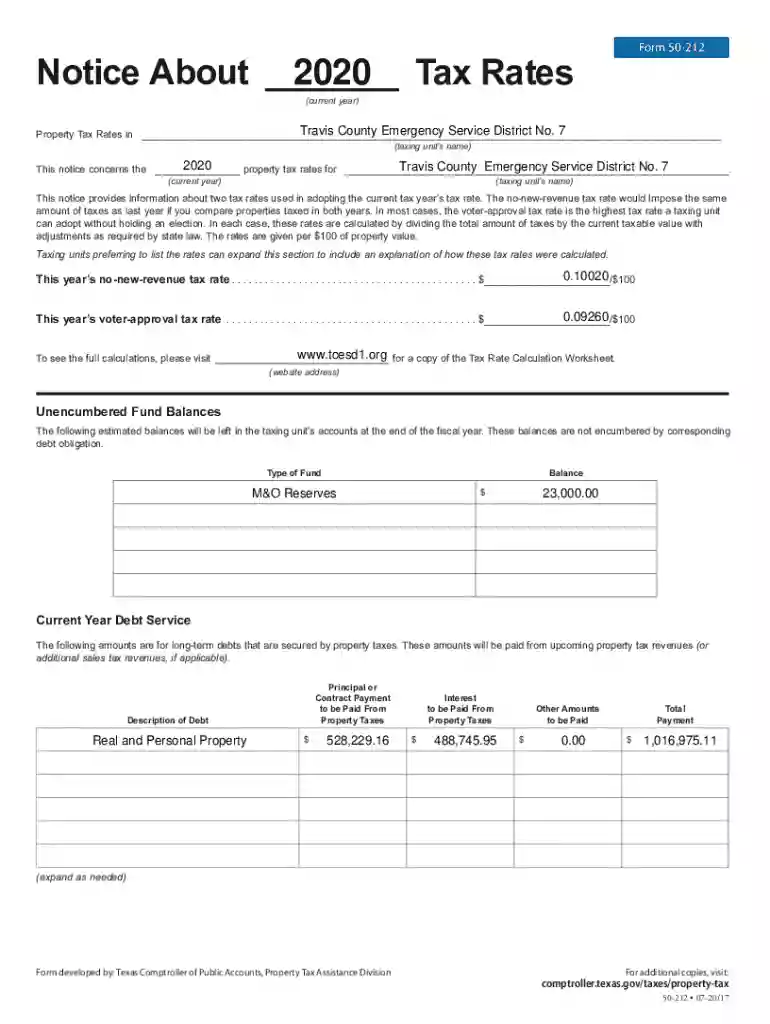
Form 50-212 Notice About Tax Rates - tcesd5 2026

Get Form
Form 50-212 Notice About Tax Rates - tcesd5 Preview on Page 1

Here's how it works

01. Edit your form online
Type text, add images, blackout confidential details, add comments, highlights and more.

02. Sign it in a few clicks
Draw your signature, type it, upload its image, or use your mobile device as a signature pad.

03. Share your form with others
Send it via email, link, or fax. You can also download it, export it or print it out.

Definition and Meaning of Form 50-212 Notice About Tax Rates - tcesd5

Form 50-212 provides official information regarding the property tax rates for specified local entities such as the Travis County Emergency Services District No. 7 (TCESD5) for a given tax year. This document typically outlines essential calculations such as the no-new-revenue tax rate and the voter-approval tax rate. These figures help residents understand how tax rates affect their property taxes. It serves as a transparent disclosure to taxpayers regarding how local governments fund services.

How to Use the Form 50-212 Notice About Tax Rates - tcesd5

The Form 50-212 Notice is instrumental for property owners and tax professionals in several ways. Primarily, it enables them to:

  • Compare annual tax rates, helping property owners anticipate changes in their property tax obligations.
  • Understand the financial decisions impacting local services, as changes in tax rates may reflect budget reallocations or new expenditure needs.
  • Make informed decisions about property investments by assessing potential long-term tax implications.

When using the form, it is essential to review both the no-new-revenue and voter-approval tax rates, as these figures impact the tax calculations directly.

Steps to Complete the Form 50-212 Notice About Tax Rates - tcesd5

While Form 50-212 is a notice and not typically one that individuals complete or submit, understanding its structure and details can help users interpret its data effectively:

  1. Review Key Areas: Examine sections covering the current fiscal year's tax rates, provisions for voter approval, and historical comparisons.
  2. Identify Rate Changes: Pay close attention to how current rates compare to prior years to assess fiscal trends.
  3. Understand Calculations: Familiarize yourself with the calculations for no-new-revenue and voter-approval tax rates to understand potential fluctuations in your property taxes.
  4. Consult Tax Authorities If Necessary: Contact local tax authorities for further explanations, especially if discrepancies or uncertainties in tax impacts arise.

Key Elements of the Form 50-212 Notice About Tax Rates - tcesd5

Form 50-212 contains several critical elements that provide comprehensive insights into tax rates:

  • No-New-Revenue Tax Rate: Indicates the rate necessary to generate the same tax revenue as the previous year, exclusive of new constructions.
  • Voter-Approval Tax Rate: The tax rate which, if exceeded, would allow taxpayers to call for an election to approve the higher rate.
  • Expenditure Adjustments: Changes in tax rates due to enhancements in capital projects or other significant district demands.
  • Unencumbered Fund Balances: Details on available funds that have not been allocated to particular expenditures, which impact total revenue needs.

Legal Use of the Form 50-212 Notice About Tax Rates - tcesd5

Form 50-212 is legally mandated to ensure transparency and accountability in local tax rate changes. The legal foundation for the form stems from state taxation codes requiring local governments to notify taxpayers about their tax rate proposals and ratifications. It provides legal grounds for residents to contest or dialogue with tax authorities about local fiscal decisions impacting their tax liabilities.

State-Specific Rules for the Form 50-212 Notice About Tax Rates - tcesd5

While the form’s primary content is standardized, several state-specific rules may influence its details:

  • Texas Regulations: In Texas, local governments follow strict guidelines for calculating and communicating tax rates to ensure taxpayer awareness and compliance.
  • Public Hearing Requirements: States may require public hearings before approving tax rates surpassing certain thresholds, providing taxpayers opportunities for input.

State laws govern the exact calculations and notifications related to the tax rates, ensuring uniform application and compliance.

Examples of Using the Form 50-212 Notice About Tax Rates - tcesd5

Form 50-212 is valuable in numerous practical scenarios:

  • Budget Planning: Residents can use the form to plan annual household budgets by aligning anticipated property tax obligations with income projections.
  • Policy Impact Studies: Researchers may use historical data from these forms to study the effects of tax rate changes on local economic conditions.
  • Real Estate Investments: Investors can assess the tax environment and stability of property taxes in particular districts, influencing their investment decisions.

Filing Deadlines and Important Dates

For taxpayers relying on information from the form, keeping track of important deadlines is crucial:

  • Notification Deadlines: Local governments must adhere to deadlines for issuing tax rate notices to ensure taxpayers are informed in a timely manner.
  • Public Review Periods: Often, there are set periods during which taxpayers can review and challenge the proposed tax rates.
  • Finalization Dates: Knowing when rates are finalized helps property owners plan for any necessary adjustments in their financial planning.

Understanding these timeline elements helps taxpayers and stakeholders effectively respond to rate changes.

See more Form 50-212 Notice About Tax Rates - tcesd5 versions

We've got more versions of the Form 50-212 Notice About Tax Rates - tcesd5 form. Select the right Form 50-212 Notice About Tax Rates - tcesd5 version from the list and start editing it straight away!
Versions Form popularity Fillable & printable
2022 4.8 Satisfied (119 Votes)
2020 4.1 Satisfied (25 Votes)
be ready to get more

Complete this form in 5 minutes or less

Get form

Got questions?

We have answers to the most popular questions from our customers. If you can't find an answer to your question, please contact us.
Contact us
To qualify for the age 65 or older residence homestead exemption, the individual must be age 65 or older, have an ownership interest in the property and live in the home as his or her principal residence.
Changes in Property Use: Property tax reassessments can be triggered by shifts in how a home or parcel is used, such as converting a residence into a rental, building an accessory unit, or changing land from agricultural to residential use.
Deduction for Seniors (Sec. 70103) New deduction: Effective for 2025 through 2028, individuals who are age 65 and older may claim an additional deduction of $6,000.
California property taxes increase every year at a maximum rate of 2%, so you can expect a slight increase on an annual basis.
The bill passed onto the full Senate Tuesday, SB 23, would raise their total homestead exemption all the way to $200,000.

Security and compliance

At DocHub, your data security is our priority. We follow HIPAA, SOC2, GDPR, and other standards, so you can work on your documents with confidence.

Learn more
ccpa2
pci-dss
gdpr-compliance
hipaa
soc-compliance

People also ask

With Senate Bill 4, the homestead exemption is now $140,000, an almost 1,000% increase. Seniors homestead exemption now goes all the way up to $200,000. This session, we also spent $50 billion on property tax relief.
Governor Greg Abbott today signed House Bill 9, Senate Bill 4, and Senate Bill 23 into law to provide lasting property tax relief for Texans at a bill signing ceremony at Robson Ranch Clubhouse.