




01. Edit your form online
Type text, add images, blackout confidential details, add comments, highlights and more.

Type text, add images, blackout confidential details, add comments, highlights and more.

Draw your signature, type it, upload its image, or use your mobile device as a signature pad.

Send it via email, link, or fax. You can also download it, export it or print it out.
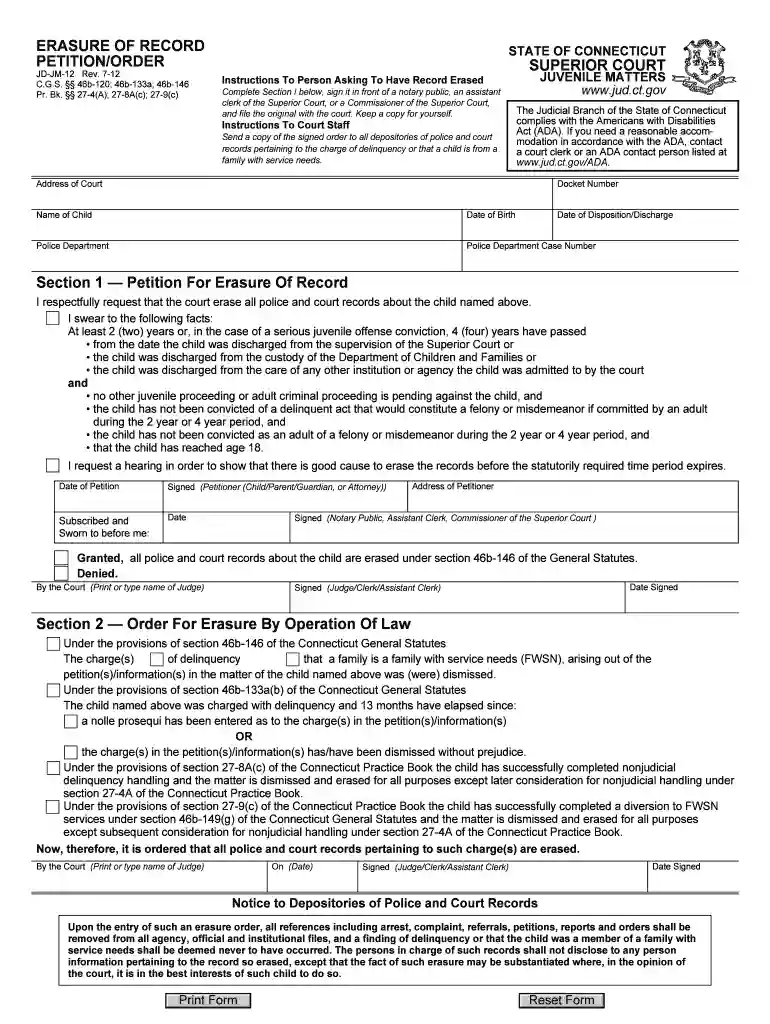
The "ERASURE OF RECORD PETITION ORDER" refers to a formal request submitted to a judicial court in Connecticut aiming to remove certain records from legal files. This process is typically applicable to juvenile records, and its purpose is to assist individuals in clearing their past, allowing them to move forward without the hindrance of obsolete legal documents. Understanding this form is critical for those hoping to attain a clean slate and have their records made inaccessible for background checks or legal inquiries.
Using the ERASURE OF RECORD PETITION ORDER involves several key steps designed to ensure thorough processing. Initially, individuals must read the instructions carefully to check if they meet the eligibility criteria. Once confirmed, the petitioner should gather all necessary documents, such as personal identification and any relevant court documents. The completed form is then submitted to the appropriate Connecticut judicial court for review. Each submission requires personal details and specifics about the records to be erased, ensuring that the request is directed correctly.
To effectively process a petition for the erasure of a record, several documents are necessary. These typically include:
Organizing these documents before submission can significantly accelerate processing time and ensure a complete petition package.
The ERASURE OF RECORD PETITION ORDER is primarily used for removing juvenile records from state and legal databases, rendering these histories inaccessible for future legal proceedings. This legal instrument supports the rehabilitation process, giving individuals the opportunity to clear their names in situations where records are no longer pertinent. It is critical that the request adheres to Connecticut state laws to avoid denial. Successful use of this form assures the erasure of applicable records and shields them from background checks or public scrutiny, aligning with privacy rights.
Familiarity with these terms helps individuals navigate the process with clarity and ensures that all requirements are met correctly.
Eligibility for the ERASURE OF RECORD PETITION ORDER involves several specific qualifications:
Understanding these criteria can prevent unnecessary rejections and guarantee a smoother legal process.


Connecticut has tailored rules that dictate the use of an ERASURE OF RECORD PETITION ORDER. For instance, only records adjudicated within Connecticut fall under this jurisdiction. Furthermore, Connecticut law outlines specific deadlines and rules for filing, which can impact the success of the petition. Adherence to these state-specific guidelines ensures that the process is legally sound and that the requester fully complies with Connecticut law.
Consider a young adult who was charged with a minor offense as a juvenile but has since avoided legal infractions. This individual can file an ERASURE OF RECORD PETITION ORDER to remove the blemish from their permanent record, aiding in applications for college or employment. Another example involves someone who has completed all court-ordered rehabilitation programs and seeks the erasure of those records to continue their professional career without prejudice. These scenarios illustrate the crucial role the form plays in reshaping one's legal and personal future prospects.
We've got more versions of the ERASURE OF RECORD PETITION ORDER - jud ct form. Select the right ERASURE OF RECORD PETITION ORDER - jud ct version from the list and start editing it straight away!
At DocHub, your data security is our priority. We follow HIPAA, SOC2, GDPR, and other standards, so you can work on your documents with confidence.
The law requires automatic erasure of eligible offenses that occurred on or after January 1, 2000. The law became effective in 2023; however, implementation has
Instructions to person asking to have record erased. Complete Section I below, sign it in front of a notary public, an assistant clerk of the.
Mar 19, 2021 Indicate by check mark whether the registrant (1) has filed all reports required to be filed by Section 13 or 15(d) of the Securities


