
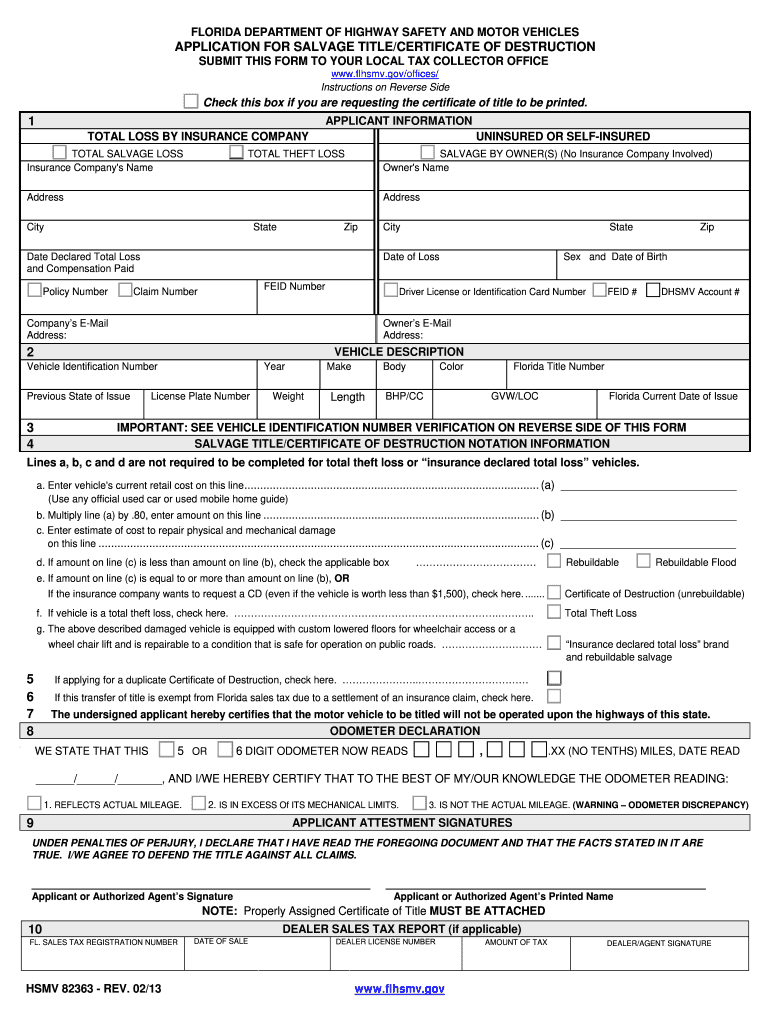







Definition and Meaning of the HSMV 82 Form
The HSMV 82 form is issued by the Florida Department of Highway Safety and Motor Vehicles. It is an application for obtaining a Salvage Title or Certificate of Destruction. The form is specifically used in cases where a vehicle is declared a total loss by insurance companies or owners. Its primary function is to establish the vehicle's status as a salvage or destroyed vehicle, which has significant implications for insurance claims and resale.
How to Use the HSMV 82 Form
To use the HSMV 82 form effectively, you must first ensure that the vehicle in question meets the criteria for a salvage or a total loss vehicle. The form requires detailed information about the applicant and the vehicle, including:
- Applicant's full name and contact information.
- Detailed vehicle description, including make, model, year, and vehicle identification number (VIN).
- Odometer reading and declaration.
This information is crucial for processing your application and ensuring the correct classification of the vehicle.
Steps to Complete the HSMV 82 Form
-
Gather Required Information: Before starting the form, collect all necessary information including the vehicle's details and the insurance claim documentation.
-
Fill Out Applicant Information: Enter your full legal name, address, and contact information in the designated fields.
-
Provide Vehicle Details: Include the vehicle's make, model, year, and VIN accurately to avoid processing delays.
-
Complete Odometer Declaration: Read and agree to the odometer disclosure statement, indicating whether the reading is actual, exceeds the limit, or differs from the actual mileage.
-
Verify VIN: If required in your state, have a certified official or agent verify the VIN for accuracy.
-
Attach Supporting Documents: Include any necessary documents such as insurance reports or damage assessments with your application.
-
Review and Sign: Double-check all entered information for accuracy before signing.
Importance of the HSMV 82 Form
Filing the HSMV 82 form is crucial in legally establishing a vehicle's salvage status, which aids in preventing fraud and protecting consumers. The form serves as an essential document for insurance companies when determining payouts and for new buyers to understand a vehicle's history. It ensures transparency and compliance with state regulations.
Key Elements of the HSMV 82 Form
- Appellant Information: Collects personal data required to identify the applicant processing the title change.
- Vehicle Information: Offers a comprehensive layout where details such as VIN, odometer reading, and physical vehicle condition must be indicated.
- Signature Section: Finalizes the form with the declaration and acknowledgment of the applicant.
Each of these elements is critical in validating the legitimacy and accuracy of the application.
Legal Use of the HSMV 82 Form
The form serves a legal purpose by ensuring vehicles with significant damage are correctly reported to the Florida Department of Highway Safety and Motor Vehicles. Failure to use the form properly can result in legal issues such as penalties for misrepresentation or fraudulent claims. It helps both vehicle owners and insurance bodies maintain honesty in vehicle assessments.
Who Issues the HSMV 82 Form
This form is issued and regulated by the Florida Department of Highway Safety and Motor Vehicles. The agency is responsible for overseeing vehicle titles, registrations, and ensuring compliance with state laws and regulations concerning vehicle status changes.
State-Specific Rules for the HSMV 82 Form
Florida's state regulations require that any vehicle deemed a total loss and being issued a salvage title undergo certain procedural checks. This includes submitting an accurate and completed HSMV 82 form. It is vital to understand that state-specific rules may affect aspects like VIN verification and supporting documentation, making it essential to consult local DMV guidelines when filling out the form.
Required Documents to Accompany the Form
- Insurance documentation validating the total loss claim.
- Vehicle accident reports or assessment documentation.
- Proof of identification for the applicant.
- Any additional forms or verifications requested by the DMV, such as the VIN verification.
These documents support the application process by providing evidence and validation of claims made on the form.




