




01. Edit your form online
Type text, add images, blackout confidential details, add comments, highlights and more.

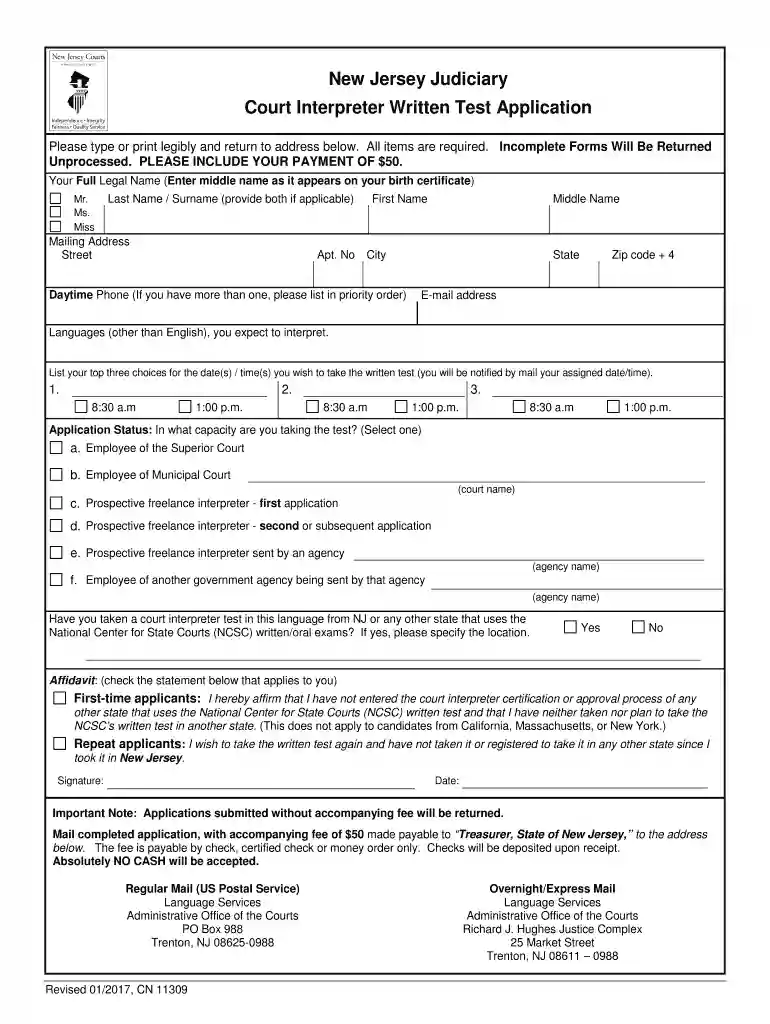
Type text, add images, blackout confidential details, add comments, highlights and more.

Draw your signature, type it, upload its image, or use your mobile device as a signature pad.

Send it via email, link, or fax. You can also download it, export it or print it out.
The "Overview of the Written Examination Overview of the Written Examination" outlines the necessary components and importance of the written examination for prospective court interpreters. It is a valuable resource designed to provide a comprehensive understanding of the test's structure and purpose. This document's key significance lies in detailing the skills and knowledge candidates must demonstrate, such as English vocabulary, court-related terminology, and ethical practices. By understanding these components, candidates can better prepare and position themselves for success in their roles.
The examination comprises multiple-choice questions aimed at assessing crucial areas:
This focus not only ensures the candidate’s linguistic capability but also their preparedness for the ethical expectations of the role.
Completing and understanding the "Overview of the Written Examination Overview of the Written Examination" involves several steps. These steps guide candidates through the registration and preparation phases necessary for taking the examination.
Eligibility Confirmation: Verify if you meet the eligibility criteria for the court interpreter examination. This ensures you have the prerequisites needed to participate.
Registration: Pay the required $50 examination fee and complete the registration process. It is essential to adhere to deadlines to secure your place in the testing schedule.
Preparation: Employ recommended strategies to prepare for the test. This includes reviewing vocabulary, familiarizing yourself with court procedures, and understanding ethical guidelines.
Exam Completion: Attend the examination as scheduled, following all instructions to avoid disqualification or penalties.
Taking these steps seriously will enhance your preparedness and increase your chances of passing the examination successfully.
The overview document comprises several integral elements essential for candidates.
Eligibility Requirements: Lists the qualifications needed to take the examination, such as educational background or prior court experience.
Registration Procedures: Details the steps needed to officially register for the examination, including deadlines and payment instructions.
Exam Content and Structure: Provides an in-depth look at the areas assessed, ensuring candidates are aware of what to focus on during their preparation.
Testing Policies: Emphasizes the importance of understanding the rules and procedures, helping candidates avoid common pitfalls.
These elements serve as a foundation for candidates, ensuring they have a clear understanding of the examination expectations and protocols.
To participate in the written examination, specific eligibility criteria must be met. These may include:
Resident Status: Candidates might be required to prove their residency in New Jersey or demonstrate authorization to work in the United States.
Educational Qualifications: A minimum educational requirement, such as a high school diploma or equivalent, may be necessary.
Language Proficiency: Demonstrating proficiency in English and, potentially, another language is crucial for interpreter roles.
Understanding these criteria beforehand ensures that candidates do not waste resources on the registration process if they do not qualify.


The "Overview of the Written Examination Overview of the Written Examination" is mainly used by individuals aspiring to become court interpreters. However, there are other interested parties who may benefit from the document:
Educational Institutions: Colleges and training centers might use the document to guide students in their career preparations.
Legal Professionals: Lawyers or court officials may reference the document to understand the criteria and standards for interpreters.
Government Agencies: Departments overseeing court procedures might rely on the document to ensure uniform standards are applied.
Each of these users seeks to ensure they are equipped with the necessary knowledge and resources, whether for personal or organizational benefit.

The document features several terms and phrases critical for candidates:
Registration Fee: The cost associated with securing a place on the examination schedule.
Multiple-Choice Question: A question type that requires the selection of one correct answer from several options.
Ethical Guidelines: Standards of conduct that dictate acceptable behavior in legal settings.
Clarifying these terms helps demystify the exam process and aids candidates in understanding the exact requirements and expectations.
The effectiveness of the "Overview of the Written Examination Overview of the Written Examination" can be illustrated through practical examples:
Prospective Interpreter Preparation: A candidate uses the document to identify study areas, leading to improved exam performance.
Educational Program Development: A training institution develops a prep course curriculum based on the examination's outlined content areas.
Providing clear examples showcases the document's utility in both individual preparation and broader educational contexts.
We've got more versions of the Overview of the Written Examination Overview of the Written Examination form. Select the right Overview of the Written Examination Overview of the Written Examination version from the list and start editing it straight away!
At DocHub, your data security is our priority. We follow HIPAA, SOC2, GDPR, and other standards, so you can work on your documents with confidence.
The purpose of a written examination is to provide the instructor with evidence regarding the amount of knowledge the student has acquired in the course.
The written test measures candidates knowledge of three essential areas in the work of a court interpreter at the level of a minimally qualified
Apr 1, 2019 PART 3 THE WRITTEN EXAMINATION. 3.1 Description of the Written Examination. The Written Examination has two sections: English and Spanish.


