




01. Edit your form online
Type text, add images, blackout confidential details, add comments, highlights and more.

Type text, add images, blackout confidential details, add comments, highlights and more.

Draw your signature, type it, upload its image, or use your mobile device as a signature pad.

Send it via email, link, or fax. You can also download it, export it or print it out.
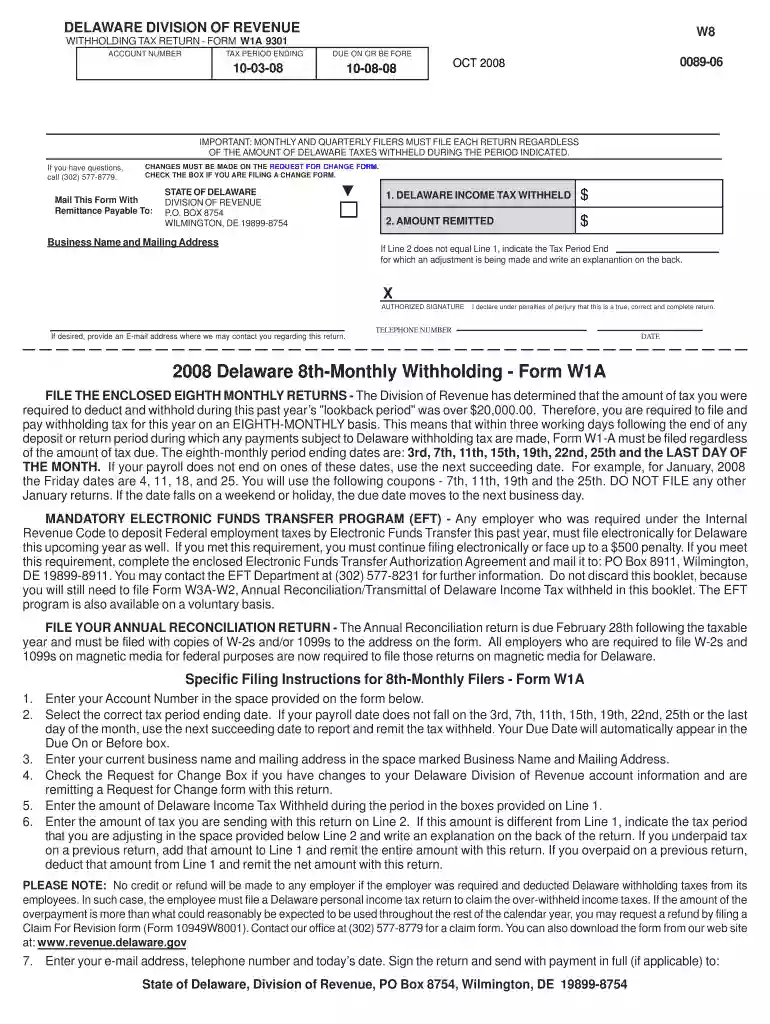
Form W1A is a withholding tax return form utilized by employers in Delaware to report and remit income tax withheld from employees' wages. It's an essential document for ensuring compliance with state tax obligations, providing a structured format for detailing employer account numbers, withheld amounts, and other relevant business information. Employers use this form to maintain accurate records of tax reporting and to avoid penalties that can arise from non-compliance.
Using Form W1A involves a clear understanding of Delaware's withholding tax policies. Employers must regularly submit this form as part of their payroll processing, including details such as total wages paid and the taxes withheld. To effectively use the form, employers should:
Completing Form W1A requires careful attention to detail to avoid errors that could lead to delays or penalties. Follow these steps for accurate completion:
Prepare Required Information:
Fill Out Employer Details:
Report Income and Withholding:
Review and Submit:
Adhering to filing deadlines for Form W1A is crucial for compliance. Delaware law mandates specific submission dates based on the employer's size and payroll frequency. Key deadlines include:
Understanding these deadlines helps avoid late filing penalties and ensures seamless tax compliance.
Form W1A serves a legal purpose by documenting the employer's tax withholding and reporting activities as mandated by state law. It's a critical part of maintaining lawful compliance with Delaware tax policies. Employers must keep meticulous records of filed forms and retained copies for organizational records. Additionally, they should remain informed about any regulatory changes that could affect the filing process.
Form W1A is comprised of essential sections that require careful completion, including:
These elements ensure the form meets its legal obligations and provides accurate documentation for tax reporting.
Typical scenarios illustrating the use of Form W1A include:
In each case, adherence to form requirements supports legal compliance and aids in avoiding penalties associated with incorrect or late filings.
Failure to comply with Form W1A filing requirements can result in significant penalties. These might include:
Understanding these potential penalties emphasizes the importance of accurate and timely Form W1A submissions.
We've got more versions of the form w1a form. Select the right form w1a version from the list and start editing it straight away!
At DocHub, your data security is our priority. We follow HIPAA, SOC2, GDPR, and other standards, so you can work on your documents with confidence.
Limit switches are used in electrical control systems to sense position. The predetermined motion of a cam, machine component, or piece part actuates the.
FILE THE ENCLOSED EIGHTH MONTHLY RETURNS - Use the form above if you are required to file and pay your Delaware Withholding tax for.
Here A is the space of formal F-linear combinations of elements of the form w1A w2 A A wm , i.e. A has one basis element for each choice of m = 0,1,2,


