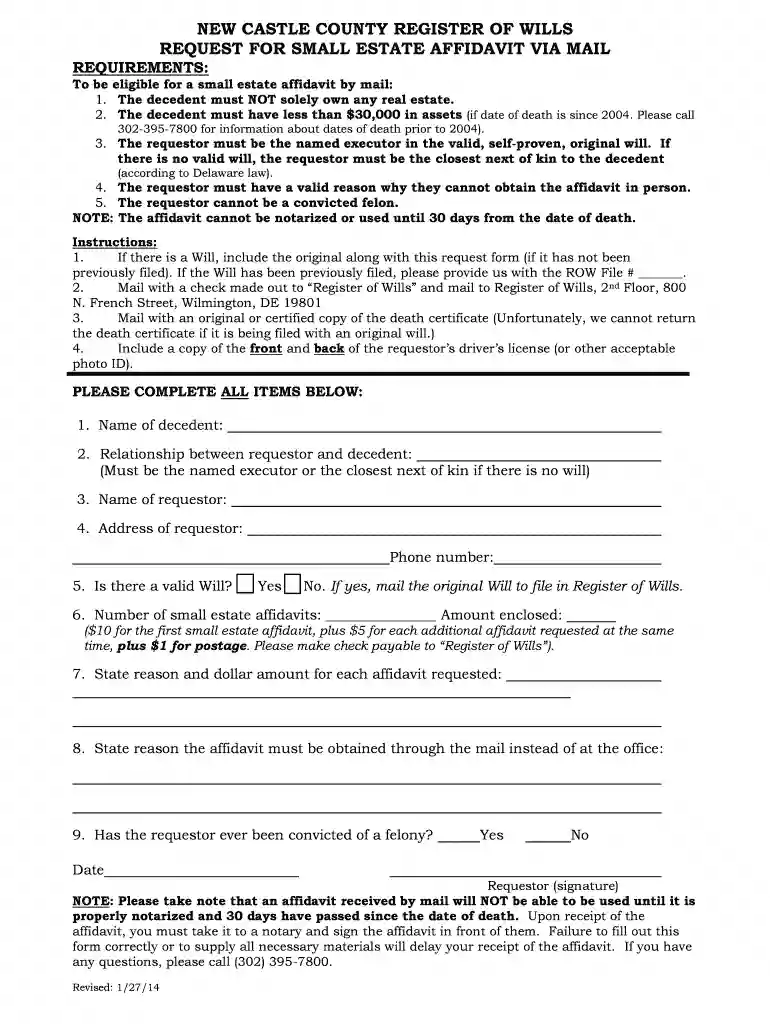
Definition and Purpose of the Small Estate Affidavit Mail-In Request Form
The Small Estate Affidavit Mail-In Request Form is a legal document used to settle the estate of a deceased person when the value of the estate is below a certain threshold, varying by state. This form allows certain assets to be transferred to the rightful heirs without undergoing formal probate. It is particularly useful when the decedent left behind simple estates, making the process of transferring ownership more expedient and cost-effective.
- Affidavit Usage: The primary function is to streamline estate settlement by providing an affidavit that asserts entitlement to the assets, bypassing lengthy legal procedures.
- Eligibility: Generally applicable when no formal probate proceedings have been initiated, ensuring administrative ease for small estates.
How to Use the Small Estate Affidavit Mail-In Request Form
Using the Small Estate Affidavit Mail-In Request Form involves providing detailed information and satisfying certain conditions. The form requires:
- Basic Information: Input the decedent’s name, date of death, and last known address.
- Asset Declaration: List all assets included in the estate, confirming they fall below the statutory limit.
- Heir Information: Specify details of rightful heirs or beneficiaries, including name and relationship to the decedent.
- Affiant’s Statement: Include a declaration by the affiant (the person filling out the affidavit) affirming their lawful claim under penalty of perjury.
Submitting the Form
Complete the above sections truthfully and mail the form to the designated county clerk's office, along with necessary supporting documentation.
Required Documents for Submission
Several documents must accompany your submission of the Small Estate Affidavit Mail-In Request Form, ensuring completeness and authenticity:
- Death Certificate: An official document confirming the decedent's death.
- Proof of Relationship: Evidence showing the affiant’s relationship to the decedent, often required to establish rightful claimant status.
- Asset Verification: Documentation verifying the specifics of assets claimed within the estate, such as bank statements or titles.
- Affidavit of Heirship: Sometimes needed as supplementary proof for establishing heirs, especially if the will is absent or contested.
Steps to Complete the Small Estate Affidavit Mail-In Request Form
Filling out the Small Estate Affidavit is a straightforward process if all pertinent information is ready:
- Gather Information: Collect all necessary personal, asset, and heir documentation.
- Fill Out the Form: Enter the decedent and asset details accurately on the form.
- Attach Required Documents: Include all required documents as per the previous section.
- Review for Accuracy: Double-check all entries for accuracy to prevent delays in processing.
- Mail the Form: Send the completed form and attachments to the relevant authority. Use certified mail to ensure documentation reaches its destination securely.
Eligibility Criteria for Using the Form
Eligibility to use the Small Estate Affidavit depends on several key criteria that must be met:

- Estate Value: Must be under the statutory limit, which varies by jurisdiction. Typically, this ranges from $50,000 to $200,000.
- Time Passed Since Death: At least 30 days must pass after the death of the individual.
- State of Residency: The decedent must have been a resident of the state where the affidavit is filed.
- Probate Status: No existing active probate case should be pending for the estate.
State-Specific Rules Governing the Form
Each state has unique regulations that affect the use and processing of the Small Estate Affidavit:
- Asset Limit: States like California and Texas have specific value thresholds for estate classification as "small."
- Form Variations: While the purpose is similar, form specifics—including required notary participation—can vary significantly between states.
- Designation of Heirs: Some states may require affiants to provide additional information regarding heirs or beneficiaries.
Submission Methods for the Small Estate Affidavit Mail-In Request Form
While the preferred method is mail-in, there are multiple ways you might submit the form, depending on the jurisdiction's provisions:
- Mail: The most common method, requiring dispatch of all documents to the probate court or designated office.
- In-Person: Some states offer the option to submit documents personally at the court for expedited handling.
- Online Submission: In limited cases, digital submission may be allowed through dedicated platforms, contingent upon jurisdictional allowances for electronic filings.
Important Terms Related to the Small Estate Affidavit Mail-In Request Form
Understanding the specific vocabulary used in connection with the Small Estate Affidavit is crucial for correctly preparing the document:
- Affiant: The person who swears the affidavit affirming their right to the estate.
- Probate: The legal process of validating a will and settlement of debts and allocation of assets.
- Heir: An individual legally entitled to inherit some or all of a decedent’s estate in the absence of a will.
- Decedent: The deceased individual whose estate is being settled.
This comprehensive coverage ensures that all critical aspects and nuances of the Small Estate Affidavit Mail-In Request Form are thoroughly explored, providing a helpful guide for users navigating this process.