




01. Edit your publication 1494 online
Type text, add images, blackout confidential details, add comments, highlights and more.

Type text, add images, blackout confidential details, add comments, highlights and more.

Draw your signature, type it, upload its image, or use your mobile device as a signature pad.

Send it via email, link, or fax. You can also download it, export it or print it out.
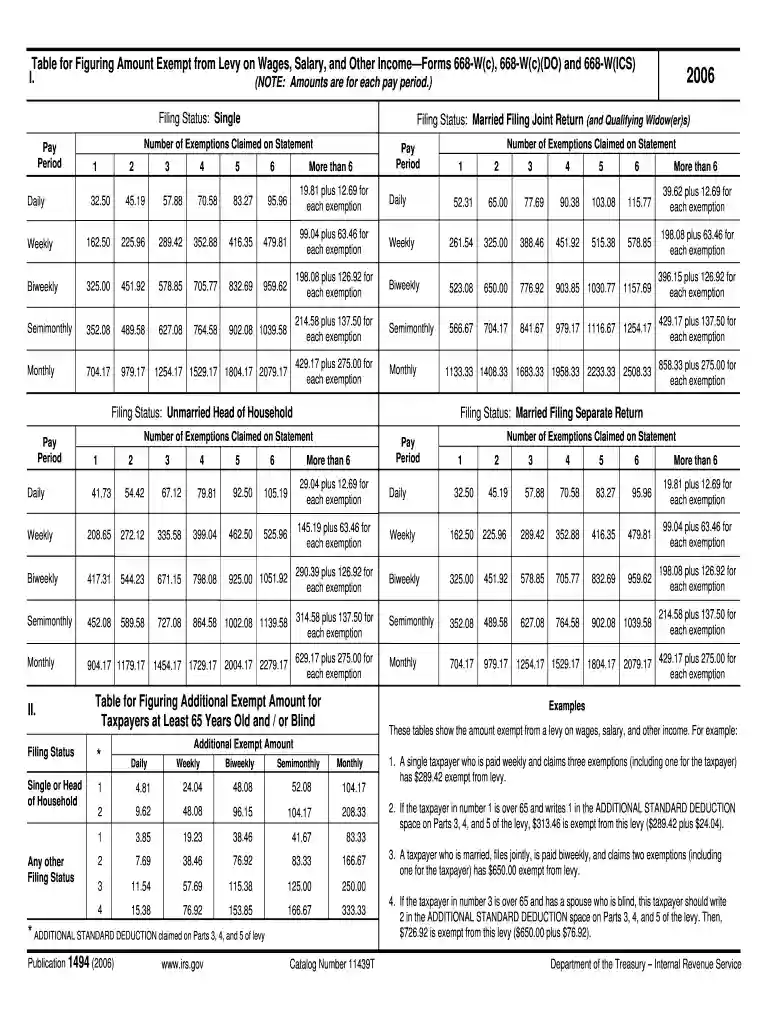
Publication 1494 is an informational guideline issued by the Internal Revenue Service (IRS) that provides specific tables to calculate the exempt income amount from levy under different conditions. These tables help determine the amount of wages, salary, and other income that cannot be legally levied, assisting both taxpayers and employers in understanding and complying with tax levies. This document is particularly relevant for parties involved in wage garnishment or income levies, providing a clear and structured way to navigate these complex processes.
Publication 1494 can be used to determine the portion of an individual's income that is exempt from an IRS levy. To effectively use this document:
While Publication 1494 itself is not a form that requires completion, understanding and applying it correctly involves several steps:
Publication 1494 encompasses several critical elements essential for accurate interpretation:
To fully understand Publication 1494, familiarize yourself with terms such as levy, garnishment, exempt income, and filing status. These concepts are pivotal for comprehending the publication’s application and implications.
Publication 1494 is legally used to ensure compliance with IRS requirements concerning levies on wages. It forms an integral component of the bureaucratic frameworks that prevent excessive or erroneous levying of income.
The IRS outlines specific procedures and rules within Publication 1494 for calculating and applying exempt income amounts. These guidelines are essential for accurate enforcement and adherence to levy standards.
Non-compliance with Publication 1494 guidelines can result in legal consequences for both employers and taxpayers. These penalties may include monetary fines and potential legal action, making adherence crucial for all parties involved.
We've got more versions of the publication 1494 form. Select the right publication 1494 version from the list and start editing it straight away!
At DocHub, your data security is our priority. We follow HIPAA, SOC2, GDPR, and other standards, so you can work on your documents with confidence.
Pub. 15-A, Employers Supplemental Tax Guide. Pub. 1494, Table for Figuring Amount Exempt From. Levy on Wages, Salary, and Other Income (Form. 668W and 668W(c)).
Publication 1494 (Rev. 1-2025). Daily. Weekly. 625.00. 1250.00. 2100.00 2525.00. 837.50. 1675.00. Semimonthly. Monthly. 1875.00. 125.78. 3150.00. 1575.00.


