




01. Edit your form online
Type text, add images, blackout confidential details, add comments, highlights and more.

Type text, add images, blackout confidential details, add comments, highlights and more.

Draw your signature, type it, upload its image, or use your mobile device as a signature pad.

Send it via email, link, or fax. You can also download it, export it or print it out.
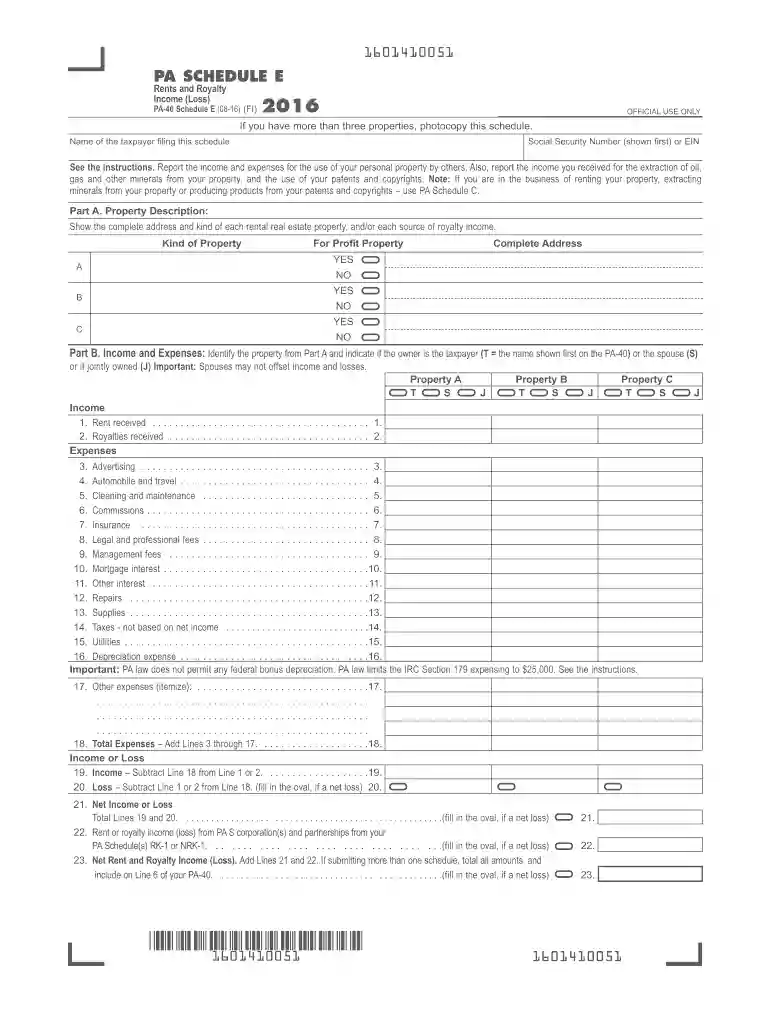
The 2015 Pennsylvania Income Tax Return (PA-40) is a form used by Pennsylvania residents and non-residents to report their income, tax liabilities, and eligibility for certain tax credits. It serves as a fundamental instrument for tax submissions to the Pennsylvania Department of Revenue. The form encompasses detailed sections for various income sources, deductions, and credits, ensuring taxpayers accurately report their financial activities for the year 2015.
Taxpayers should carefully review these elements to ensure compliance with state tax obligations.
Completing the PA-40 requires attention to detail and an understanding of one's financial situation. Here’s a step-by-step guide:
These steps ensure accurate filing and compliance with state tax laws.
Obtaining the PA-40 form is straightforward. Here are the methods available:
Ensure the version used is specifically for the 2015 tax year.
Filing the PA-40 involves several detailed steps:
Several crucial elements form the core of the PA-40:
Understanding these elements helps in achieving an accurate tax return.
Understanding certain terms is essential for accurately completing the PA-40:
These terms guide the completion of the PA-40 process more effectively.
For the 2015 tax year, understanding critical deadlines is crucial to avoid penalties:
Timely filing ensures compliance and minimizes potential issues with the department.
Failure to submit the PA-40 correctly or on time can lead to severe consequences:
Understanding these penalties encourages timely and accurate tax filing, ensuring compliance with state tax laws.
We've got more versions of the 2015 Pennsylvania Income Tax Return (PA-40) - Revenue form. Select the right 2015 Pennsylvania Income Tax Return (PA-40) - Revenue version from the list and start editing it straight away!
At DocHub, your data security is our priority. We follow HIPAA, SOC2, GDPR, and other standards, so you can work on your documents with confidence.
Feb 22, 2016 If you prefer to file state taxes on your own, there is only one Pennsylvania State tax form (PA-40). Read the instructions to determine if
Total PA Taxable Income. Add only the positive income amounts from Lines 1c, 2, 3,. 4, 5, 6, 7 and 8. DO NOT ADD any
Mar 28, 2016 Excluding acquisition costs of $39.2 million or 40 basis points in 2015 and $28.5 million or 35 basis points in 2014, operating income margin


