




01. Edit your form online
Type text, add images, blackout confidential details, add comments, highlights and more.

Type text, add images, blackout confidential details, add comments, highlights and more.

Draw your signature, type it, upload its image, or use your mobile device as a signature pad.

Send it via email, link, or fax. You can also download it, export it or print it out.
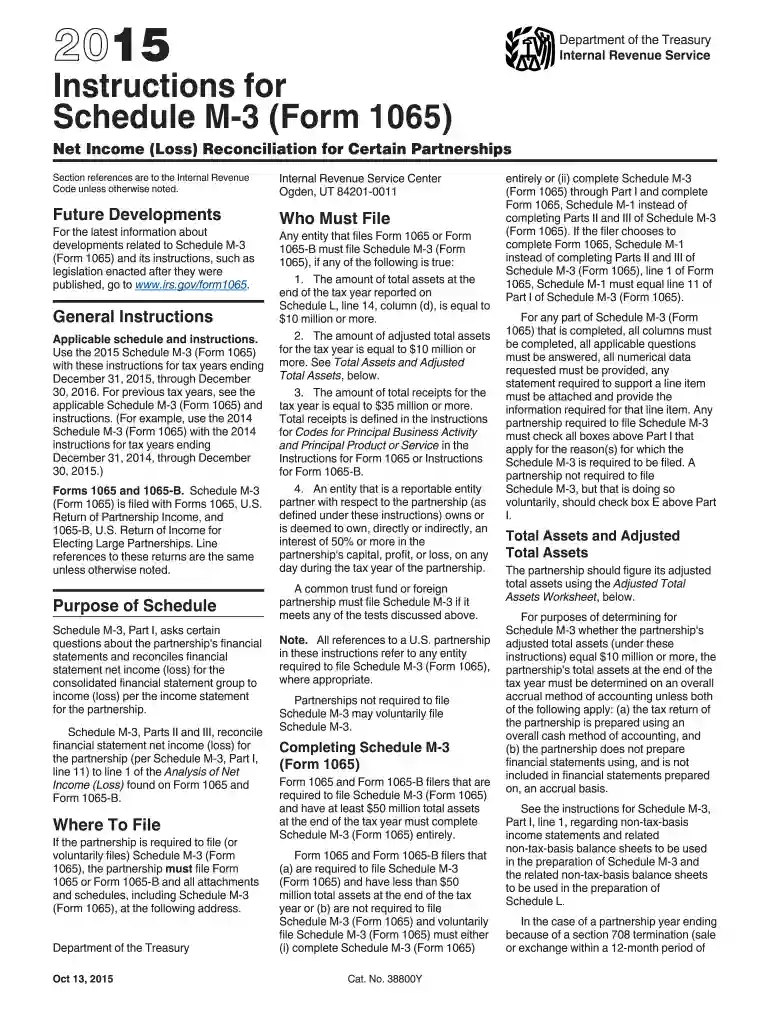
The 2015 Instructions for Schedule M-3 (Form 1065) are detailed guidelines published by the IRS to assist certain partnerships in accurately reconciling the net income (or loss) reported in financial statements with tax return figures. This form is essential for partnerships that have significant discrepancies between their book income and taxable income, often due to differing accounting rules. Using Schedule M-3 correctly ensures compliance with IRS regulations and helps prevent potential audits.
Not every partnership is required to file Schedule M-3. Generally, partnerships with total assets of $10 million or more at the end of the tax year need to use this form. Additionally, partnerships reporting a significant difference between their book and taxable income might be mandated to file.


The form mainly applies to large partnerships, including LLCs taxed as partnerships and other entities with complex financial operations. These partnerships must adhere to the Schedule M-3 instructions to reconcile any differences accurately.
Collect Financial Statements: Begin with your partnership's financial statements, which will serve as the base for reconciliation.
Identify Discrepancies: Use the form to identify and list any differences between the financial statement net income and taxable income.
Report Adjustments: Clearly document any adjustments needed, whether due to depreciation, amortization, or other financial factors.
Complete Each Part of the Form:
Review For Accuracy: Double-check all entries to ensure compliance with IRS guidelines.
To accurately complete the form, partnerships need their complete set of financial statements and any supplementary documentation supporting income and expense entries.
The IRS requires precise reporting on Schedule M-3 to prevent financial discrepancies. Partnerships must follow published instructions meticulously, ensuring all figures match their records.
Failure to accurately complete and file the schedule can result in significant penalties and increased scrutiny from the IRS. It is crucial for partnerships to review the instructions carefully and seek professional advice if necessary.
Partnerships can submit Schedule M-3 electronically, which is often preferred for its speed and convenience. However, paper submissions remain an option for those without electronic filing capabilities. Ensure using the latest IRS submission guidelines to avoid delays.
The process can be simplified by using tax software compatible with IRS forms, such as TurboTax or QuickBooks, which offer guided steps for entering the necessary data.
All entries on Schedule M-3 must be transparent and supported by documentation. Partnerships are advised to maintain comprehensive records to justify any discrepancies or adjustments.
Accurate completion of the schedule is vital for compliance with U.S. tax laws, reducing the risk of audits or legal challenges regarding discrepancies between book and tax income.
While the 2015 instructions are specific to that tax year, it's critical to consult the most current IRS instructions for subsequent filings. Variants of the form exist for different tax years, and ensuring the correct version is used prevents potential filing errors.
By understanding and utilizing these instructions effectively, partnerships can ensure accurate compliance and prevent potential legal issues with the IRS.
We've got more versions of the 2015 Instructions for Schedule M-3 (Form 1065) Instructions for Schedule M-3 (Form 1065), Net Income form. Select the right 2015 Instructions for Schedule M-3 (Form 1065) Instructions for Schedule M-3 (Form 1065), Net Income version from the list and start editing it straight away!
At DocHub, your data security is our priority. We follow HIPAA, SOC2, GDPR, and other standards, so you can work on your documents with confidence.
Apr 15, 2015 Whats New. Premium tax credit. You may be eligible to claim the premium tax credit if you, your spouse, or a dependent.
Oct 13, 2015 Schedule M-3, Part I, asks certain questions about the partnerships financial statements and reconciles financial statement net income (loss)
by IA Lipin 2012 Cited by 6 Part II of this article describes in detail key existing reporting requirements such as reportable transaction disclosure statement and Form


