




01. Edit your form online
Type text, add images, blackout confidential details, add comments, highlights and more.

Type text, add images, blackout confidential details, add comments, highlights and more.

Draw your signature, type it, upload its image, or use your mobile device as a signature pad.

Send it via email, link, or fax. You can also download it, export it or print it out.
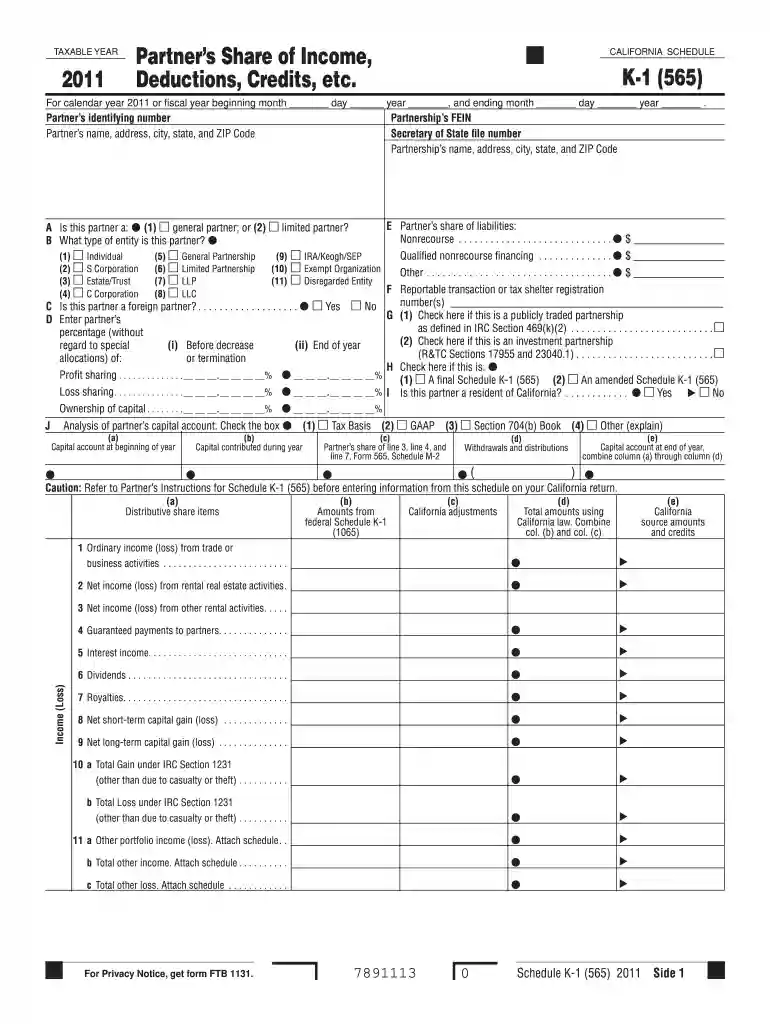
The IRS K-1 (565) form, primarily used in 2011, provides detailed information about a partner's share of income, deductions, credits, and other financial data related to a partnership. This form is specific to California and is integral for state tax reporting, capturing each partner's stake in the financial outcomes of a business entity. It includes sections detailing profit and loss percentages, partner identification, and a breakdown of their share of income, which encompasses ordinary income, capital gains, and other relevant financial elements. Understanding this form is crucial for accurately filing state taxes and ensuring compliance with California taxation laws for partnerships.
To access the IRS K-1 (565) form from 2011, taxpayers can visit the official California Franchise Tax Board website or use tax preparation software that archives previous years' forms. These platforms often provide downloadable and printable formats, facilitating easy access. Additionally, one can contact the California Franchise Tax Board directly for instructions on obtaining older forms. Keeping digital or printed copies of these forms is essential for record-keeping and ensuring accurate financial reporting for partnerships in subsequent years.
Completing the K-1 (565) form involves several meticulous steps:
Completing this form requires precision to ensure accurate tax reporting and compliance with California state laws.
The K-1 (565) form includes several critical components:
Each section must be filled accurately to ensure that partners' financial responsibilities and benefits are properly documented and reported.
The K-1 (565) form is primarily utilized by partners in California-based partnerships. These partnerships can range from small businesses to large entities with multiple stakeholders. The form serves as a key document for partners, ensuring that their personal tax returns reflect their share of the partnership’s income, losses, and other relevant financial data. It is also crucial for those in limited liability companies (LLCs) taxed as partnerships and other similar entities.


Following IRS guidelines for the K-1 (565) form is crucial for compliance:
These guidelines help maintain compliance with both federal and state tax regulations.
Timely filing of the K-1 (565) form is crucial. Partnerships must generally submit completed forms by March 15 or the 15th day of the third month following the close of the partnership’s tax year. Partners should also consider state-specific deadlines, which may require earlier submissions to accommodate differences in processing times or state requirements. Adhering to these deadlines will help avoid potential penalties for late or incomplete filings.
Failing to properly file or complete the K-1 (565) form can result in significant penalties. These may include fines for late submission, inaccuracies, or failure to report all financial details accurately. The California Franchise Tax Board may impose additional penalties if discrepancies are found during audits. Staying aware of legal responsibilities and ensuring thorough understanding and adherence to filing requirements are critical in avoiding these penalties and maintaining compliance.
The K-1 (565) form is compatible with various tax preparation software, such as TurboTax and QuickBooks. These platforms often include guided steps to assist users in accurately completing the form and ensuring all calculations and allocations are correct. Using such software can enhance accuracy and provide real-time assistance with complex tax scenarios, making the tax preparation process more efficient and reliable.
These sections provide a comprehensive guide to understanding, accessing, and completing the IRS K-1 (565) form for the year 2011, ensuring that all partnerships within California comply with the requisite tax requirements.
We've got more versions of the irs k 1 565 form printable 2011 form. Select the right irs k 1 565 form printable 2011 version from the list and start editing it straight away!
| Versions | Form popularity | Fillable & printable |
|---|---|---|
| 2025 | 4.3 Satisfied (39 Votes) | |
| 2023 | 4.4 Satisfied (43 Votes) | |
| 2022 | 4.5 Satisfied (40 Votes) | |
| 2021 | 4.8 Satisfied (83 Votes) | |
| 2020 | 4.4 Satisfied (238 Votes) | |
| 2019 | 4.3 Satisfied (80 Votes) | |
| 2018 | 4.4 Satisfied (52 Votes) | |
| 2017 | 4.4 Satisfied (58 Votes) | |
| 2016 | 4.3 Satisfied (247 Votes) | |
| 2015 | 4.4 Satisfied (44 Votes) | |
| 2012 | 4.2 Satisfied (60 Votes) | |
| 2011 | 4 Satisfied (38 Votes) |
At DocHub, your data security is our priority. We follow HIPAA, SOC2, GDPR, and other standards, so you can work on your documents with confidence.
Feb 7, 2012 Amended return. You generally make this on March 1, 2011, and resided here until Augustdate for filing Form 1040NR or Form choice when you
This packet contains: Instructions for completing the. Form 511: Oklahoma resident income tax return. Form 511 income tax form. Form 538-S: Sales Tax
Paperless Schedule K-1 The FTB discontinued the Paperless Schedules K-1 (565) program due to the increasing support of our business e-file program. For more


