




01. Edit your form online
Type text, add images, blackout confidential details, add comments, highlights and more.

Type text, add images, blackout confidential details, add comments, highlights and more.

Draw your signature, type it, upload its image, or use your mobile device as a signature pad.

Send it via email, link, or fax. You can also download it, export it or print it out.
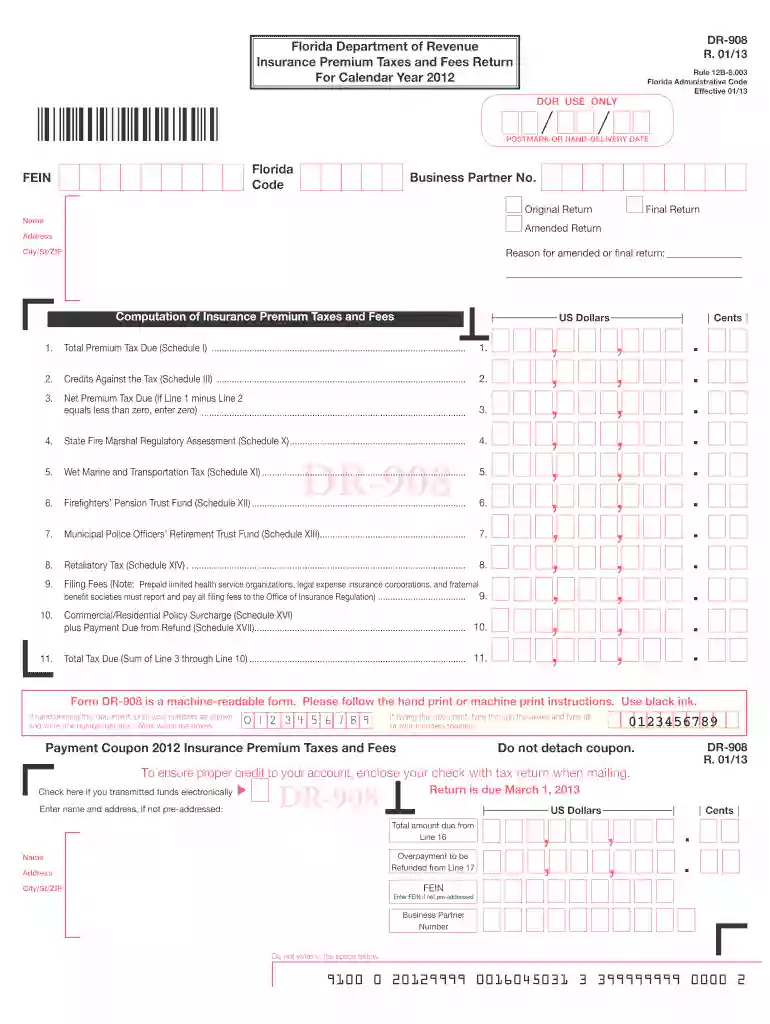
Form DR-908 is an official document used by insurers to report insurance premium taxes and associated fees to the Florida Department of Revenue. It covers the computation of insurance premium taxes, credits, and various fees due within a specified calendar year. This form is essential for ensuring that insurers accurately calculate and remit their tax liabilities to the state of Florida. Understanding the components and requirements of this form is critical for complying with Florida state tax regulations.
Completing Form DR-908 requires careful attention to detail. The following steps provide a comprehensive guide on how to accurately fill out the form:
Understanding specific terminology associated with Form DR-908 is crucial for proper filing:
Form DR-908 must be used in compliance with Florida's legal requirements. Failure to correctly file this form can result in penalties, interest on unpaid taxes, and potential legal consequences. Insurers are legally obligated to maintain accurate records that support their tax filings and demonstrate compliance with state tax laws. Ensuring accuracy and adherence to deadlines is vital to avoid non-compliance issues.
Primarily, Form DR-908 is used by insurance companies that operate and collect premiums within the state of Florida. This includes both domestic and foreign insurers required to report their in-state activities. The form is relevant for a wide array of insurance providers, including those in life, health, property, and casualty insurance sectors.


Form DR-908 must be filed annually, typically by a specific deadline set by the Florida Department of Revenue. Missing this deadline can lead to financial penalties. It's crucial for insurers to be aware of and adhere to these deadlines to ensure compliant filing. Key dates for the current filing year can be found on the Department’s official website or through official notices.
The form can be obtained directly from the Florida Department of Revenue’s website. It is also often available through tax preparation software that supports state-specific forms. Accessing the form online is the most efficient method, ensuring you have the latest version necessary for accurate reporting.
Failing to comply with the requirements of Form DR-908 can result in significant penalties. These may include:
Both digital and paper versions of Form DR-908 are available. The decision between using a digital or paper format depends on the insurer’s preference and processing capabilities. Many choose digital submission due to its efficiency and the convenience of automated calculation tools. However, for those who prefer traditional methods, paper submission remains an option. Regardless of format, ensuring data accuracy and timely submission remains paramount.
We've got more versions of the Form DR-908 form. Select the right Form DR-908 version from the list and start editing it straight away!
| Versions | Form popularity | Fillable & printable |
|---|---|---|
| 2025 | 4.1 Satisfied (38 Votes) | |
| 2024 | 4.2 Satisfied (30 Votes) | |
| 2023 | 4.1 Satisfied (39 Votes) | |
| 2022 | 4.8 Satisfied (35 Votes) | |
| 2021 | 4.2 Satisfied (70 Votes) | |
| 2020 | 4.4 Satisfied (80 Votes) | |
| 2019 | 4.3 Satisfied (135 Votes) | |
| 2018 | 4.4 Satisfied (175 Votes) | |
| 2015 | 4.4 Satisfied (118 Votes) | |
| 2013 | 4.4 Satisfied (482 Votes) |
At DocHub, your data security is our priority. We follow HIPAA, SOC2, GDPR, and other standards, so you can work on your documents with confidence.
Refunds claimed under Chapter 624, F.S., must be filed with the Department on the following forms: 1. Form DR-908, Insurance Premium Taxes and Fees Tax Return (
Dec 21, 2011 These forms are generally due by the due date of your final Form 941 or Form 944. D. File Form W-3 to file Forms W-2. Note. These forms are


