




01. Edit your form online
Type text, add images, blackout confidential details, add comments, highlights and more.

Type text, add images, blackout confidential details, add comments, highlights and more.

Draw your signature, type it, upload its image, or use your mobile device as a signature pad.

Send it via email, link, or fax. You can also download it, export it or print it out.
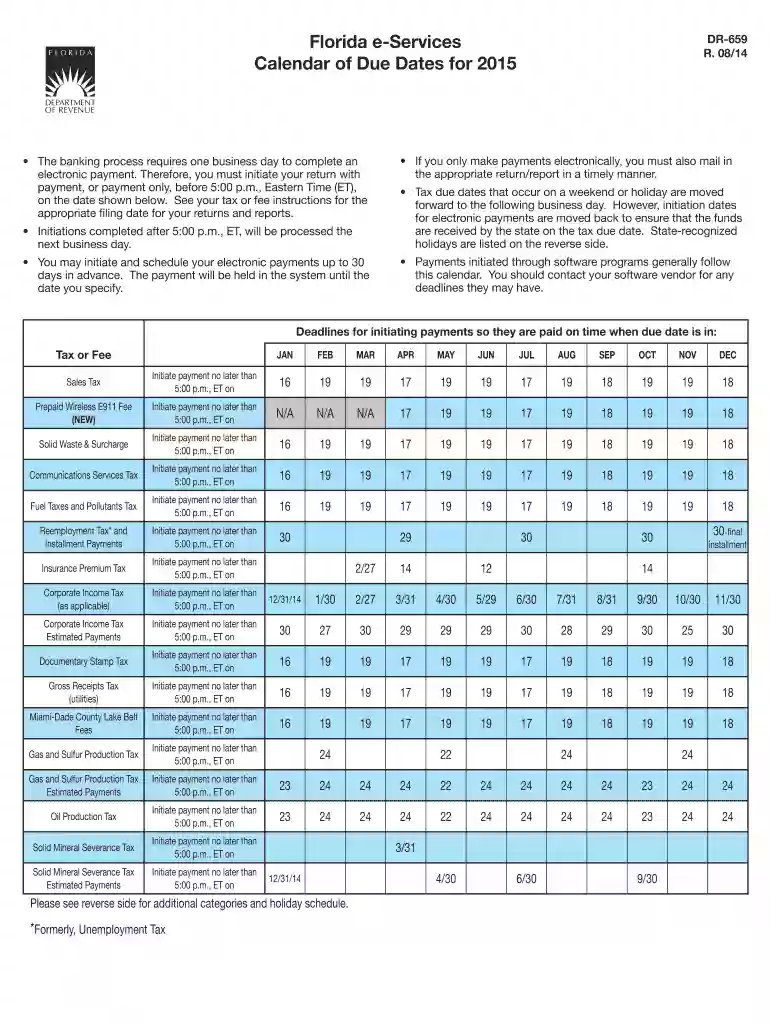
The Florida e-Services Calendar of Due Dates for 2015, often referred to as "formuPack," is a comprehensive schedule that outlines the important deadlines for electronic payments related to taxes and fees specific to Florida. This calendar serves as a crucial tool for individuals and businesses in Florida, providing a systematic guide to ensure timely payment submissions for various obligations, such as sales tax, unemployment tax, and corporate income tax. Understanding the function and essence of this calendar is essential for compliance and efficient tax management.
To effectively utilize the formuPack, start by identifying the specific tax or fee you are responsible for. The calendar lists deadlines chronologically, so locate your tax type and note the corresponding electronic filing and payment due dates. The calendar is structured to highlight the importance of submitting payments by 5:00 p.m. ET on the specified dates to ensure timely processing. Payments made after this time are processed the next business day, which could result in late fees or penalties if deadlines are missed.
The calendar includes a detailed holiday schedule that affects due dates, making it critical to consider these adjustments when planning payments. Key filing deadlines typically include monthly or quarterly dates for sales tax remittance and annual deadlines for corporate tax filings. These deadlines are crucial as they ensure that both state revenue agencies and businesses maintain financial accountability. The schedule acts as a reminder, reducing the risk of oversight.
The calendar serves as a legal guideline for taxpayers in Florida, ensuring all electronic payments are made in a timely manner to comply with state laws. Adhering to the specified deadlines helps individuals and businesses avoid legal penalties, interest on late payments, and potential audits. It is also vital during legal disputes to demonstrate that all obligations were met according to the outlined schedule.
The primary users of this calendar include small business owners, accountants, large corporations, and tax professionals. These stakeholders rely on the formuPack to maintain compliance with state tax requirements, manage financial schedules, and provide accurate reporting. By using the calendar, these groups can efficiently plan, execute, and report their financial obligations.


Failure to adhere to the deadlines in the Florida e-Services Calendar of Due Dates for 2015 can result in various penalties. Late payment or filing can attract fines and accruing interest charges, significantly increasing the financial burden on individuals and businesses. Additionally, consistent non-compliance might lead to further scrutiny from state tax authorities and potential damage to a business's financial standing.
For ease of use, the calendar data can be integrated with popular accounting software, such as TurboTax or QuickBooks. This integration allows users to synchronize due dates with their financial records and set automated reminders. This compatibility helps ensure that users stay informed of approaching deadlines and manage their electronic payment submissions efficiently.
We've got more versions of the Florida e-Services Calendar of Due Dates for 2015 - formuPack form. Select the right Florida e-Services Calendar of Due Dates for 2015 - formuPack version from the list and start editing it straight away!
| Versions | Form popularity | Fillable & printable |
|---|---|---|
| 2026 | 4.8 Satisfied (53 Votes) | |
| 2025 | 4.7 Satisfied (49 Votes) | |
| 2024 | 4.4 Satisfied (60 Votes) | |
| 2023 | 4.2 Satisfied (38 Votes) | |
| 2022 | 4.9 Satisfied (20 Votes) | |
| 2021 | 4.4 Satisfied (390 Votes) | |
| 2020 | 4.4 Satisfied (407 Votes) | |
| 2018 | 4.4 Satisfied (203 Votes) | |
| 2017 | 4 Satisfied (45 Votes) | |
| 2017 | 3.9 Satisfied (27 Votes) | |
| 2015 | 4.3 Satisfied (497 Votes) | |
| 2015 | 4 Satisfied (39 Votes) |
At DocHub, your data security is our priority. We follow HIPAA, SOC2, GDPR, and other standards, so you can work on your documents with confidence.


