



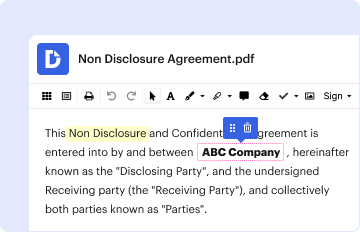
01. Edit your form online
Type text, add images, blackout confidential details, add comments, highlights and more.

Type text, add images, blackout confidential details, add comments, highlights and more.
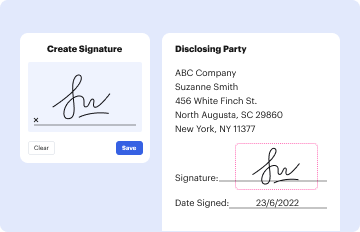
Draw your signature, type it, upload its image, or use your mobile device as a signature pad.

Send it via email, link, or fax. You can also download it, export it or print it out.
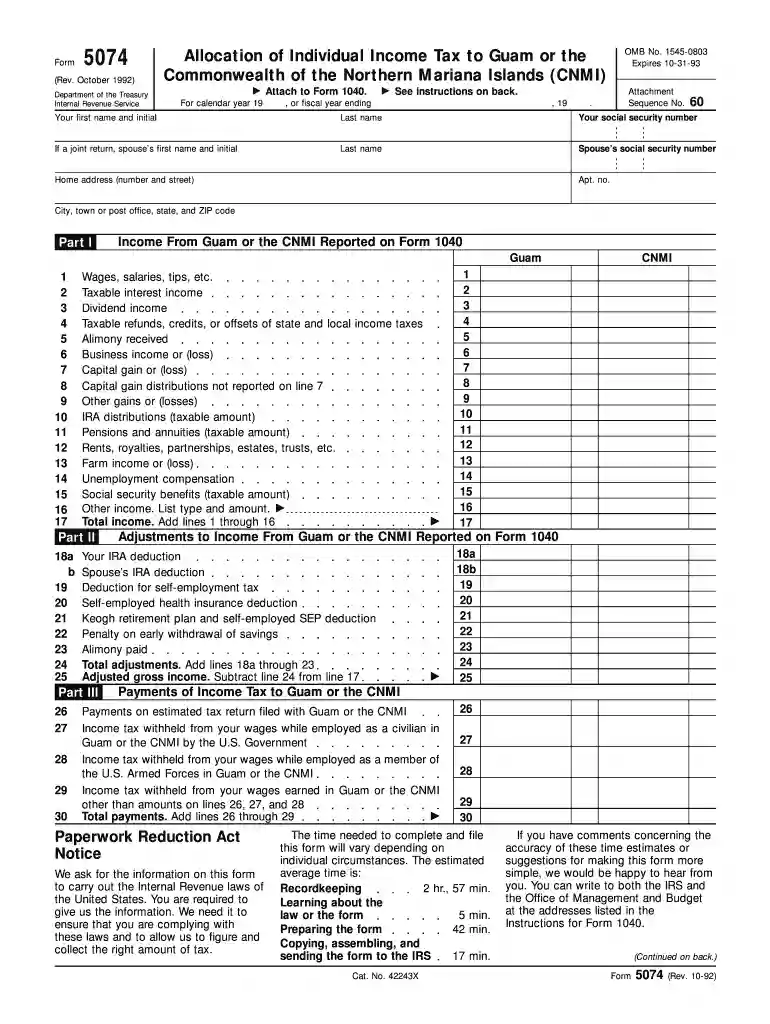
Form 5074, titled "Allocation of Individual Income Tax to Guam or the Commonwealth of the Northern Mariana Islands (CNMI)," serves a specific function for U.S. taxpayers reporting income from these territories. The form assists individuals in dividing their U.S. income tax obligations between the mainland and either Guam or CNMI, according to income sourced from these regions. This allocation is essential to accurately reflect the taxpayer’s financial responsibilities and ensure compliance with both U.S. and territorial tax regulations.
Successfully completing Form 5074 involves several critical steps that help in accurately reporting income:
Gather Necessary Information:
Determine Income Allocation:
Complete the Form Details:
Attach Required Documents:
Familiarity with key terms can simplify the process of completing Form 5074:
Understanding these terms is fundamental to accurately completing the form and ensuring that income is properly reported according to U.S. and territorial tax laws.
Form 5074 is legally significant as it ensures compliance with the Internal Revenue Code's stipulations regarding income earned in Guam or CNMI. Filing this document accurately prevents misreporting of income which can lead to penalties or interest charges. Taxpayers must meticulously follow IRS guidelines to allocate income correctly, avoiding potential legal challenges and ensuring the correct application of tax laws.
The IRS provides detailed guidelines to assist taxpayers in accurately filing Form 5074:
Adhering to these guidelines is crucial for proper tax compliance and avoiding potential fines or audits.
Form 5074 must be filed by the standard IRS tax return deadline, typically April 15. When this date falls on a weekend or holiday, the deadline extends to the next business day. Taxpayers who fail to meet this deadline should consider filing for an extension using Form 4868 to avoid late-filing penalties.
To complete Form 5074 accurately, you must gather the following essential documents:
Having these documents at hand allows for accurate completion and reporting on Form 5074, preventing errors and potential audits.
Taxpayers can choose between digital or paper submissions when filing Form 5074:
Both methods have merits, and the choice often depends on taxpayer preference and comfort with technology. However, electronic submission is often faster and more secure.
We've got more versions of the form 5074 1992 form. Select the right form 5074 1992 version from the list and start editing it straight away!
| Versions | Form popularity | Fillable & printable |
|---|---|---|
| 2025 | 4.3 Satisfied (24 Votes) | |
| 2024 | 4.7 Satisfied (47 Votes) | |
| 2023 | 4.3 Satisfied (37 Votes) | |
| 2022 | 4.8 Satisfied (24 Votes) | |
| 2021 | 4.8 Satisfied (31 Votes) | |
| 2020 | 4.4 Satisfied (194 Votes) | |
| 2019 | 4 Satisfied (29 Votes) | |
| 2018 | 4.4 Satisfied (466 Votes) | |
| 2017 | 4.2 Satisfied (62 Votes) | |
| 1992 | 4.4 Satisfied (140 Votes) |
At DocHub, your data security is our priority. We follow HIPAA, SOC2, GDPR, and other standards, so you can work on your documents with confidence.
To Our Share Owners: ForThe Coca-Cola Company, the year 1992 was turbulent, testing and, ultimately, reassuring. . The turbulence came in the form of global
5074. Optical goods stores. 4879. Sporting goods bicycle shops. 4697. Stationery stores. 5033. Used merchandise antique stores. (except motor vehicle parts).
1992. 1993. 1994. 1995. 1996. 1997. 1998. 1999. 2000. 2001 5074. 5075. 5076. 5077. 5078. 5079. 5080. 5081. 5082. 5083.


