




01. Edit your form online
Type text, add images, blackout confidential details, add comments, highlights and more.

Type text, add images, blackout confidential details, add comments, highlights and more.

Draw your signature, type it, upload its image, or use your mobile device as a signature pad.

Send it via email, link, or fax. You can also download it, export it or print it out.
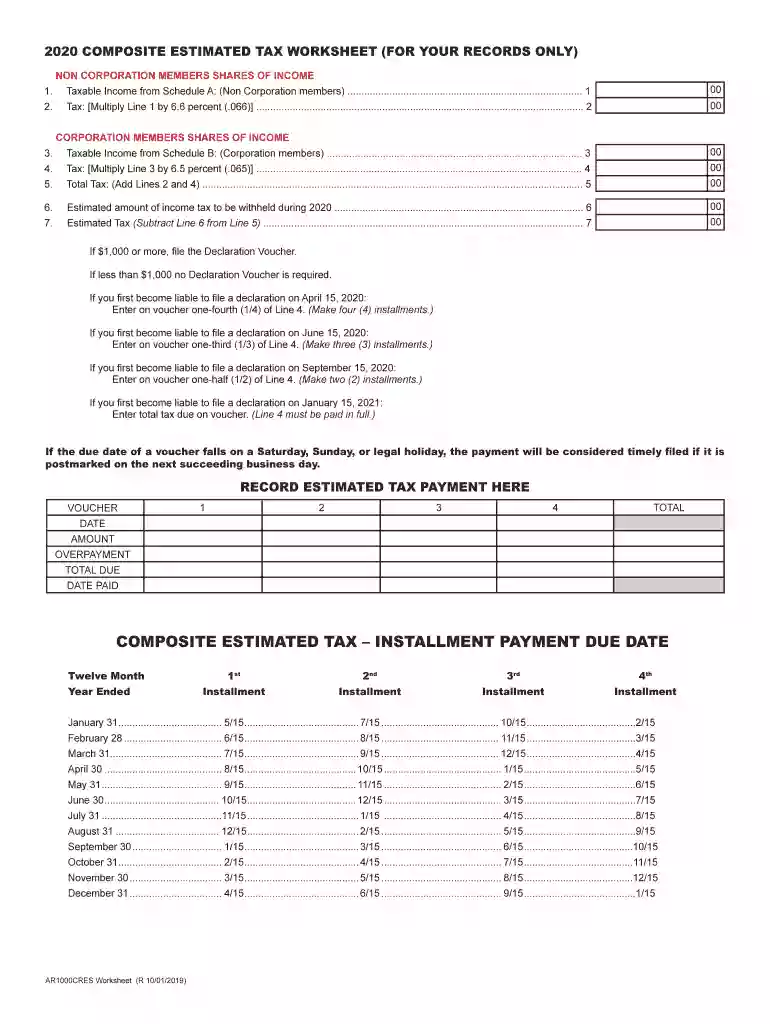
The Arkansas Estimated Tax Declaration Vouchers are forms used by taxpayers in the state of Arkansas to report anticipated income tax payments. These forms are essential for individuals and businesses that expect to owe more than $1,000 in taxes for a given year, ensuring the state receives tax payments periodically throughout the year rather than in a lump sum at the end. They provide a mechanism to calculate and pay estimated taxes to prevent underpayment penalties and facilitate more accurate financial planning for taxpayers.
Accurate completion of the Arkansas Estimated Tax Declaration Vouchers involves several detailed steps:
Arkansas has specific guidelines concerning the declaration of estimated taxes:
Utilizing the Arkansas Estimated Tax Declaration Vouchers comes with legal obligations:
Arkansas state tax payments must be coordinated with federal IRS estimated tax guidelines:
Several specific taxpayer types frequently use Arkansas Estimated Tax Declaration Vouchers:


Arkansas offers multiple methods for submitting estimated tax declarations:
By understanding and leveraging these elements efficiently, individuals and businesses can ensure more accurate tax planning and compliance with Arkansas tax laws.
We've got more versions of the STATE OF ARKANSAS Estimated Tax Declaration Vouchers form. Select the right STATE OF ARKANSAS Estimated Tax Declaration Vouchers version from the list and start editing it straight away!
At DocHub, your data security is our priority. We follow HIPAA, SOC2, GDPR, and other standards, so you can work on your documents with confidence.
May 18, 2010 The provision for income taxes from continuing operations increased from $20,760,000 to $21,407,000, which resulted in an effective income tax
A taxpayer should file a tentative return in the form of estimated tax voucher #5 on or before the original due date for filing the return (May 15 for
Calendar year 2025 filers must file their Declaration of Estimated Tax on or before April 15th of the income year. 2. Fiscal year filers must file their


