




01. Edit your form online
Type text, add images, blackout confidential details, add comments, highlights and more.

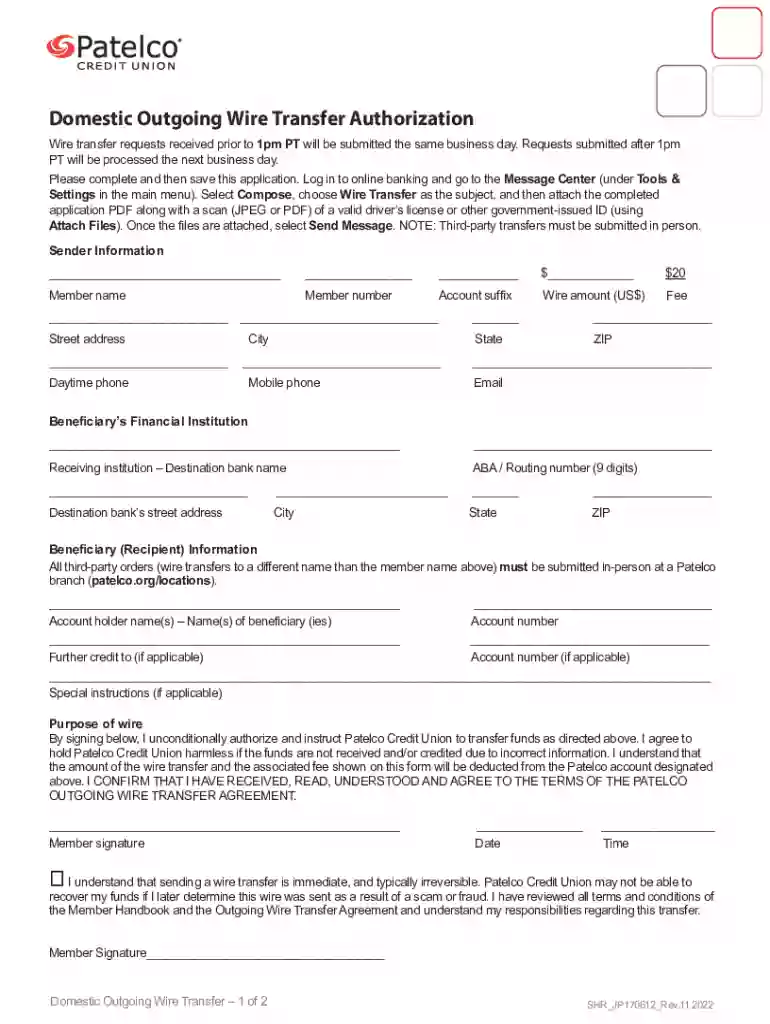
Type text, add images, blackout confidential details, add comments, highlights and more.

Draw your signature, type it, upload its image, or use your mobile device as a signature pad.

Send it via email, link, or fax. You can also download it, export it or print it out.
ACH transfers and wire transfers are two popular electronic methods for transferring funds, but they operate differently. An Automated Clearing House (ACH) transfer is a type of electronic bank transaction that processes in batches, typically taking two to three business days. ACH transfers are commonly used for regular payments like payroll, mortgage, and utility bills because of their lower costs and efficiency. In contrast, a wire transfer is a direct bank-to-bank electronic payment that is processed individually, often used for faster and more direct transactions such as real estate closings or same-day payments. Wire transfers usually incur higher fees and can be executed within minutes to a few hours.
To initiate an ACH transfer, one must provide banking details such as the bank account number and routing number. This information allows the funds to be moved electronically between accounts on set dates. For wire transfers, the sender must provide similar banking details, along with a SWIFT/BIC code for international transactions. It's crucial to complete forms accurately to ensure the funds reach the recipient swiftly and without error.
Both ACH and wire transfers are governed by distinct legal frameworks. ACH transfers in the U.S. are regulated by the National Automated Clearing House Association (NACHA) and fall under regulations set by the Federal Reserve Board. Wire transfers are covered under the Uniform Commercial Code (UCC) Article 4A in the U.S., defining the rights and responsibilities involved in funds transfers. These regulations ensure transparency, security, and legal accountability in electronic funds transfers.
Most transactions, both ACH and wire transfers, are now processed electronically for efficiency and speed. However, some banks still offer paper-based initiation, especially for wire transfers, although this is increasingly rare. Digital processing is preferred for its streamline capabilities and ability to integrate with software like QuickBooks or TurboTax, enabling seamless record-keeping and data management.
ACH and wire transactions integrate smoothly with financial software systems such as QuickBooks, allowing businesses to automate payroll and manage transactional records with precision. Such compatibility reduces manual entries and errors, adding efficiency to financial operations.
We've got more versions of the ACH Transfer vs Wire Transfer - What is the difference? form. Select the right ACH Transfer vs Wire Transfer - What is the difference? version from the list and start editing it straight away!
At DocHub, your data security is our priority. We follow HIPAA, SOC2, GDPR, and other standards, so you can work on your documents with confidence.
Dec 28, 2022 The term wire transfer also has a more narrow technical meaning, referring to one certain method of transferring funds, which usually involves
Jan 31, 2025 ACH transfers are one of the two main bank transfer payment methods in the United States, the other being domestic Wire transfers.


