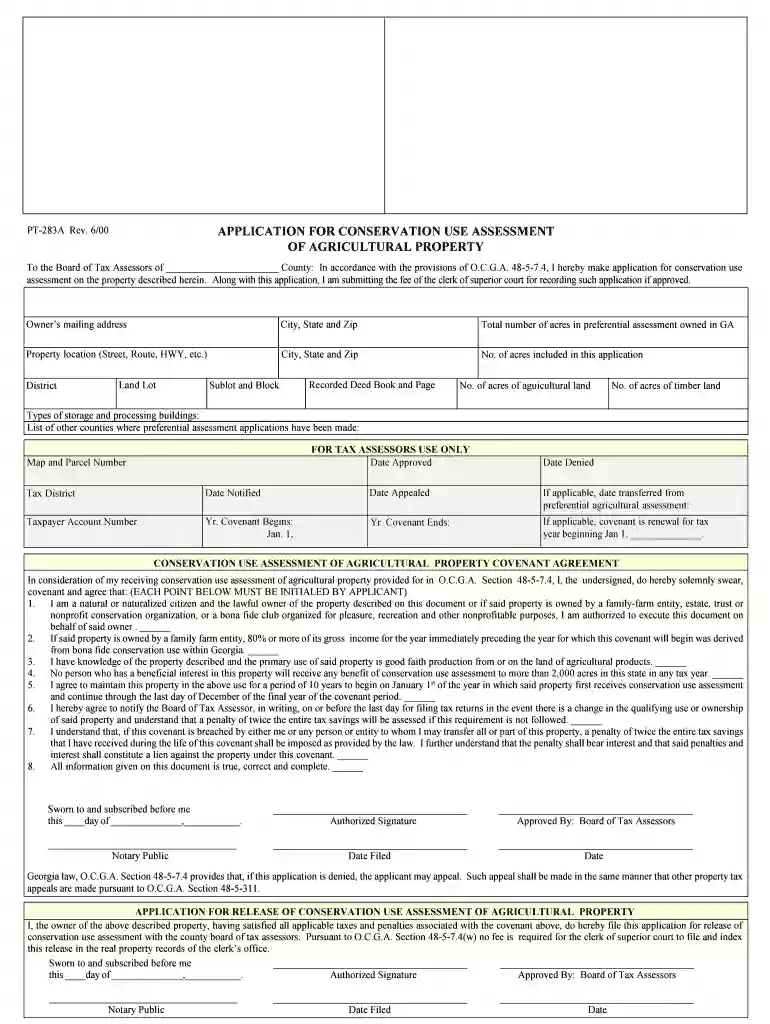
APPLICATION FOR CONSERVATION USE ASSESSMENT 2026

Get Form
APPLICATION FOR CONSERVATION USE ASSESSMENT Preview on Page 1

Here's how it works

01. Edit your form online
Type text, add images, blackout confidential details, add comments, highlights and more.

02. Sign it in a few clicks
Draw your signature, type it, upload its image, or use your mobile device as a signature pad.

03. Share your form with others
Send it via email, link, or fax. You can also download it, export it or print it out.

Definition & Meaning

The "Application for Conservation Use Assessment" is a formal request submitted by property owners seeking preferential tax treatment for their agricultural land under Georgia law (O.C.G.A. 48-5-7.4). This application allows landowners to receive reduced property tax assessments by committing to keep their land under conservation use for a specific period. The process involves declaring the property's intended use and agreeing to certain conservation practices, which are outlined in a covenant agreement attached to the application.

Key Elements of the APPLICATION FOR CONSERVATION USE ASSESSMENT

Understanding the essential parts of the application is crucial for a successful submission. The form typically includes:

  • Property Details: Requires a thorough description of the property's location, acreage, and current use. This section ensures that the land matches the conservation requirements.
  • Owner Information: Collects detailed information about the landowner(s), including names, addresses, and contact details, ensuring accurate identification and communication.
  • Covenant Agreement: Defines the obligations and conditions that the owner must adhere to for maintaining conservation status, such as restricting non-agricultural development.
  • Appeal Process: Offers guidelines for contesting a denial of the application, providing a structured approach to address disputes over eligibility or compliance.
  • Release Section: Allows for the release or termination of the conservation use assessment under specific conditions, which may involve penalties if breaches occur.

Legal Use of the APPLICATION FOR CONSERVATION USE ASSESSMENT

The application functions as a legal document that binds the landowner to specific land use conditions for the term of the covenant, typically ten years. Breaking this agreement can result in significant penalties, including recoupment of tax savings. Legal references within the form align with state laws to uphold support for agricultural conservation efforts. Owners are encouraged to consult legal counsel to fully understand their commitments before submitting the form.

Steps to Complete the APPLICATION FOR CONSERVATION USE ASSESSMENT

Completing the application involves several detailed steps:

  1. Gather Required Information: Compile all necessary details regarding the property and ownership, ready to be inputted into the application.
  2. Fill Out the Form: Enter the information into the corresponding sections of the application, ensuring accuracy and completeness.
  3. Sign the Covenant Agreement: Review and sign the covenant agreement, acknowledging the land-use commitments involved.
  4. Attach Supporting Documents: Include any additional documentation that might be required, such as prior appraisals or land surveys.
  5. Submit the Form: Decide on the submission method—online, mail, or in-person—and ensure the application reaches the correct county office.

Eligibility Criteria

Eligibility for conservation use assessment generally requires that the property be actively used for agricultural production or equivalent conservation practices. The property size and type, as well as the owner's compliance with usage restrictions and management plans, are critical factors in determining eligibility. These requirements aim to ensure that tax benefits support genuine conservation efforts.


decoration image ratings of Dochub

Penalties for Non-Compliance

Failure to adhere to the terms of the covenant agreement can result in:

  • Tax Recoupment: Owners might have to repay the tax savings received under the assessment, often with interest.
  • Legal Consequences: Possible legal actions may be taken for violating the terms of the agreement, especially if deliberate misuse of the property is involved.
  • Future Ineligibility: Breaching the covenant might render the property ineligible for future conservation use assessments, deterring repeated misuse.

State-Specific Rules for the APPLICATION FOR CONSERVATION USE ASSESSMENT

While the application process is governed by state law, specific rules can vary by county. Some counties may have additional requirements or offer supplementary guidance tailored to local agricultural conditions and conservation goals. Applicants should verify details with their local county tax assessor's office to ensure compliance with all pertinent state and local regulations.

Important Terms Related to APPLICATION FOR CONSERVATION USE ASSESSMENT

Familiarity with key terms in the application helps clarify the obligations and options available to landowners:

  • Covenant: A binding agreement obligating specific land use practices.
  • Recoupment: The repayment of tax benefits if the covenant is broken.
  • Primary Use: The predominant activity conducted on the property must align with conservation or agricultural purposes.
  • Appeal: The formal process of contesting an application denial or assessment adjustment.

These terms are pivotal in understanding the application process and the legal framework surrounding conservation use assessments in Georgia.

See more APPLICATION FOR CONSERVATION USE ASSESSMENT versions

We've got more versions of the APPLICATION FOR CONSERVATION USE ASSESSMENT form. Select the right APPLICATION FOR CONSERVATION USE ASSESSMENT version from the list and start editing it straight away!
Versions Form popularity Fillable & printable
2015 4.8 Satisfied (136 Votes)
2000 4 Satisfied (56 Votes)
be ready to get more

Complete this form in 5 minutes or less

Get form

Got questions?

We have answers to the most popular questions from our customers. If you can't find an answer to your question, please contact us.
Contact us
Generally, a minimum of 10 acres is required for enrollment, but some counties have recently increased the minimum acreage to 25 acres. No more than 2,000 acres can be enrolled in CUVA by any one non-industrial, private landowner. Foreign citizens and foreign corporations are not eligible to enroll.
Conservation Use Assessment Conservation use property is assessed at 40% of current use value which gives a reduced assessment to the owner of this type of property when compared to other properties assessed at 40% of fair market value.
The easement can last as long as its the only way to reasonably access the landlocked property. It also likely runs with the property from one owner to the next.
Conservation easements are conveyed by deed, have a conservation purpose, are in perpetuity (legal term meaning forever), require stewardship and monitoring, may only be extinguished by a court of law, are permanent and may offer tax benefits. It is difficult to remove a conservation easement.
Yes, under certain circumstances. Any family member who is related to the covenant holder within the fourth degree of civil reckoning can receive up to 5 acres of your covenant property solely for the purpose of building a home without breaching the covenant.

Security and compliance

At DocHub, your data security is our priority. We follow HIPAA, SOC2, GDPR, and other standards, so you can work on your documents with confidence.

Learn more
ccpa2
pci-dss
gdpr-compliance
hipaa
soc-compliance

People also ask

Georgia law allows a party to obtain a private way, also known as an easement, over the land of another through a process known as prescription (also sometimes called adverse possession). See OCGA Section 49-4-40 et seq. This requires seven years of uninterrupted use through improved lands.
A conservation easement must last forever, or as the Internal Revenue Code states, a restriction for a conservation purpose must be in perpetuity. However, forever is a long time and many things can change, such as the nature of the property, character of surrounding properties, and the desires of different landowners.

Related links