




01. Edit your form online
Type text, add images, blackout confidential details, add comments, highlights and more.

Type text, add images, blackout confidential details, add comments, highlights and more.

Draw your signature, type it, upload its image, or use your mobile device as a signature pad.

Send it via email, link, or fax. You can also download it, export it or print it out.
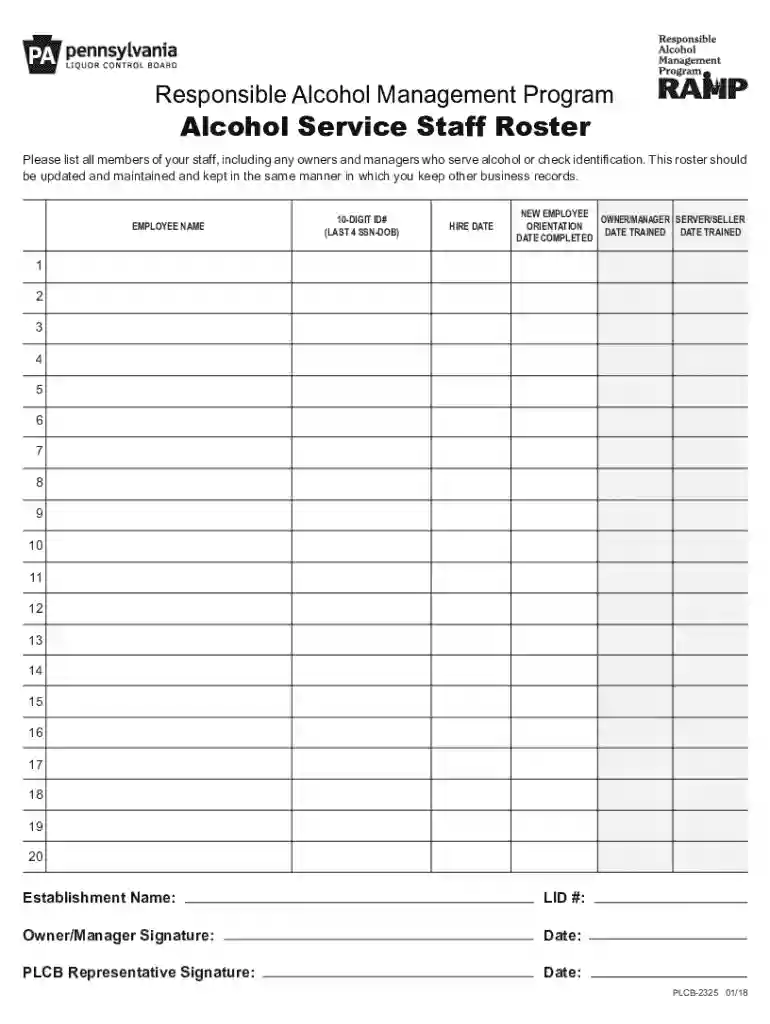
The Responsible Alcohol Management Program (RAMP) Staff Roster is an essential tool for establishments involved in the sale or service of alcohol. This document ensures compliance with requirements set forth by the Pennsylvania Liquor Control Board (PLCB). The roster includes details of all employees, such as owners and managers, who are engaged in the selling or serving of alcohol. The primary purpose of this roster is to certify that at least fifty percent of employees have undergone a PLCB-approved alcohol service training program. Maintaining this roster is crucial for businesses striving to maintain their RAMP certification, a vital component for legal operation in the industry.
Using the form effectively involves several steps to ensure compliance and accuracy. First, gather all necessary employee information, including names, roles, and training status. The form facilitates the tracking of employee training and certification, helping managers stay informed about who has completed the necessary training. Next, accurately fill out each section of the form with the relevant details. This involves listing each staff member and their corresponding training completion information. After completing the form, regularly update it to reflect any changes in staff or their training status to ensure ongoing compliance with RAMP requirements.
The RAMP Staff Roster is not only crucial for legal compliance; it plays a significant role in public safety and liability management. By maintaining this roster, businesses demonstrate their commitment to responsible alcohol service, reducing the risk of legal penalties owing to non-compliance. Additionally, the roster serves as a record that can be presented during inspections or audits, showcasing adherence to state laws. This proactive approach not only protects the establishment but also cultivates a responsible drinking environment, enhancing the business's reputation in the community.
The RAMP Staff Roster requirements are specific to the state of Pennsylvania, governed by rules from the PLCB. Businesses outside Pennsylvania may have different local regulations and programs governing alcohol service training requirements. Within Pennsylvania, it's legally mandated that the roster be maintained and readily available for inspection. Failure to adhere to these state-specific rules can result in penalties or revocation of liquor licenses, emphasizing the importance of regular updates and accurate records.
Consider a local bar in Pennsylvania that strives to maintain compliance with RAMP requirements. By accurately maintaining the RAMP Staff Roster, the bar manager can readily demonstrate to inspectors that all employees have the necessary training. This roster is also instrumental in internal audits to ensure that new hires promptly complete the mandated training. For another scenario, imagine a restaurant encountering staff changes; the roster helps in efficiently updating training records, thus ensuring continuous compliance even amid personnel shifts.
To remain compliant, it’s not enough just to have the roster; adherence to updating practices is equally important. The form must be reviewed regularly and updated with any staff changes or training status updates. Legal use also involves ensuring that the form is signed and dated by management, confirming its accuracy before any audits or at the time of inspections. Non-compliance could lead to hefty fines and damage to the establishment's legal standing, emphasizing the roster's role as a critical compliance tool.
Primarily, establishments that directly engage in the service and sale of alcohol—such as bars, restaurants, and liquor stores—benefit the most from maintaining a RAMP Staff Roster. These businesses face significant risks and responsibilities when serving alcohol to the public. The roster assists these establishments in substantiating compliance with legal requirements, thus minimizing liability risks. Additionally, any business that wishes to uphold a strong record of responsible alcohol service would find value in integrating the RAMP Staff Roster into their operational compliance processes.
We've got more versions of the DocHub 518688-ramp-staff-rosterGet RAMP Staff Roster - US Legal Forms form. Select the right DocHub 518688-ramp-staff-rosterGet RAMP Staff Roster - US Legal Forms version from the list and start editing it straight away!
At DocHub, your data security is our priority. We follow HIPAA, SOC2, GDPR, and other standards, so you can work on your documents with confidence.


