




01. Edit your form online
Type text, add images, blackout confidential details, add comments, highlights and more.

Type text, add images, blackout confidential details, add comments, highlights and more.

Draw your signature, type it, upload its image, or use your mobile device as a signature pad.

Send it via email, link, or fax. You can also download it, export it or print it out.
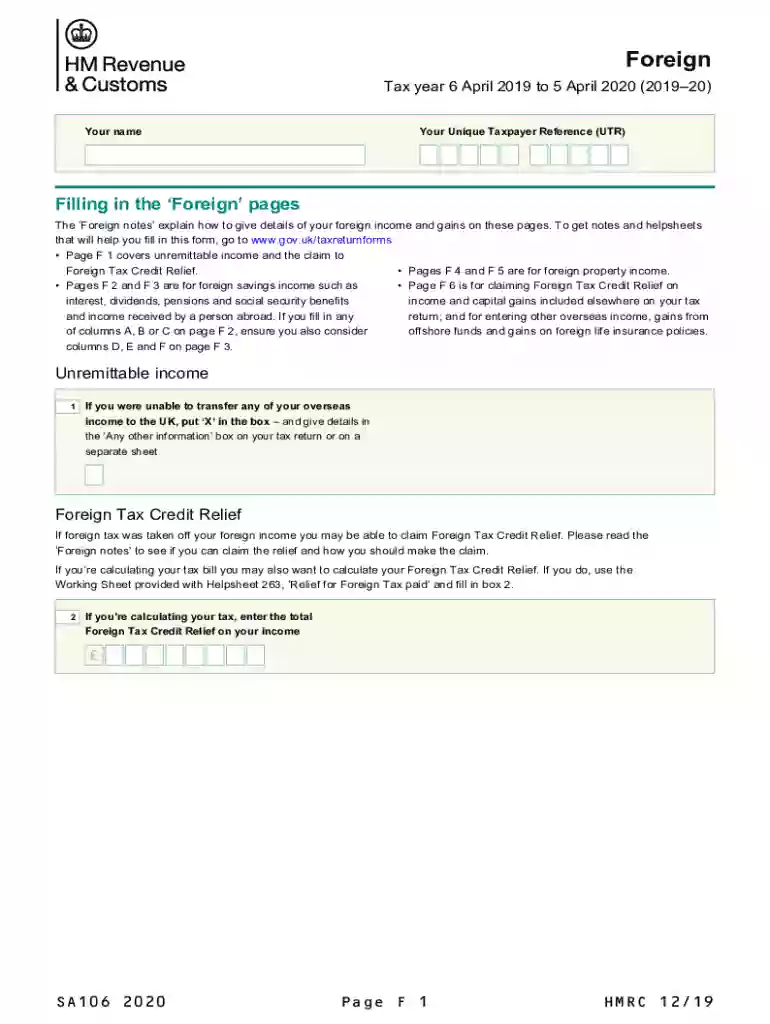
Form SA106 for the year 2020 is a supplementary document used in the UK for reporting foreign income and gains as part of the self-assessment tax return process. Taxpayers who have foreign income or gains need to declare them using this form. This includes income from savings, dividends, pensions, and capital gains earned outside the UK. Understanding and completing Form SA106 accurately ensures compliance with UK tax laws and helps in claiming any eligible Foreign Tax Credit Relief.
Individuals can obtain the SA106 form from the official UK government website or through professional tax preparation software. This form is typically included as part of the online tax return process, allowing for direct integration and submission along with the main tax return package. Those who prefer paper submissions can download the form, print it, and complete it manually.
Gather Required Information: Start by compiling all necessary documentation related to your foreign income and gains. This includes statements from foreign banks, investment accounts, and property rental agreements.
Fill Out Income Sections: Enter details of any foreign employment income, pensions, or savings. It's crucial to convert all amounts to GBP using the official HMRC exchange rate for the relevant tax year.
Report Dividends and Gains: Detail any dividends received and capital gains achieved while accounting for any available Foreign Tax Credit Relief.
Submit to HMRC: Once completed, the form should be submitted to HMRC either electronically if you're filing online or via postal service if using a paper form.
Using Form SA106 is critical for individuals who earn income from foreign sources. Declaring such income is not only a legal requirement but also ensures that you pay the correct amount of UK tax. The form also allows you to claim reliefs to avoid double taxation on income taxed abroad.
Form SA106 is commonly used by UK residents who:
It is also pertinent for expatriates who have financial interests in multiple countries.
The legal use of Form SA106 involves accurately declaring all foreign income and gains to comply with UK tax obligations. Failing to declare such income or providing inaccurate information can result in penalties and legal consequences. Thus, it is vital to ensure that all information is correct and supported by appropriate documentation.
The deadline for submitting Form SA106 as part of the self-assessment tax return is usually January 31st for the previous tax year if filed online. For paper submissions, the deadline typically falls on October 31st. Timely submission is essential to avoid late filing penalties.
Failure to complete and submit Form SA106 on time, or providing incorrect information, can lead to financial penalties. HMRC imposes fines based on the severity and frequency of the offense, with potential for interest accrual on unpaid taxes. Taxpayers must ensure accuracy and adherence to deadlines to avoid such penalties.
Form SA106 is compatible with several tax preparation software programs, such as TurboTax and QuickBooks, which can facilitate the process of entering information, calculating tax liabilities, and submitting the form electronically. These software options often streamline the procedure and reduce the likelihood of errors.
While Form SA106 pertains to UK taxation, understanding equivalents like the IRS's Foreign Earned Income Exclusion can aid dual residents in managing cross-jurisdictional tax compliance. Cross-border taxpayers should remain aware of both regions' requirements for complete disclosure.
Form SA106 is issued by HM Revenue and Customs (HMRC), the UK government's tax authority responsible for collecting taxes, administering tax credits, and enforcing compliance. Taxpayers can access resources and guidance through the HMRC website or consult a tax advisor for personalized advice.
We've got more versions of the Foreign (2020) Use the SA106(2020) supplementary pages to declare foreign income and gains and claim form. Select the right Foreign (2020) Use the SA106(2020) supplementary pages to declare foreign income and gains and claim version from the list and start editing it straight away!
At DocHub, your data security is our priority. We follow HIPAA, SOC2, GDPR, and other standards, so you can work on your documents with confidence.
Feb 3, 2021 ference report that provides additional. COVID funding for institutions of higher education without allocating funding in a fair and
Defendant-Appellee. On Appeal from the United States District Court for the District of Columbia. SUPPLEMENTAL APPENDIX. Of Counsel: ROBERT P


