




01. Edit your form online
Type text, add images, blackout confidential details, add comments, highlights and more.

Type text, add images, blackout confidential details, add comments, highlights and more.

Draw your signature, type it, upload its image, or use your mobile device as a signature pad.

Send it via email, link, or fax. You can also download it, export it or print it out.
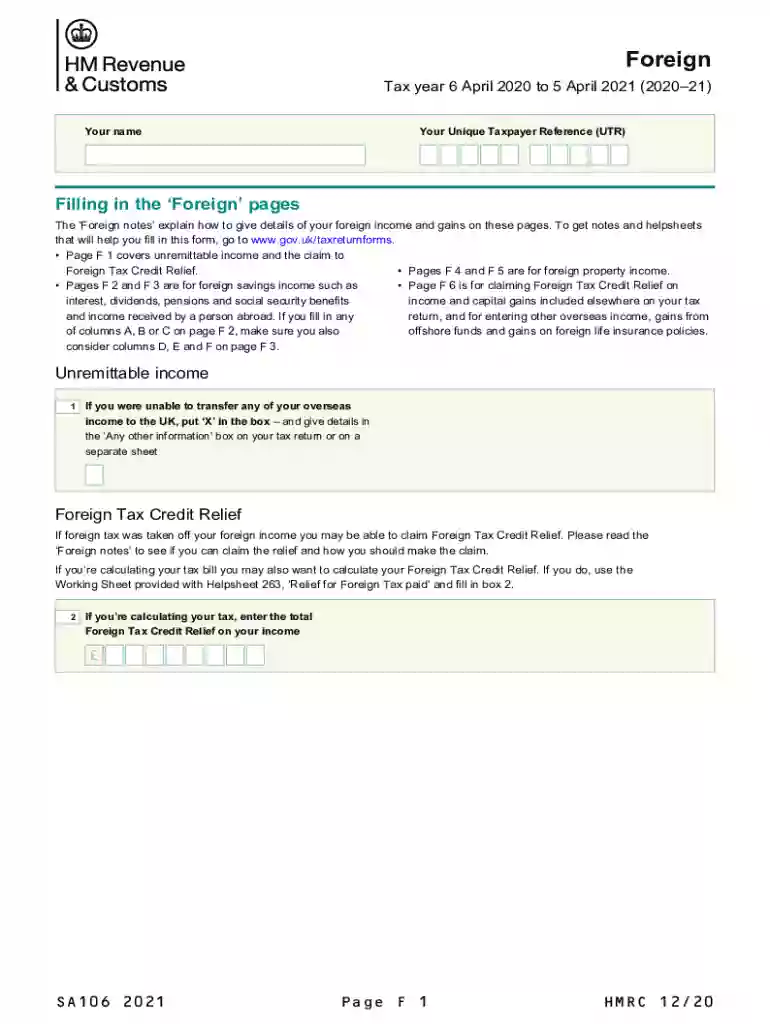
The Foreign (2021) SA106 supplementary pages are used by UK taxpayers to declare foreign income, gains, and claims on their tax returns. These pages allow individuals to report income from overseas sources like property, savings, and investments, ensuring compliance with UK tax laws. They are integral for claiming the Foreign Tax Credit Relief, which can prevent double taxation on international earnings. Taxpayers must also specify the countries from which the income is sourced using country codes provided in the form.
Gather Required Information: Collect all relevant financial documents from foreign income sources, such as bank statements or foreign tax returns, to ensure accurate reporting.
Fill Out Personal Information: Enter personal and tax identification details as specified on the main tax return forms.
Declare Foreign Income and Gains:
Calculate Foreign Tax Credit Relief:
Finalize and Submit: Double-check all entries for accuracy and completeness. Submit the form online or via mail as instructed by the tax authority.
Property Income: Declaration of earnings from rental properties abroad, including details on expenses and eligibility for reliefs.
Savings and Investments: Report interest or dividends from foreign bank accounts and shares.
Foreign Tax Credit Relief: Calculate this relief to offset foreign taxes paid against UK liability on the same income type.
Country Codes: Essential for each income source to determine applicable credit and treaty benefits.
Double Taxation: Occurs when the same income is taxed in more than one country. The SA106 form helps mitigate this through tax treaties.
Foreign Tax Credit: A relief mechanism for minimizing tax overlap, allowing taxpayers to claim credits for taxes paid to foreign governments.
Treaty Benefits: Special provisions in tax treaties that may grant exemptions or reduced tax rates for international income.
Annual Deadline: The SA106 form is due along with the standard UK tax return, typically by January 31 following the tax year.
Amendments: Corrections to previously filed returns must be submitted by January 31 two years after the relevant tax year.
Expats: UK citizens living abroad with income from foreign sources.
Investors: Individuals holding overseas investments or properties.
Pensioners: Those receiving foreign pensions.


UK Tax Legislation: The SA106 form must be completed in compliance with UK tax laws, ensuring correct foreign earnings declaration.
Penalties for Non-Compliance: Failure to declare foreign income accurately can result in fines or additional tax liabilities.
Digital Submission: Offers convenience and immediate confirmation of receipt. Online systems often provide prompts and checks to reduce errors.
Paper Submission: Still accepted for those who prefer or require it due to technical limitations. Must be submitted to HMRC by the same deadline but may take longer to process.
Scenario 1: A UK resident with rental property income in Spain uses the SA106 pages to declare this income and apply relevant tax treaties to avoid double taxation.
Scenario 2: An investor with foreign dividends submits currency conversion reports alongside the SA106 to claim the Foreign Tax Credit.
We've got more versions of the Foreign (2021) Use the SA106(2021) supplementary pages to declare foreign income and gains and claim form. Select the right Foreign (2021) Use the SA106(2021) supplementary pages to declare foreign income and gains and claim version from the list and start editing it straight away!
At DocHub, your data security is our priority. We follow HIPAA, SOC2, GDPR, and other standards, so you can work on your documents with confidence.


