




01. Edit your form online
Type text, add images, blackout confidential details, add comments, highlights and more.

Type text, add images, blackout confidential details, add comments, highlights and more.

Draw your signature, type it, upload its image, or use your mobile device as a signature pad.

Send it via email, link, or fax. You can also download it, export it or print it out.
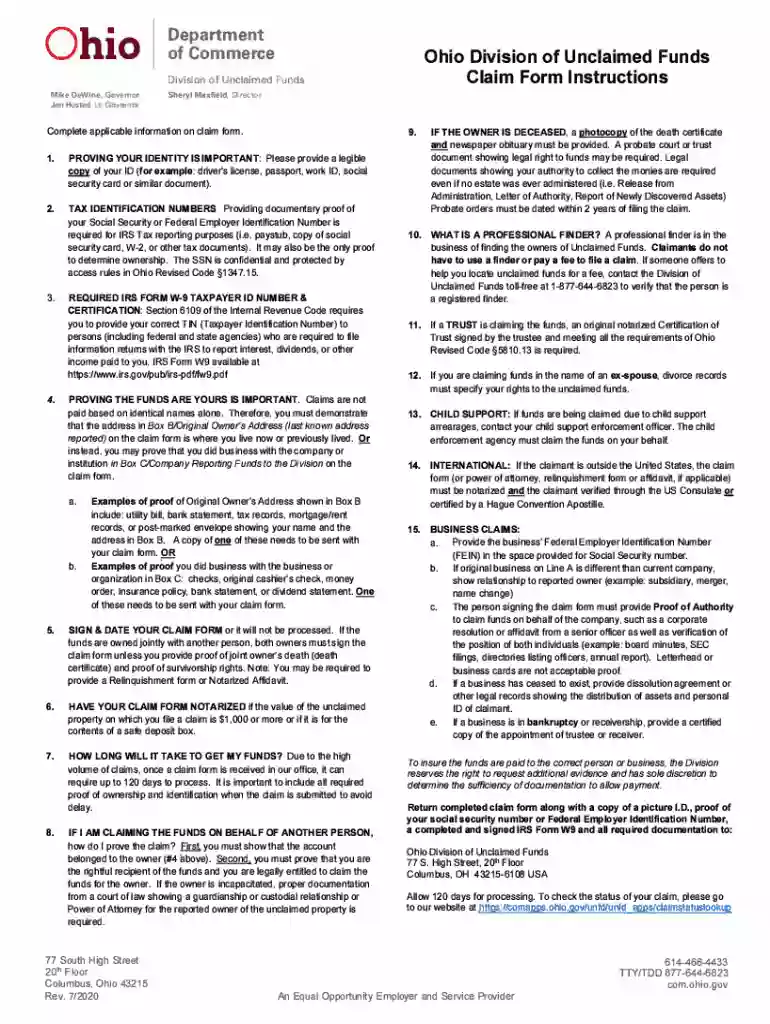
The "PDF Claim Form Instructions - Ohio Department of Commerce - Ohio" is a comprehensive guide designed to assist individuals and organizations in filing claims for unclaimed funds with the Ohio Department of Commerce. This document explains the precise steps for proving identity and ownership, ensuring that applicants comply with state-specific regulations. Unclaimed funds could include forgotten bank accounts, unexpired gift certificates, or dormant insurance policies. The instructions provide clarity on the process, making it accessible and understandable to claimants.
To file a claim using the instructions, follow these detailed steps:
Gather Required Documentation: Before you begin the process, ensure you have all necessary documents, including proof of identity and any documents proving ownership or entitlement.
Complete the Claim Form: Carefully fill out the form, ensuring all details are accurate. This often involves specifying personal information and describing the asset being claimed.
Attach Supporting Documents: Attach copies of documents like identification, proof of address, and any legal paperwork that supports your claim.
Submit the Form: Depending on the process described in the instructions, submission may be done electronically, by mail, or in-person.
Await Processing: After submission, the Ohio Department of Commerce will review the claim. This can take up to 120 days.
Follow Up If Necessary: If additional documentation is requested or if the claim is delayed, promptly respond to any communications from the department.
Consider a person who moved cities and left behind a dormant savings account. They would use the claim form instructions to reclaim funds available in that account by verifying identity and demonstrating ownership.
When preparing to complete the claim form, ensure you have ready access to:
The "PDF Claim Form Instructions - Ohio Department of Commerce - Ohio" outlines the available submission methods:
For online convenience, claims may be submitted through the official Ohio Department of Commerce website. This method often speeds up the process and provides digital tracks of submissions.
For those preferring physical submissions, forms can be sent to the provided address. Ensure all documentation is securely included in the envelope.
In some cases, direct submission at an office may be allowed, especially for large or complex claims requiring face-to-face verification.
The Ohio Department of Commerce has specific rules regarding unclaimed funds, which are reflected in these instructions:
Filing a claim with these instructions must adhere to Ohio legal guidelines, ensuring all information is correctly provided to avoid penalties:
Claimants may refer to these instructions for a variety of cases:
To qualify for filing a claim using the Ohio Department of Commerce's form, you must:


Upon submission, the review process can take up to 120 days. Factors like the complexity of the claim or additional documentation needs can affect this timeline. Consistent follow-ups and prompt responses to any queries from the department can expedite approval.
While the claim form is applicable to a broad range of entities, it is especially useful for:
By following these optimally selected instruction blocks, claimants can streamline the recovery process of their unclaimed assets in Ohio.
We've got more versions of the PDF Claim Form Instructions - Ohio Department of Commerce - Ohio form. Select the right PDF Claim Form Instructions - Ohio Department of Commerce - Ohio version from the list and start editing it straight away!
| Versions | Form popularity | Fillable & printable |
|---|---|---|
| 2020 | 4.8 Satisfied (196 Votes) |
At DocHub, your data security is our priority. We follow HIPAA, SOC2, GDPR, and other standards, so you can work on your documents with confidence.
Building Code Compliance Electronic Plan Submission Submit your permit application and PDF drawings online. Industrialized Units Plan Submission Program Submit
Jan 31, 2012 Form 1120S if (a) it elected to be an S that tax year. If no date is specified and. When To File corporation by filing Form 2553, (b) the the


