




01. Edit your berg balance test calculator online
Type text, add images, blackout confidential details, add comments, highlights and more.

Type text, add images, blackout confidential details, add comments, highlights and more.

Draw your signature, type it, upload its image, or use your mobile device as a signature pad.

Send berg balance scale calculator via email, link, or fax. You can also download it, export it or print it out.
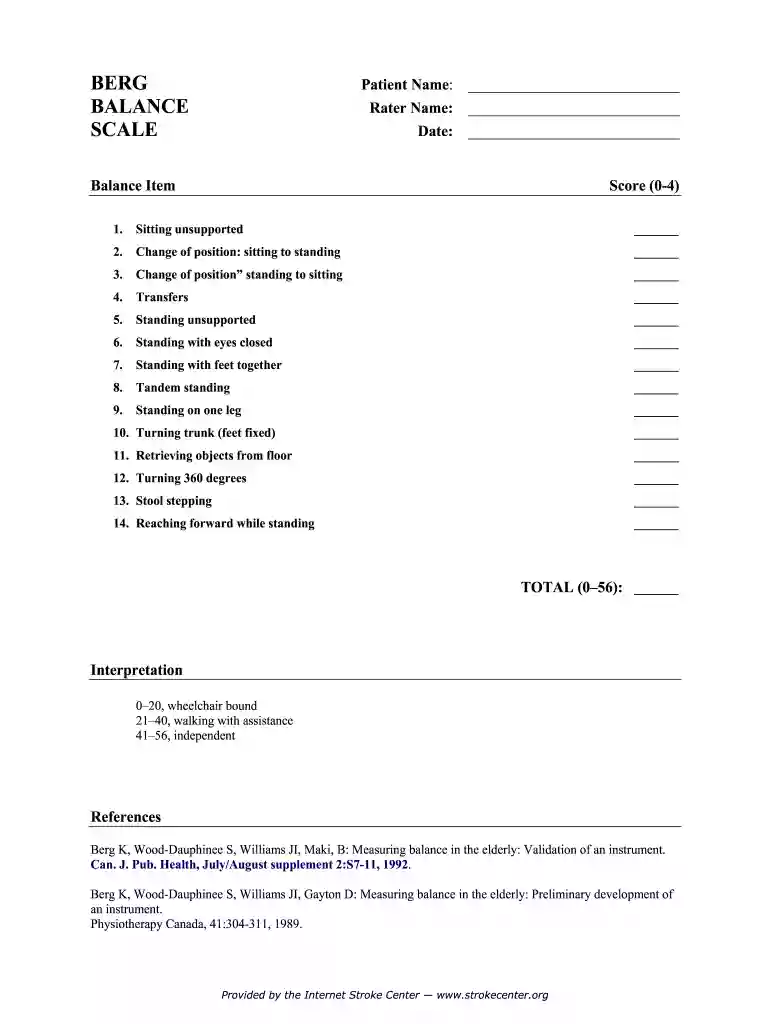
The Berg Balance Scale (BBS) is a widely recognized assessment tool used to evaluate balance proficiency in individuals, particularly among the elderly population and those with balance impairments. It consists of a series of 14 functional tasks that focus on various aspects of balance and mobility. Each task is scored on a scale from zero to four, where a score of four indicates that a task can be completed independently and safely, while a score of zero signifies an inability to perform the task. The overall scoring ranges from zero to 56, enabling health professionals to categorize a person's balance and mobility status into three distinct groups:
The BBS has been validated through extensive research, making it a standard in clinical settings for fall risk assessment.
Utilizing the Berg Balance Scale requires a structured approach to ensure accuracy and reliability in assessments. Here are key steps involved:
Setting Up: Prepare an environment that allows for a safe assessment. Ensure that all necessary equipment, such as a stopwatch, measuring tape, and chairs, is readily available.
Administering the Test: The assessor conducts each task while observing the individual's ability to execute the movements. Each task should be clearly defined to the participant to minimize confusion.
Scoring: As each task is completed, assign a score from zero to four. Keep in mind the specific criteria associated with each score to ensure consistency in assessment.
Documenting the Results: After assessing all 14 tasks, total the scores to derive the final balance score, providing a clear picture of the individual's balance capabilities.
Interpreting the Scores: Use the total score to categorize the participant's mobility status and determine any necessary interventions or adjustments in their rehabilitation plan.
Completing the Berg Balance Scale effectively involves several tasks that the individual must perform:
Bilateral Standing: The individual stands with their feet together for 10 seconds.
Unilateral Standing: The participant stands on one foot for a maximum of ten seconds.
Forward Reaching: The individual is assessed while reaching forward for an object that is placed slightly beyond arm's length.
Retrieving an Object from the Floor: The participant bends down to pick up a shoe from the floor and returns to a standing position.
The Turn: The individual is asked to turn 360 degrees to the right and then to the left.
Step Up: Stepping onto a stool or platform is evaluated for stability.
Walking with Head Turns: The individual walks a certain distance while turning their head from side to side.
Timed Up and Go Test: The participant rises from a seated position, walks three meters, turns around, walks back, and sits down again. Timing is recorded.
Each task measures a specific aspect of balance and provides comprehensive insight into the individual's mobility and fall risk.
Understanding key terms associated with the Berg Balance Scale enhances comprehension of its application and interpretation:
Familiarity with these terms is essential for accurately conducting assessments and conveying results to other healthcare professionals.
The Berg Balance Scale is utilized by a range of healthcare professionals who focus on mobility and rehabilitation:
By identifying who uses the BBS, it's clear how integral this tool is in varied health settings, ensuring tailored care for individuals with balance challenges.


At DocHub, your data security is our priority. We follow HIPAA, SOC2, GDPR, and other standards, so you can work on your documents with confidence.
Berg Balance Scale. About: This scale measures balance in older adults. Items: 14. Equipment: Yardstick. One standard chair with arm rests. One standard chairRead more
P-values are calculated through a permutation test. Higher density scores are associated with better clusters. The results indicate a single pseudo-stableRead more


