




01. Edit your form online
Type text, add images, blackout confidential details, add comments, highlights and more.

Type text, add images, blackout confidential details, add comments, highlights and more.

Draw your signature, type it, upload its image, or use your mobile device as a signature pad.

Send it via email, link, or fax. You can also download it, export it or print it out.
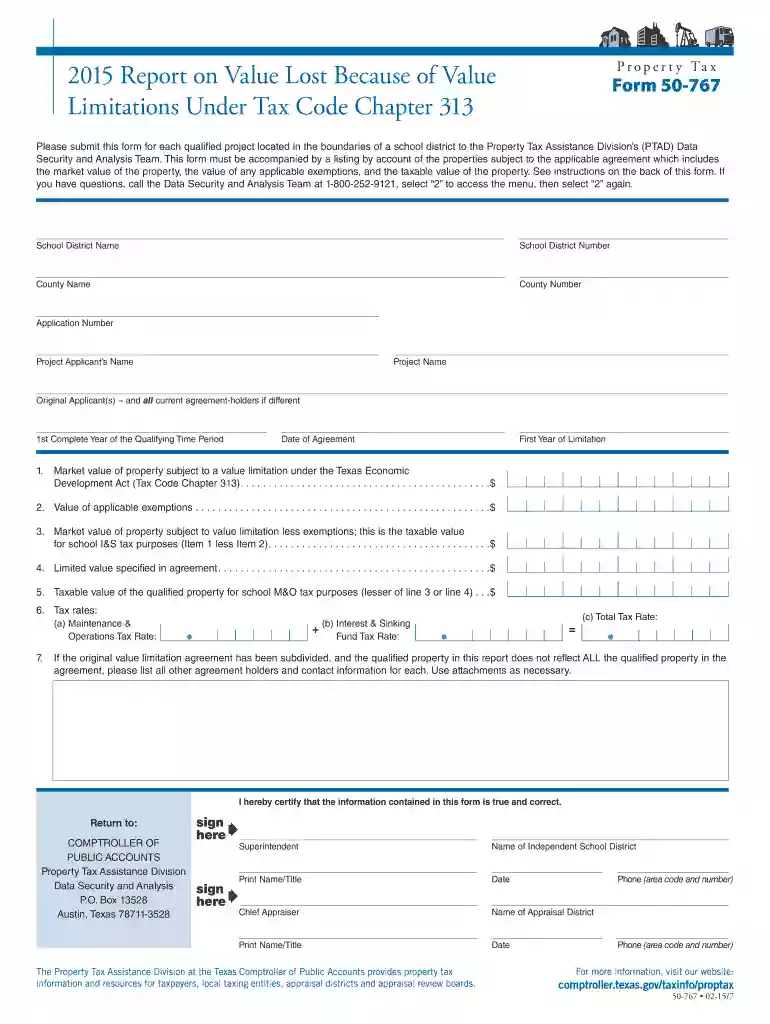
Form 50-767 is a crucial document under the Texas Economic Development Act, primarily used for reporting property tax information concerning qualified projects. This form is integral for recording details about the market value, exemptions, and taxable values of properties within the boundaries of school districts. The form's purpose is to ensure compliance with tax regulations by consolidating necessary data about property valuations. It is typically completed by the Superintendent and Chief Appraiser to validate the collected data’s accuracy and compliance.
To use Form 50-767 effectively, begin by understanding its sections. It requires detailed inputs about each project's property assessment, including specific exemptions and market values. Carefully review each field and gather all necessary information beforehand. Input data carefully to avoid discrepancies that might hinder compliance. Given its legally binding nature, accuracy in completing the form is vital. Ensure all fields are thoroughly checked, and the required signatures are provided before submission.
This form is primarily used by local government officials, including school district superintendents and chief appraisers. These professionals ensure that the property assessments within their jurisdiction meet Texas state tax compliance standards. Furthermore, businesses involved in qualified projects under the Texas Economic Development Act must also use this form to report accurate property tax details to local authorities.
The form consists of several critical elements:
While the core requirements of Form 50-767 align with Texas state regulations, it's important to consider specific guidelines that might apply to different regions within Texas. These rules might pertain to assessment percentages, allowable exemptions, or specific submission procedures. As each school district may have unique requirements, reference local directives to remain fully compliant.
The correct, legal use of Form 50-767 ensures compliance with Texas Tax Code Chapter 313. It guards against inaccuracies that could lead to audits or penalties. Proper usage implies accurate reporting, verified signatures, and timely submission, reflecting true and current property valuations within district boundaries. Misuse, such as falsifying data, falls under non-compliance, subject to legal repercussions.
Failure to properly complete and submit Form 50-767 can result in penalties, including fines or legal action against the responsible entities. Non-compliance may also affect the standing of a project under the Texas Economic Development Act, potentially resulting in loss of tax benefits or agreements being voided. Timely, accurate submission protects against these risks, ensuring all involved parties adhere to state legislation.
Real-world scenarios highlight the importance of Form 50-767. For instance, a school district might use it to assess the impact of a new commercial development. Accurate property valuations ensure that the district receives appropriate tax revenue based on the project's economic impact. Similarly, a renewable energy company developing a wind farm could leverage this form to accurately report its facility's market value and taxable status, ensuring compliance and optimizing any applicable exemptions.
We've got more versions of the form 50 767 2015 form. Select the right form 50 767 2015 version from the list and start editing it straight away!
At DocHub, your data security is our priority. We follow HIPAA, SOC2, GDPR, and other standards, so you can work on your documents with confidence.
Jan 2, 2023 Chapter 313 (Form 50-767), and identify and include with the protest the following documentation: Report on. Value Lost Because of Value
by L General Cited by 5 Generally, you can deduct the actual state and local gen- eral sales taxes (including compensating use taxes) you paid in 2006 if the tax rate was the same
50-798, Trainee Instructor Feedback Form (PDF) 50-799, Instructor 50-767, Report on Value Lost Because of Value Limitations Under Tax Code


