




Here's how it works

01. Edit your blank court motion forms online
Type text, add images, blackout confidential details, add comments, highlights and more.

02. Sign it in a few clicks
Draw your signature, type it, upload its image, or use your mobile device as a signature pad.

03. Share your form with others
Send it via email, link, or fax. You can also download it, export it or print it out.
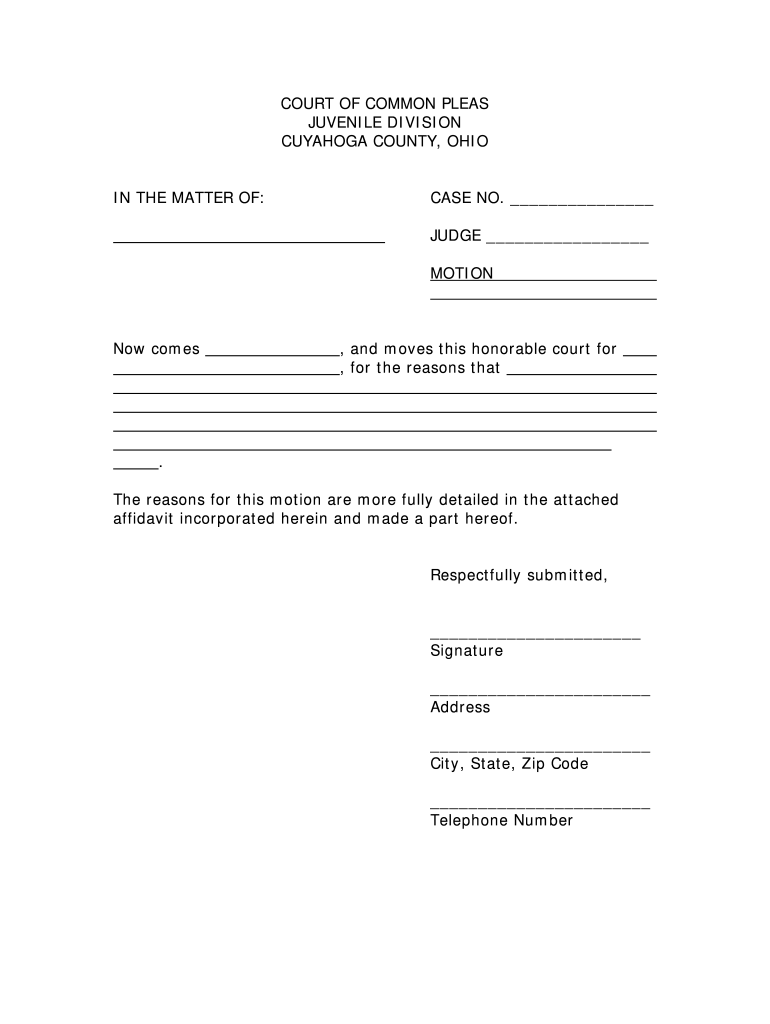
How to use or fill out blank motion juvenile with our platform

- Click ‘Get Form’ to open the blank motion juvenile in the editor.
- Begin by filling in the case number and judge's name at the top of the form. This information is crucial for identifying your case.
- In the section labeled 'Now comes,' enter your name and specify what you are requesting from the court. Be clear and concise.
- Detail your reasons for the motion in the provided space, ensuring that they align with any attached affidavit.
- Complete your signature, address, city, state, zip code, and telephone number at the bottom of the form to validate your submission.
- If applicable, fill out the affidavit section by stating your relationship to the juvenile and providing any necessary details as outlined.
- Finally, complete the certificate of service by indicating how you served a copy of this motion to relevant parties.
Start using our platform today for free to streamline your document editing and ensure a smooth filing process!
Fill out blank motion juvenile online
It's free
It's free
Got questions?
We have answers to the most popular questions from our customers. If you can't find an answer to your question, please contact us.
Contact us
What is a petition in juvenile court?
Petition: A document filed in juvenile court alleging that a juvenile is a delinquent or a status offender and asking that the court assume jurisdiction over the juvenile or that an alleged delinquent be transferred to criminal court for prosecution as an adult.
What are the four main decision points in the juvenile court process?
The juvenile justice process involves seven major decision points: (1) arrest or intake, (2) referral to court, (3) secure detention, (4) waiver to adult criminal court, (5) case petitioning, (6) delinquency finding/adjudication, (7) disposition (including probation, or confinement in a secure correctional facility).
What is a juvenile petition similar to?
It can allege that the juvenile committed a law violation, or was truant or uncontrollable. A petition is also the document that alleges child neglect or abuse, or that a child is a dependent child. Adjudication is like an adult court arraignment.
What are the three types of cases handled in juvenile court?
Juvenile courts hear three types of cases: (1) delinquency; (2) child protection; and (3) status offenses. Each of these types of cases has an entirely different focus.
How to file a petition in juvenile court?
0:29 1:57 Next visit your local County office or Courthouse to obtain the necessary forms. The specific formsMoreNext visit your local County office or Courthouse to obtain the necessary forms. The specific forms needed may vary by jurisdiction. So its essential to ask the court clerk for guidance.
Security and compliance
At DocHub, your data security is our priority. We follow HIPAA, SOC2, GDPR, and other standards, so you can work on your documents with confidence.
Learn more


People also ask
What are the steps in a juvenile case?
The Juvenile Court Process: What You Should Know 1) Investigation. 2) Diversion. 3) First Appearance. 4) Arraignment. 5) Pre-Trial Hearing (also known as Pretrial Conference or a Case Setting Hearing) 6) Fact Finding Hearing (also known as an adjudication hearing or trial) 7) Disposition. 8) After Disposition.
What is the trial process in juvenile court called?
6) Fact Finding Hearing (also known as an adjudication hearing or trial) In juvenile court, instead of a jury, a judge is the one to decide whether the prosecuting attorney has proven his or her case beyond a reasonable doubt.


