
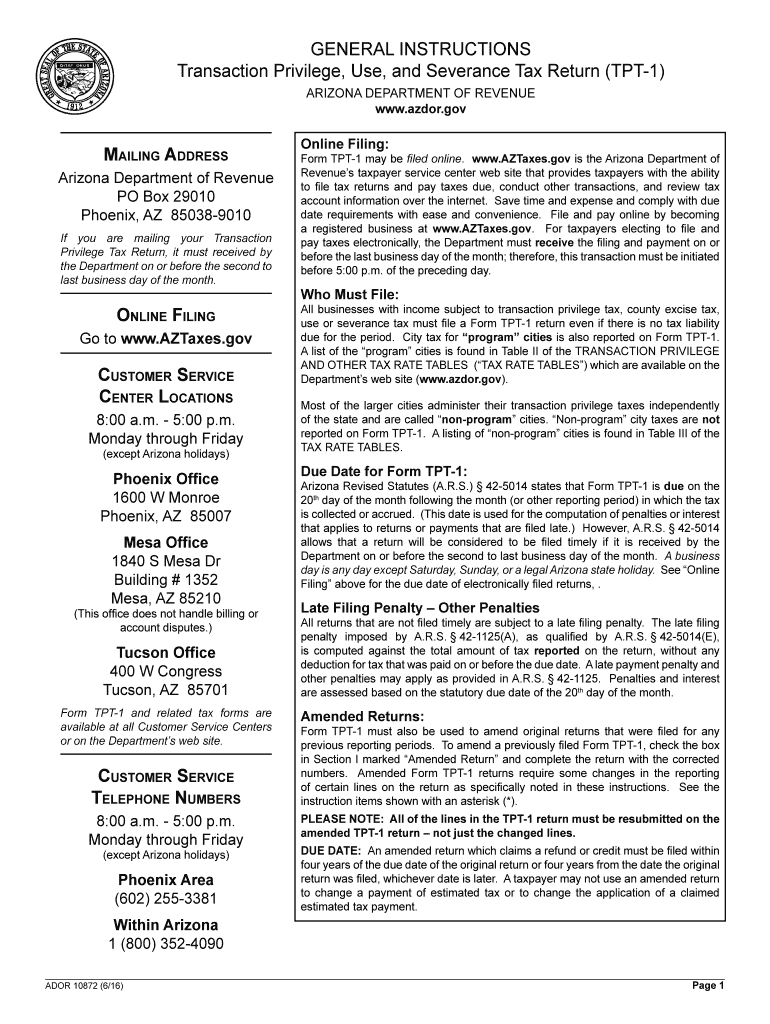







Understanding the Transaction Privilege, Use, and Severance Tax Return Form
The Transaction Privilege, Use, and Severance Tax Return (TPT-1) form is a critical document used by businesses operating in Arizona to report business taxes. This form is not merely an overview of sales tax; rather, it covers a range of transaction-related taxes imposed on businesses for the privilege of conducting business within the state.
The TPT-1 form aims to capture various tax liabilities on a detailed level, accommodating the diverse nature of businesses. Organizations are required to report transaction privilege taxes, which differ based on the business entity type and the specific business activities they conduct in Arizona. Understanding this complexity helps ensure proper filing and compliance with state regulations.
Importance of Filing the TPT-1 Form
Filing the TPT-1 Form is mandatory for businesses in Arizona that engage in taxable activities, regardless of whether the business has no tax due for a particular period. The form ensures that the Arizona Department of Revenue receives accurate records of tax liabilities linked to diverse business transactions.
Timely and compliant filing reduces the risk of incurring penalties for non-compliance or late submission. Businesses need to track their activities accurately to avoid underreporting or omissions which can attract fines and audits. This proactive approach not only maintains legal compliance but also enhances operational transparency and accountability.
Steps to Complete the TPT-1 Form
-
Gather Required Information: Collect all necessary financial data and documentation concerning business transactions within Arizona. Ensure details of sales, deductibles, taxable activities, and other financial records are complete and accurate.
-
Identify Business Classification: Determine the specific classification of the business. The nature of services or goods offered influences which parts of the form need to be completed. Arizona's tax system categorizes different transactions, and each category may have distinct tax rates.
-
Calculate Tax Liability: Use the information collected to calculate the transaction privilege tax and any applicable use or severance taxes. Normally this is done by applying the relevant tax rates to the taxable income related to different classifications of business activities.
-
Fill Out the Form: Accurately fill out each section of the TPT-1 form. Use original records for all reported amounts and ensure that each segment of the document corresponds with the respective transaction classification.
-
Review and Submit: Double-check all entries for accuracy. Amend any discrepancies before submission. The form can typically be filed online for convenience, or in hard copy by mail, depending on business preference and regulatory guidelines.
Digital vs. Paper TPT-1 Form Submission
Filing the TPT-1 form can be done both digitally and through traditional paper methods, each with its unique set of benefits.
-
Digital Submission: This is often quicker and allows for instant processing. Electronic systems reduce the risk of human error during data entry and enable immediate confirmation of form receipt. Given the integration capabilities with accounting software, digital submissions offer streamlined data entry and processing.
-
Paper Submission: Some businesses may prefer physical submissions for record-keeping or lack of digital system access. However, this process is generally slower as it involves manual processing and lacks instant acknowledgment of receipt.
State-Specific Rules for TPT-1 Filing
Arizona imposes specific rules for filing the TPT-1 form. Businesses must adhere to state guidelines about tax rates and exemptions, as these can vary significantly across business types and regions within the state.
-
Local Tax Regulations: Arizona has additional local taxes that may affect the total tax liability recorded on the TPT-1 form. These local taxes require separate accountability alongside state-level taxes.
-
Exemptions and Deductions: There are specific deductions and exemptions that businesses can claim states on their TPT-1 form. Understanding these can significantly impact the overall tax liability for the business.
Penalties for Non-Compliance
Failure to file the TPT-1 form timely or accurately can lead to significant penalties. These may include fines, interest on unpaid taxes, and in severe cases, legal action against the business. Arizona enforces these penalties to encourage compliance and ensure that businesses contribute fairly to the state's revenue.
Businesses should consult tax professionals to navigate these requirements effectively, minimizing the potential pitfalls of non-compliance and ensuring adherence to all relevant tax laws.
Examples of Business Obligations for TPT-1
Various organizations, such as retail stores, service providers, and manufacturers, have different reporting requirements under the TPT-1 form. Each business type has unique sales tax implications based on its operations.
-
Retail Businesses: Need to report sales tax collected from consumers and ensure that they are accurately reported as part of the TPT-1 submission.
-
Service Providers: Certain services are taxable, requiring providers to report and remit taxes associated with their billing for applicable services.
These real-world examples highlight the variability in reporting requirements, necessitating a tailored approach to each category's requirements on the TPT-1 form.
Key Elements of the TPT-1 Form
The TPT-1 form includes several essential sections that organizations must complete accurately. Key elements generally include sections for reporting the gross receipts, deductions, taxable amounts, and tax calculations.
-
Gross Receipts: All revenue from sales and services conducted within Arizona must be documented.
-
Deductions: Businesses can claim deductions based on specified non-taxable revenue as defined by Arizona law.
-
Tax Calculations: This section summarizes the totals for tax due, allowing businesses to remit payment along with the form submission.
Understanding these elements in depth ensures businesses comply with tax obligations efficiently while fulfilling all legal requirements imposed by the state.




