




01. Edit your form online
Type text, add images, blackout confidential details, add comments, highlights and more.

Type text, add images, blackout confidential details, add comments, highlights and more.

Draw your signature, type it, upload its image, or use your mobile device as a signature pad.

Send it via email, link, or fax. You can also download it, export it or print it out.
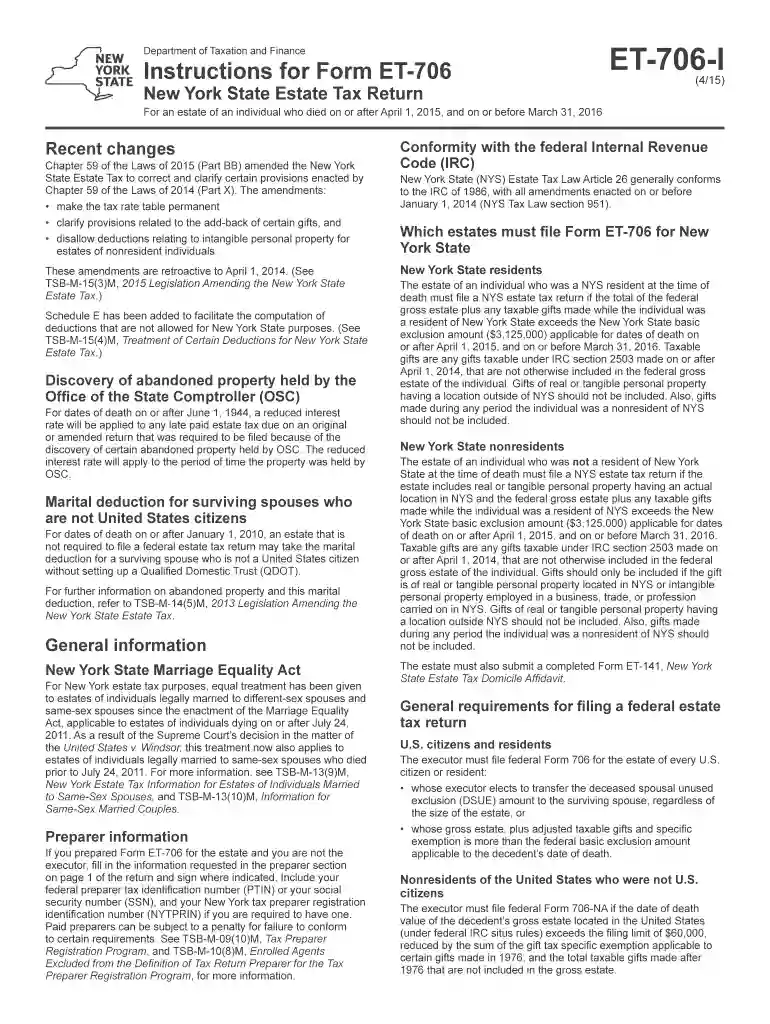
The "ET-706 Instructions 2015 Form" refers to the guidelines for completing the New York State Estate Tax Return for decedents who passed away between April 1, 2015, and March 31, 2016. The document provides essential instructions for estate representatives on how to properly file the form, claim deductions, and understand tax liabilities under New York's estate tax laws during this period. It aligns with state amendments and federal conformity standards to ensure accuracy in reporting and compliance.
The ET-706 instructions guide users through the process of completing the New York State Estate Tax Return by:
Completing the ET-706 form involves several meticulous steps:
Executors, administrators, or personal representatives of an estate typically use this form. These individuals are responsible for managing the decedent’s estate affairs including financial obligations and tax filings.


Understanding key terms enhances the completion process:
The ET-706 form must be filed in compliance with New York State laws for the declaration of estate taxes. It is legally binding and ensures the proper transfer and taxation of estates. Failure to comply with filing requirements can result in penalties or fines.
Adhering to deadlines is essential:
Failing to submit the ET-706 form or underreporting estate value can lead to:
Although primarily a state-level document, the ET-706 instructions align with federal IRS standards:
New York has specific rules differing from other states:
Consider these scenarios:
When preparing the ET-706 form, software programs commonly used include:
We've got more versions of the et 706 instructions 2015 form form. Select the right et 706 instructions 2015 form version from the list and start editing it straight away!
| Versions | Form popularity | Fillable & printable |
|---|---|---|
| 2025 | 4.4 Satisfied (35 Votes) | |
| 2024 | 4.4 Satisfied (23 Votes) | |
| 2023 | 4.7 Satisfied (49 Votes) | |
| 2021 | 4.8 Satisfied (195 Votes) | |
| 2020 | 4.4 Satisfied (98 Votes) | |
| 2019 | 4.4 Satisfied (228 Votes) | |
| 2017 | 4.3 Satisfied (109 Votes) | |
| 2016 | 4.3 Satisfied (54 Votes) | |
| 2015 | 4 Satisfied (30 Votes) | |
| 2014 | 4.1 Satisfied (49 Votes) | |
| 2012 | 3.8 Satisfied (41 Votes) | |
| 2011 | 4 Satisfied (56 Votes) | |
| 2010 | 4 Satisfied (39 Votes) |
At DocHub, your data security is our priority. We follow HIPAA, SOC2, GDPR, and other standards, so you can work on your documents with confidence.
Jan 26, 2017 For more information, see the Instructions for Form 706 and the Instructions for Form. 706A. Property Changed to. Business or Rental Use. If
Jan 1, 2016 If the value of the gross estate, together with the amount of adjusted taxable gifts, is less than the basic exclusion amount and the. Form 706
The executor must file federal Form 706-NA if the date of death value of the decedents gross estate located in the United States. (under federal IRC situs


