




01. Edit your form online
Type text, add images, blackout confidential details, add comments, highlights and more.

Type text, add images, blackout confidential details, add comments, highlights and more.

Draw your signature, type it, upload its image, or use your mobile device as a signature pad.

Send it via email, link, or fax. You can also download it, export it or print it out.
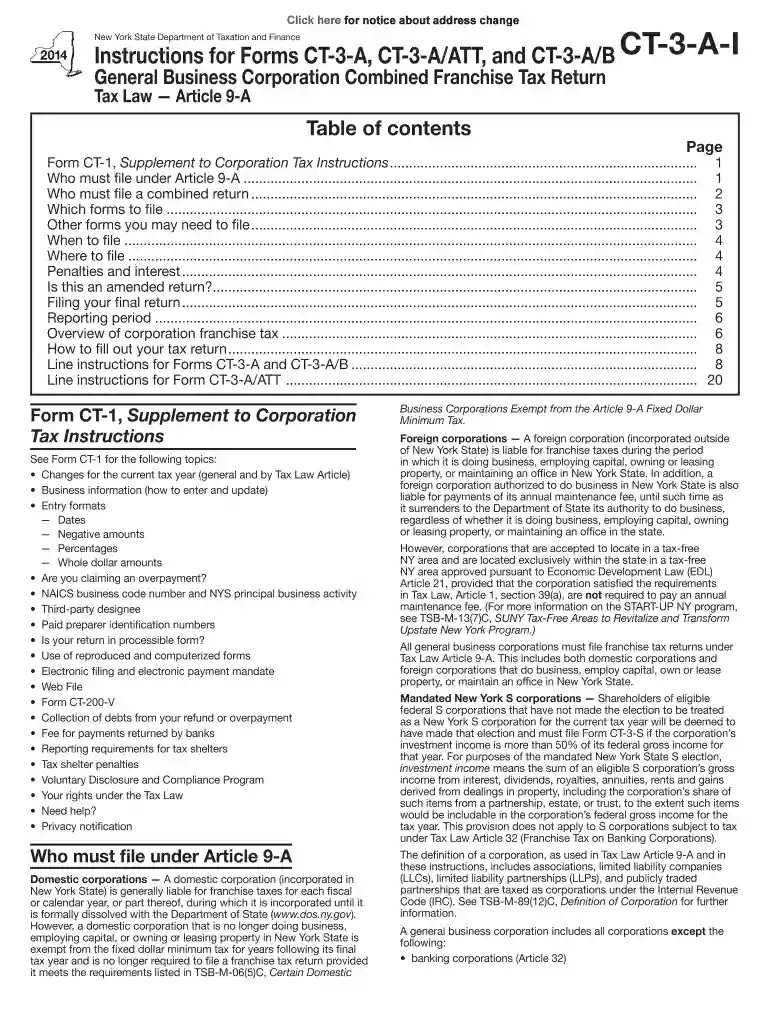
The CT-3-A instructions for 2014 detail the process for filing the New York State General Business Corporation Combined Franchise Tax Return under Article 9-A. This form is crucial for corporations that are filing combined returns. The instructions provide guidance on who must file, which includes definitions of domestic and foreign corporations, and why this form is needed, focusing on tax reporting for entities engaged in business activities within New York State.
These instructions guide corporations through preparing and filing their tax returns correctly. Start by identifying all required forms and ensure that the correct versions are used for the 2014 tax year.
Being a New York State-specific requirement, the CT-3-A form must adhere to local laws. Understanding the differences between the New York State requirements and federal requirements is crucial for compliance.
The primary users include accountants, tax professionals, and corporate financial officers within corporations obligated to file status in New York State. These individuals need to understand complex tax laws and prerequisites for filing a combined return.


Filing this form correctly is essential for tax compliance and avoiding potential penalties. Corporations must fully disclose financial activities to meet state regulations and contribute to transparent business operations, fostering investor trust and operational continuity.
Corporations may file the CT-3-A forms either electronically through recognized e-filing systems or via mail to designated New York State Department of Taxation and Finance addresses. Each method requires specific guidelines to ensure successful submission.
Failing to comply with the instructions or submit the form can result in significant penalties. It's critical to pay attention to due dates, maintain accurate records, and provide complete information to avoid repercussions from the New York State tax authorities.
Incorporating detailed, accurate content, and insights will ensure corporations meet their regulatory requirements while optimizing tax processes efficiently.
We've got more versions of the ct 3a instructions 2014 form form. Select the right ct 3a instructions 2014 form version from the list and start editing it straight away!
| Versions | Form popularity | Fillable & printable |
|---|---|---|
| 2023 | 4.1 Satisfied (30 Votes) | |
| 2022 | 4.7 Satisfied (56 Votes) | |
| 2021 | 4.8 Satisfied (108 Votes) | |
| 2020 | 4.2 Satisfied (102 Votes) | |
| 2019 | 4.4 Satisfied (167 Votes) | |
| 2018 | 4.2 Satisfied (116 Votes) | |
| 2017 | 4.3 Satisfied (50 Votes) | |
| 2016 | 4.2 Satisfied (44 Votes) | |
| 2015 | 4.4 Satisfied (71 Votes) | |
| 2014 | 4 Satisfied (31 Votes) | |
| 2013 | 4 Satisfied (23 Votes) | |
| 2011 | 4 Satisfied (56 Votes) |
At DocHub, your data security is our priority. We follow HIPAA, SOC2, GDPR, and other standards, so you can work on your documents with confidence.
May 2, 2017 Be sure that the payers name and EIN on Forms W-2 and. W-3 are the same as those used on the Form 941,. Employers QUARTERLY Federal Tax Return
The documentation should clearly show how the amounts to be moved are derived and tie to the amount on the CT form. Reallocation of payroll costs must be
Form CT-3-A/C, Report by a Corporation Included in a Combined. Franchise Tax Return, must be filed by each member of the combined group, except the taxpayer


