




01. Edit your form online
Type text, add images, blackout confidential details, add comments, highlights and more.

Type text, add images, blackout confidential details, add comments, highlights and more.

Draw your signature, type it, upload its image, or use your mobile device as a signature pad.

Send it via email, link, or fax. You can also download it, export it or print it out.
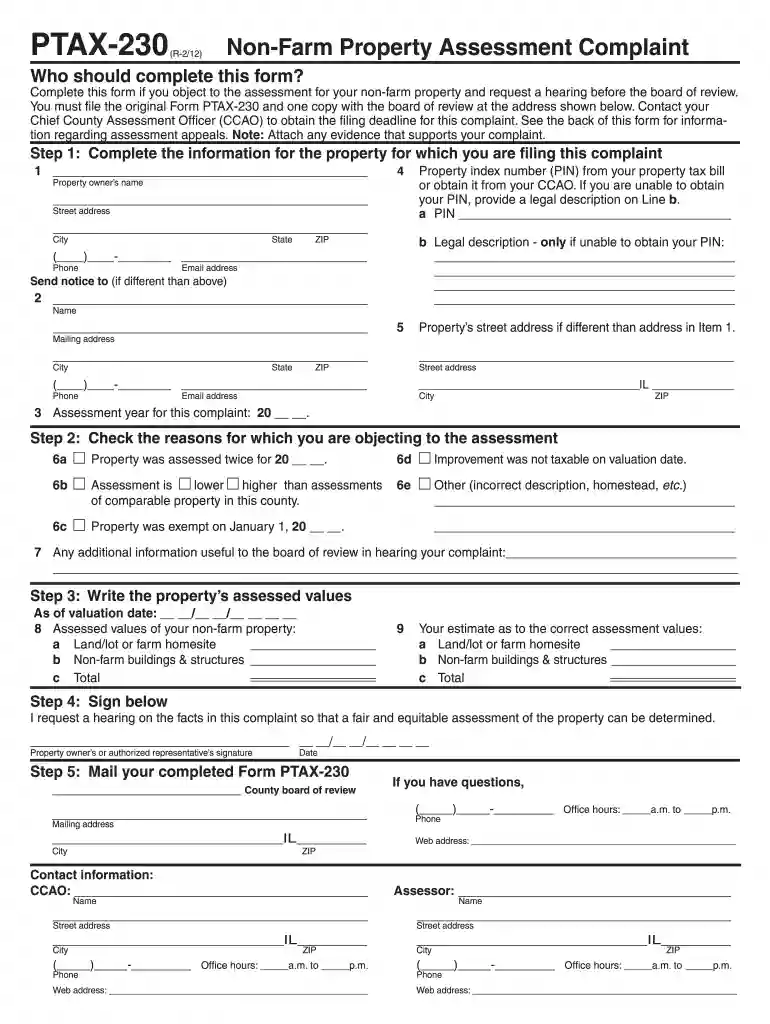
The PTAX-230 Form is a key document for property owners who wish to file a complaint regarding the assessment of their non-farm property. This form is instrumental for individuals contesting their property tax assessments, offering a path to request a formal hearing before the board of review. By using this form, property owners can outline their reasons for objecting to the current assessment and provide supporting evidence to bolster their case.
Utilizing the PTAX-230 form requires careful attention to detail to ensure all fields are filled correctly, aiding in presenting a strong case for reassessment. Understanding how to navigate and execute the form's requirements effectively can greatly impact the outcome of the appeal process.
Completing the PTAX-230 form involves several precise steps to ensure accuracy and adherence to requirements. This section outlines the essential steps to achieve a comprehensive and effective submission.
Property Details:
Reasons for Objection:
Supporting Evidence:
Sign and Date: Properly sign the form, affirming the truthfulness of the information provided.
This section covers the proper legal applications of the PTAX-230 form, ensuring users understand how to appropriately file a complaint in adherence with state laws and regulations.
The primary users of the PTAX-230 form are property owners dissatisfied with their non-farm property assessment, seeking corrections through a formal process.


Understanding the critical components of the PTAX-230 form is essential for a successful completion, ensuring accuracy and completeness in challenging an assessment.
When using the PTAX-230 form, specific documentation is necessary to substantiate your claim and reinforce the objection to the property assessment.
The PTAX-230 form is issued by the local board of review or the county assessor's office, depending on jurisdictional practices.
Property owners using the PTAX-230 form must adhere to strict filing deadlines to ensure their complaints are considered within the current tax year.
We've got more versions of the ptax 230 2012 form form. Select the right ptax 230 2012 form version from the list and start editing it straight away!
At DocHub, your data security is our priority. We follow HIPAA, SOC2, GDPR, and other standards, so you can work on your documents with confidence.
A bill to be entitled. 1. An act relating to the Department of Financial. 2. Services; amending s. 440.02, F.S.; redefining the.
by DA Frederick 2005 Cited by 4 This chapter describes the forms in which patronage refunds may be paid to qualify for cooperative tax treatment and the tax collection method applicable to


