




01. Edit your form online
Type text, add images, blackout confidential details, add comments, highlights and more.

Type text, add images, blackout confidential details, add comments, highlights and more.

Draw your signature, type it, upload its image, or use your mobile device as a signature pad.

Send it via email, link, or fax. You can also download it, export it or print it out.
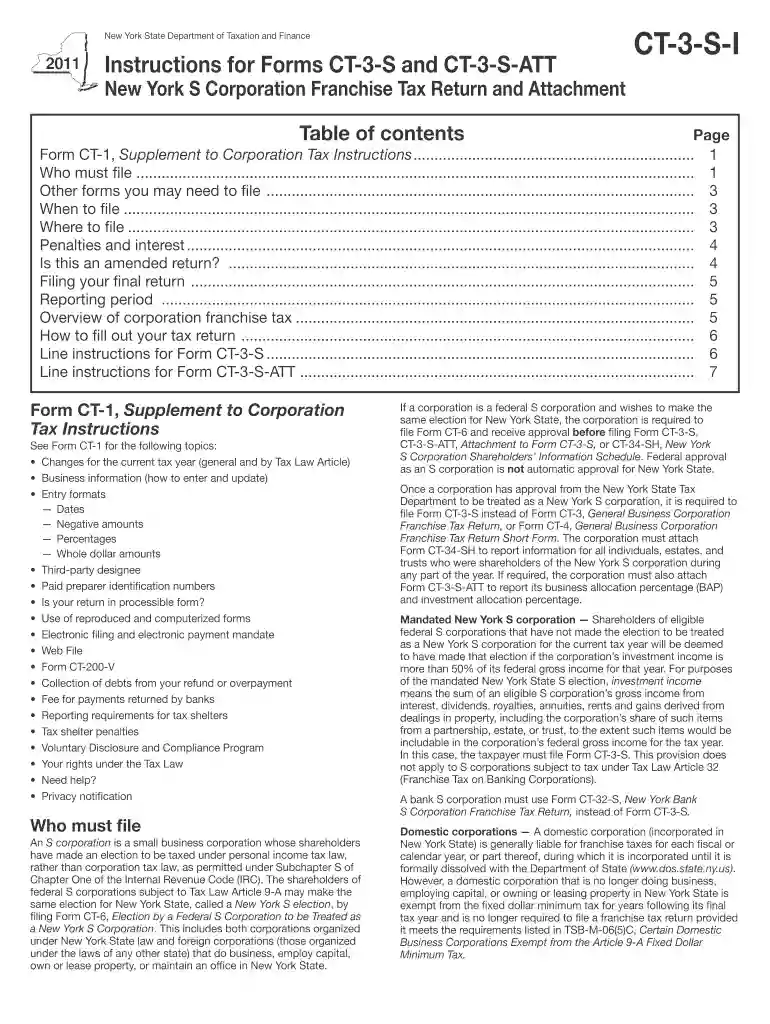
Form CT-3, officially known as the New York S Corporation Franchise Tax Return, is an essential tax document used by S corporations operating in New York State to report their income, deductions, and tax liabilities. Introduced in 2011, this form helps ensure that S corporations comply with state tax regulations. It collects detailed financial information from businesses, aiding the state in assessing the appropriate level of taxation to be levied on corporate profits.
Understanding how to properly utilize the CT-3 instructions is crucial for accurate completion of the tax return. The instructions provide a step-by-step guide on filling out the form, detailing what information is required in each section. Special attention is given to specific lines that require thorough financial breakdowns, such as income calculation and reduction formulas. The form also guides users in addressing common mistakes, ensuring a correct submission process.
There are multiple ways to access the CT-3 instructions. Traditionally, these forms are available for download from the New York State Department of Taxation and Finance website. Alternatively, you can request a physical copy by contacting their office directly. Various tax preparation software packages may also include the CT-3 form and corresponding instructions within their resources, helping users streamline the filing process.
Gather Required Financial Documentation:
Fill Out Basic Information:
Report Income and Deductions:
Determine Tax Liability:
Review and Correct Errors:
Submit the Form:
Form CT-3 is predominantly used by S corporations operating within New York State. These corporations vary in size and sector, ranging from small local businesses to larger enterprises with extensive operations within the state. S corporations must be legally recognized under New York law and are required to file this form annually to remain compliant with state taxation policies.


For the 2011 tax year, the filing deadline for Form CT-3 was traditionally set on or before March 15th following the tax year end. S corporations are advised to file by this date to avoid any penalties associated with late submissions. Extensions may be available but must be requested and justified before the original deadline.
Failing to comply with the timely filing and accurate completion of Form CT-3 can result in significant penalties. These range from fixed monetary fines to additional interest charges on unpaid taxes. The New York State Department of Taxation and Finance levies these penalties to encourage compliance and equitable tax practices among business entities.
Various tax preparation softwares, such as TurboTax and QuickBooks, often support Form CT-3, providing guided input sections that align with the form's requirements. This compatibility can significantly ease the preparation process, ensuring that all relevant fields are completed correctly and adhering to the form’s specifications.
We've got more versions of the ct 3 instructions 2011 form form. Select the right ct 3 instructions 2011 form version from the list and start editing it straight away!
| Versions | Form popularity | Fillable & printable |
|---|---|---|
| 2025 | 4.9 Satisfied (57 Votes) | |
| 2024 | 4.5 Satisfied (35 Votes) | |
| 2023 | 4.1 Satisfied (30 Votes) | |
| 2022 | 4.8 Satisfied (39 Votes) | |
| 2021 | 4.8 Satisfied (101 Votes) | |
| 2020 | 4.3 Satisfied (97 Votes) | |
| 2019 | 4.4 Satisfied (217 Votes) | |
| 2018 | 4.3 Satisfied (206 Votes) | |
| 2017 | 4.3 Satisfied (69 Votes) | |
| 2016 | 4.4 Satisfied (289 Votes) | |
| 2015 | 4.3 Satisfied (131 Votes) | |
| 2014 | 4.3 Satisfied (70 Votes) | |
| 2013 | 4 Satisfied (46 Votes) | |
| 2012 | 4 Satisfied (52 Votes) | |
| 2011 | 4.3 Satisfied (72 Votes) |
At DocHub, your data security is our priority. We follow HIPAA, SOC2, GDPR, and other standards, so you can work on your documents with confidence.
Personal (Payroll) Cost Transfers are to be signed/approved and then submitted as follows: Acceptable signatures / approvals include (1) digital signatures
May 23, 2022 CT-3-S CT-3-S-I (Instructions), New York S Corporation Franchise Tax Return. CT-3-S-ATT CT-3-S-I (Instructions), Attachment to Form CT-3-S.
It provides the order in which to apply tax credits and a summary of tax credits claimed. Transfer the credit amounts claimed to Form CT-3 or CT-3-A, whichever


