




01. Edit your california amendment agreement online
Type text, add images, blackout confidential details, add comments, highlights and more.

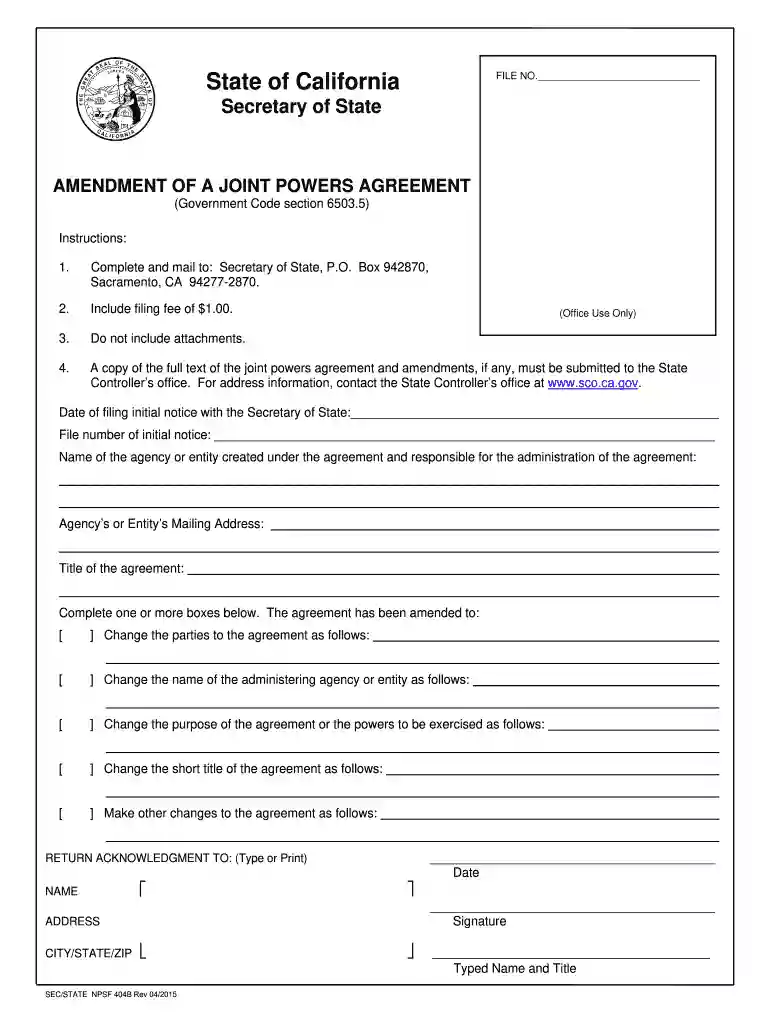
Type text, add images, blackout confidential details, add comments, highlights and more.

Draw your signature, type it, upload its image, or use your mobile device as a signature pad.

Send secretary agreement via email, link, or fax. You can also download it, export it or print it out.
An amendment form NP refers to a legal document utilized to modify specific terms or sections of a pre-existing agreement or record, typically within the realm of non-profit organizations or partnerships. This form is essential when adjustments are needed to reflect current operational or organizational changes accurately. Amendments often include alterations in structure, management, financial conditions, or objectives. The purpose of this form is to ensure that documented agreements remain relevant and legally binding as scenarios evolve. Understanding the precise role and implications of the amendment form NP enables organizations to maintain compliance with legal standards and contractual obligations.
To effectively utilize the amendment form NP, organizations should first ascertain the specific changes required for the existing agreement. This involves thoroughly reviewing the current document to identify areas needing updates. Once changes are identified, they should be clearly articulated within the amendment form, specifying the clause or section they modify. It is crucial to ensure language is precise and unambiguous to prevent potential misinterpretations. For instance, if altering management terms, explicitly state new roles, responsibilities, and management structures. After drafting, ensure all necessary parties review and approve the amended content to maintain legal validity.
The amendment form NP typically includes several critical elements to ensure its effectiveness and enforceability:
The amendment form NP holds significant legal weight, serving as an official record of changes made to binding agreements. Legally, an amendment is considered part of the original document once signed by all parties, possessing the same legal standing. The amendments should comply with local, state, and federal laws governing the specific type of agreement being altered. Legal use cases may include modifying bylaws, partnership terms, or operational procedures for non-profit entities. It is highly recommended to have this document reviewed by legal counsel to confirm its validity and alignment with legal requirements.
The amendment form NP is commonly used by non-profit organizations, partnerships, and similar entities that need to adjust their foundational agreements without drafting new ones entirely. Non-profits, for example, might use this form to change board member compositions or modify fundraising strategies. Partnerships may require amendments to adjust profit-sharing ratios or redefine roles among partners. It is crucial for any entity using this form to ensure that all stakeholders are aware of and agree to the proposed changes, thereby facilitating a smooth transition and operational continuity.


While the amendment form NP is a widely used legal instrument, specific rules and regulations can vary significantly by state. Different jurisdictions may have unique requirements concerning documentation, filing procedures, and notification timelines. Some states may demand the amendment to be filed with a state authority or require additional disclosures. It is essential for organizations to consult with a legal professional familiar with state-specific laws to ensure compliance and avoid potential legal complications.
Consider a non-profit organization needing to update its mission statement due to shifts in the community's needs. By using the amendment form NP, the organization can formally adjust its operational focus while maintaining legal compliance. Another example is a partnership business opting to add a new partner. Instead of drafting a completely new agreement, the existing one can be amended to reflect the updated partnership structure and distribution of responsibilities. These scenarios highlight the form's flexibility and practicality in adapting to evolving organizational needs without starting from scratch.
We've got more versions of the california amendment agreement form. Select the right california amendment agreement version from the list and start editing it straight away!
At DocHub, your data security is our priority. We follow HIPAA, SOC2, GDPR, and other standards, so you can work on your documents with confidence.
Any number of amendments may be submitted to the shareholders and voted on at one meeting. Alternatively, amendments may be adopted by unanimous written consent
(1) pharmacy prescription number;. (2) pharmacys national identification number;. (3) patient name;. (4) patient address, including street, city, state, ZIP
Amended return filing status. You must check one box even if you are not changing your filing status. Caution: In general, you cant.


