



01. Edit your form online
Type text, add images, blackout confidential details, add comments, highlights and more.

Type text, add images, blackout confidential details, add comments, highlights and more.
Draw your signature, type it, upload its image, or use your mobile device as a signature pad.

Send it via email, link, or fax. You can also download it, export it or print it out.
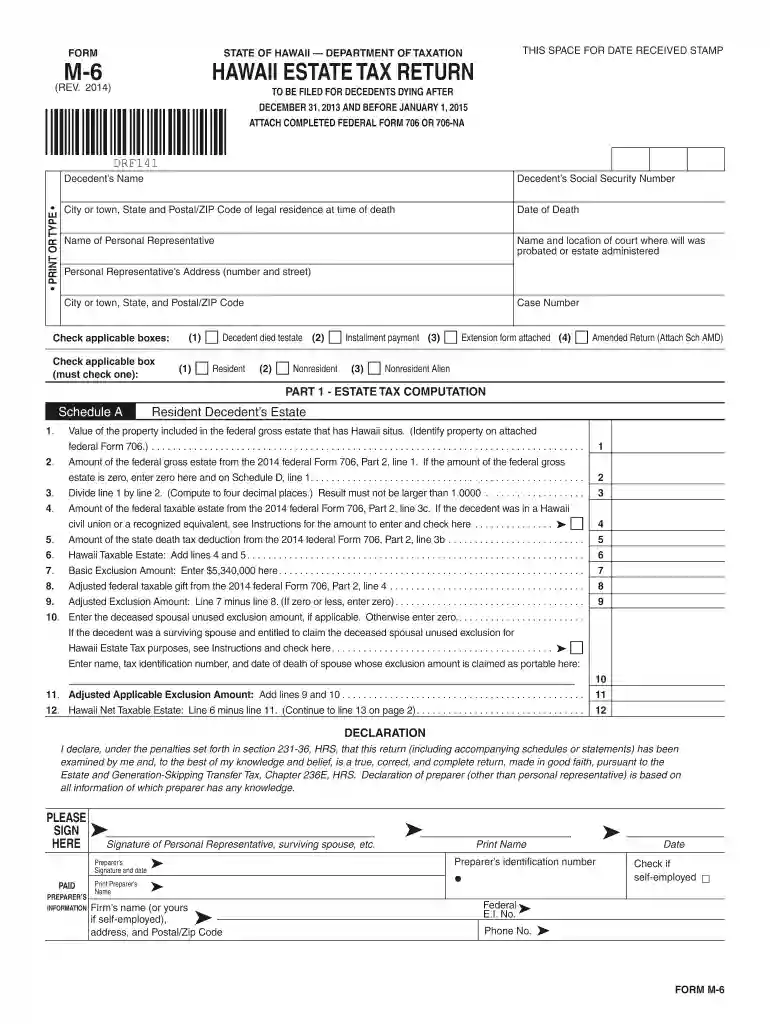
Form M-6, known as the Hawaii Estate Tax Return, is a crucial document used to determine the estate tax liability of decedents in Hawaii. This form is specifically applicable to individuals who passed away between December 31, 2013, and January 1, 2015. The form encompasses various sections where detailed information about the decedent and their estate is recorded to calculate the necessary tax obligations according to Hawaii's estate tax laws.
Gather Required Information: Start by collecting all necessary information about the decedent, including their personal details, date of death, and financial records. This data is pivotal for completing the sections related to the taxable estate.
Complete Schedules: The form includes several schedules to calculate the taxable estate value and applicable exclusions. Make sure to work through each schedule carefully, providing all the required details accurately.
Calculate Tax Amount: Using the provided instructions, compute the total estate tax liability based on the data entered. This requires a thorough understanding of exemptions and deductions applicable under Hawaii law.
Review and Verify: Double-check all the information to ensure accuracy. Mistakes in the form can lead to delays or incorrect tax calculations.
Submission: Once completed, the form must be submitted to the Hawaii Department of Taxation. Ensure you are aware of the submission deadline to avoid penalties.
Form M-6 is primarily used by personal representatives or executors of estates that include decedents in Hawaii. These individuals are responsible for managing the estate's affairs, ensuring all tax obligations are fulfilled, and distributing assets according to the decedent's wishes or the state's intestacy laws.
Hawaii has specific regulations governing estate taxes, which differ from federal rules. It is essential to familiarize oneself with these state-specific requirements, such as the exemption amounts and particular deductions unique to Hawaii. The Hawaii Department of Taxation provides guidelines to ensure compliance with these local rules.
The Hawaii Estate Tax Return must be filed typically within nine months of the decedent's date of death. It is crucial to adhere to this deadline to avoid penalties or interest on unpaid taxes. Extensions may be available under certain circumstances but require a formal request.
Failing to file Form M-6 on time or providing false information can result in significant penalties. These could include fines, additional late fees, or interest on unpaid amounts. In severe cases, incorrect filing can also lead to legal action or a requirement to pay higher taxes than initially determined. It is important to understand the implications of non-compliance and to take necessary steps to ensure accurate and timely submission.
We've got more versions of the form m 6 2014 form. Select the right form m 6 2014 version from the list and start editing it straight away!
| Versions | Form popularity | Fillable & printable |
|---|---|---|
| 2025 | 4.7 Satisfied (44 Votes) | |
| 2024 | 4.4 Satisfied (34 Votes) | |
| 2022 | 4.7 Satisfied (44 Votes) | |
| 2021 | 4.8 Satisfied (110 Votes) | |
| 2020 | 4.4 Satisfied (177 Votes) | |
| 2019 | 4.3 Satisfied (68 Votes) | |
| 2018 | 4.3 Satisfied (82 Votes) | |
| 2017 | 4.3 Satisfied (48 Votes) | |
| 2016 | 4 Satisfied (26 Votes) | |
| 2015 | 4.3 Satisfied (141 Votes) | |
| 2014 | 4.4 Satisfied (492 Votes) | |
| 2013 | 4 Satisfied (58 Votes) | |
| 2005 | 4.3 Satisfied (33 Votes) |
At DocHub, your data security is our priority. We follow HIPAA, SOC2, GDPR, and other standards, so you can work on your documents with confidence.
Jun 10, 2014 The form and the instructions have undergone revisions in the format and information required. Review these documents before completing the.
This attachment provides definitions and implementation guidance for M-14-06,. Guidance for Providing and Using Administrative Data for Statistical Purposes. I.


