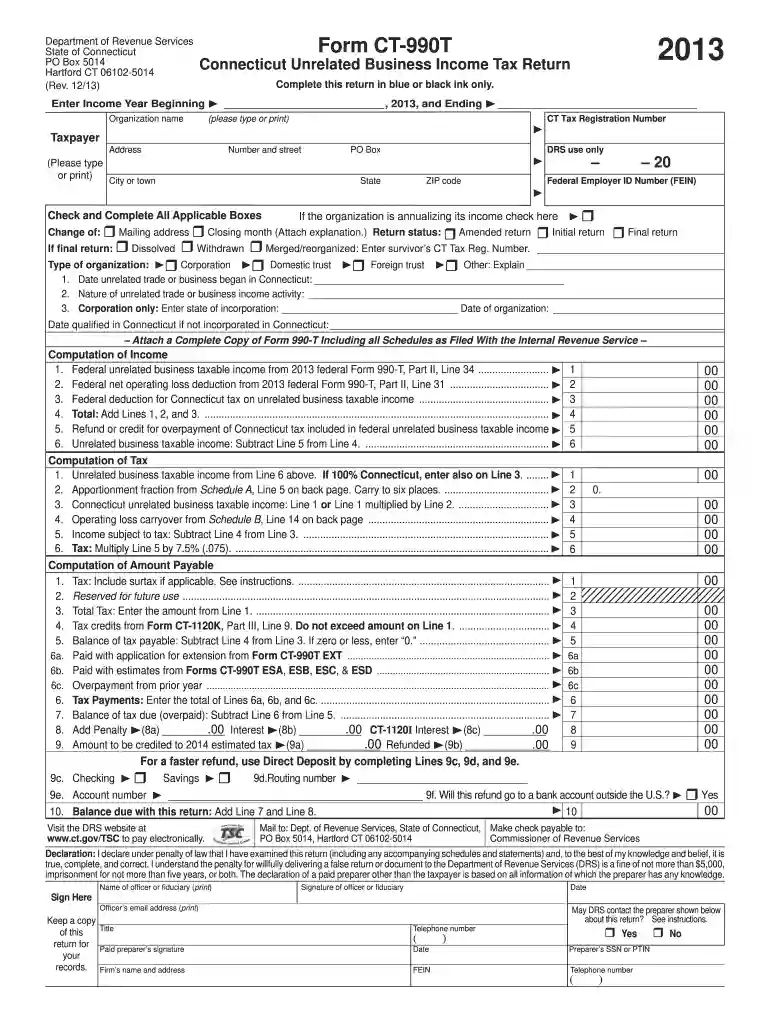
Ct 990 t 2013 form-2026

Get Form
ct 990 t 2013 form Preview on Page 1

Here's how it works

01. Edit your form online
Type text, add images, blackout confidential details, add comments, highlights and more.

02. Sign it in a few clicks
Draw your signature, type it, upload its image, or use your mobile device as a signature pad.

03. Share your form with others
Send it via email, link, or fax. You can also download it, export it or print it out.

Definition & Meaning

The CT-990T 2013 form is a tax document used specifically in Connecticut to report unrelated business income by organizations such as nonprofits. This form is crucial for entities whose unrelated business income is subject to tax according to state regulations. Unrelated business income is defined as income from a trade or business that is regularly carried on and not substantially related to the exempt purpose or function of the organization, aside from providing funds. This form helps the state ensure that organizations are paying the appropriate taxes on income not directly tied to their tax-exempt objectives.

Key Elements of the CT-990T 2013 Form

The CT-990T 2013 form includes several crucial sections that organizations must complete accurately. Key elements include:

  • Organizational Details: Information such as the organization's name, address, and federal identification number is required to establish identity and eligibility.
  • Income Computation: This section calculates the federal unrelated business taxable income, allowing for specific deductions and adjustments as per state rules.
  • Apportionment Details: Organizations may need to allocate their income across multiple states, depending on their operations, necessitating a precise understanding of Connecticut's apportionment regulations.
  • Tax Computation and Payments: This section involves calculating the tax due, based on the unrelated business income, and detailing any tax payments made throughout the year.
  • Declaration of Accuracy: The taxpayer must sign this declaration to certify that the information provided is true and accurate to the best of their knowledge.

Steps to Complete the CT-990T 2013 Form

Completing the CT-990T 2013 form requires thorough preparation and attention to detail. Here is a step-by-step breakdown:

  1. Gather Required Documents: Collect financial statements, prior year tax returns, and federal Forms 990-T to accurately report income.
  2. Fill in Organizational Information: Provide your nonprofit's legal details, such as its name, registration number, and address.
  3. Calculate Unrelated Business Taxable Income: Use worksheets and supporting documents to compute income, deductions, and tax requirements.
  4. Complete Apportionment Section: If applicable, calculate the portion of income attributed to Connecticut operations using the state's apportionment formula.
  5. Compute Tax and Payments: Enter tax liability, estimate payments made during the year, and compute any balance due or overpayment.
  6. Sign and Date: Ensure the form is signed by an authorized representative, confirming compliance and accuracy of submitted information.
  7. Submit the Form: File the completed form by the deadline through the method deemed appropriate, such as online submission or mail.

Who Typically Uses the CT-990T 2013 Form

The CT-990T 2013 form is primarily used by nonprofits and tax-exempt organizations operating in Connecticut that generate unrelated business income. This includes:


  • Charities: Organizations classified under 501(c)(3) with income streams unrelated to their philanthropic mission.
  • Educational Institutions: Schools and colleges with business activities outside of their primary educational purpose.
  • Labor Unions: Unions engaging in unrelated business operations that generate taxable income.
  • Other Tax-Exempt Bodies: Entities like trade associations or religious organizations that have income not directly tied to their exempt activities.
decoration image ratings of Dochub

IRS Guidelines and Connecticut State Rules

While IRS guidelines provide a federal framework, organizations must adhere to state-specific rules to ensure compliance with Connecticut's tax laws. The CT-990T reflects state-centric considerations such as:

  • State-Specific Deductions: Variations in allowable deductions and exemptions unique to Connecticut.
  • Apportionment Criteria: If a business operates in multiple states, it must follow Connecticut's specific rules for income apportionment.
  • Filing Deadlines: Ensuring timely submission in alignment with Connecticut's prescribed tax return due dates.

Filing Deadlines / Important Dates

Organizations must be acutely aware of important deadlines to avoid penalties. The typical deadline for filing the CT-990T is the 15th day of the 5th month following the close of the tax year, similar to federal filing requirements. For instance, if an organization's fiscal year ends on December 31, the deadline falls on May 15 of the following year. Extensions may be requested but must align with state guidelines.

Penalties for Non-Compliance

Failure to file the CT-990T 2013 form timely or accurately can result in significant penalties:

  • Late Filing Penalties: A percentage of the tax due, accruing monthly until the form is filed.
  • Underpayment Penalties: Additional charges may apply if tax estimates are significantly underestimated.
  • Accuracy-Related Penalties: For substantial inaccuracies or omissions in reporting unrelated business income.

Staying informed of these potential consequences encourages organizations to maintain diligent records and ensure compliance with state tax obligations.

Form Submission Methods (Online / Mail)

Organizations can submit the CT-990T via several approved methods:

  • Online Submission: Filing electronically through the Connecticut Department of Revenue Services' official portal is often recommended for its speed and convenience. This method provides immediate confirmation of receipt and processing status updates.
  • Mail: Traditional paper filing remains an option for those preferring physical submissions. Ensure all required documents are included and postmarked by the deadline.
  • In-Person: Though less common, organizations may choose to submit their forms at a designated state office to ensure adherence to all filing requirements.

Each method has its benefits, but practitioners should choose the one that best fits their operational practices and documentation management systems.

See more ct 990 t 2013 form versions

We've got more versions of the ct 990 t 2013 form form. Select the right ct 990 t 2013 form version from the list and start editing it straight away!
Versions Form popularity Fillable & printable
2022 4.4 Satisfied (58 Votes)
2021 4.6 Satisfied (53 Votes)
2020 4.8 Satisfied (116 Votes)
2019 4.4 Satisfied (139 Votes)
2018 4 Satisfied (53 Votes)
2017 4.3 Satisfied (185 Votes)
2016 4.4 Satisfied (69 Votes)
2015 3.7 Satisfied (30 Votes)
2014 4.3 Satisfied (64 Votes)
2013 4.3 Satisfied (49 Votes)
2012 4.3 Satisfied (48 Votes)
2011 4.4 Satisfied (39 Votes)
be ready to get more

Complete this form in 5 minutes or less

Get form

Got questions?

We have answers to the most popular questions from our customers. If you can't find an answer to your question, please contact us.
Contact us
Form CT-1120 can be filed electronically through myconneCT. DRS myconneCT allows taxpayers to electronically file, pay, and manage state tax responsibilities. If you file electronically you are expected to pay electronically at the time of filing.
Drake Tax Form CT-1065/CT-1120SI This form is required for every pass-through entity (partnership or S corp) that does business in Connecticut or has income derived from or connected with sources within Connecticut regardless of the amount of its income (loss).
HOW TO OBTAIN CONNECTICUT TAX FORMS Connecticut state tax forms can be downloaded at the Department of Revenue Services (DRS) website: .ct.gov/drs/ Connecticut tax forms and publications are available at any DRS offices, during tax filing season.
Form OS-114 is necessary for reporting sales and use tax in Connecticut. This form must be filed electronically and includes various fields for tax calculations. Proper completion of this return is crucial for compliance with state regulations.

Security and compliance

At DocHub, your data security is our priority. We follow HIPAA, SOC2, GDPR, and other standards, so you can work on your documents with confidence.

Learn more
ccpa2
pci-dss
gdpr-compliance
hipaa
soc-compliance