




01. Edit your form online
Type text, add images, blackout confidential details, add comments, highlights and more.

Type text, add images, blackout confidential details, add comments, highlights and more.

Draw your signature, type it, upload its image, or use your mobile device as a signature pad.

Send it via email, link, or fax. You can also download it, export it or print it out.
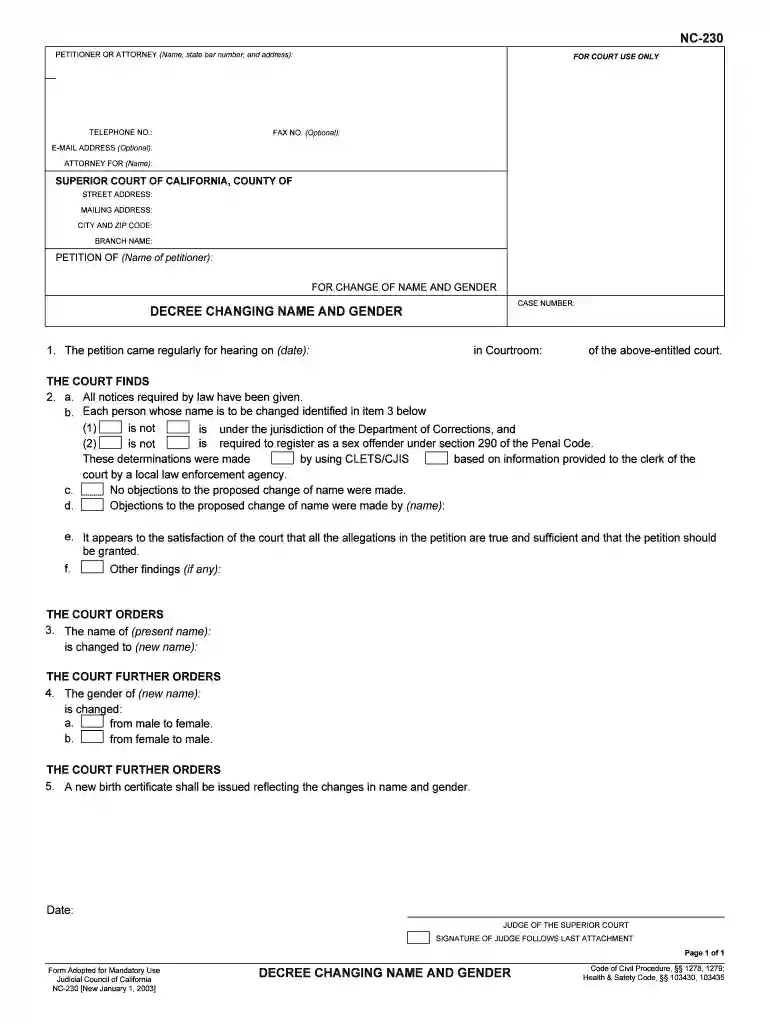
Form NC-230 is a legal petition form utilized in the Superior Court of California. This form is specifically designed for individuals seeking a change of name and gender. It outlines the necessary court findings, such as notice requirements and objections, before the court orders the change. Additionally, the form includes provisions for issuing a new birth certificate that reflects these changes. As part of the legal system's framework, the form ensures procedural compliance with identity reconfirmations within the state legal architecture.
Using form NC-230 involves a structured legal process governed by specific court requirements. The petitioner must complete the form with accurate current personal details and the desired new name and gender. After filling out the necessary information, the form is submitted along with supporting documents required by the court. The process also involves notifying relevant authorities and potentially attending a court hearing for approval. It is essential to double-check for accuracy and completeness to prevent delays or denial of the application.
Form NC-230 can be acquired from the California Superior Court's website. Alternatively, individuals may visit their local court clerk's office to request a physical copy. For those who prefer digital formats, downloadable versions are often available in PDF, ensuring that individuals can fill out and submit the form online. Various online legal aid platforms also provide access to this form, frequently including guidelines and checklists to assist in the completion process.
Form NC-230 is predominantly used by individuals in California who wish to legally change their name and gender. This form aligns with the transitioning needs of transgender individuals requiring formal recognition of their gender identity. However, it can also be used by anyone within the jurisdiction of the California Superior Court seeking a name and gender change for various reasons, such as personal preference or cultural assimilation.
The legal use of form NC-230 is strictly to initiate a legal change of name and gender through the Superior Court of California. This process establishes a new identity for all civil records, ensuring consistency across personal documents, including birth certificates and identification. Adhering to the legal framework, this form is recognized under Californian law, providing a legitimate method for personal identity change.
In California, specific rules govern the usage of form NC-230, including:
Consider an example of an individual transitioning and needing to align their legal documents with their gender identity. By using form NC-230, the person can petition the court to update their legal documents, thus reducing stress and complications associated with incongruencies in identification. Similarly, individuals desiring a name change for personal reasons, such as cultural or linguistic integration, can use this form to ensure legal recognition of their new status across all official records.
We've got more versions of the form nc230 form. Select the right form nc230 version from the list and start editing it straight away!
At DocHub, your data security is our priority. We follow HIPAA, SOC2, GDPR, and other standards, so you can work on your documents with confidence.
Nov 10, 2021 Applicants will bring form NC-330 for a gender change or NC-230 for an additional name change that the judge will sign if he approves of the
Decree Changing Name and Order Recognizing Change of Gender and for Issuance of New Birth Certificate (form NC-230) (fill out the boxes at the top and items 3
Jun 14, 2012 To avoid the result compelled by our precedents, the majority has endeavored to superimpose the amended Tort Claims Actand thus a more limited


