




01. Edit your form online
Type text, add images, blackout confidential details, add comments, highlights and more.

Type text, add images, blackout confidential details, add comments, highlights and more.

Draw your signature, type it, upload its image, or use your mobile device as a signature pad.

Send it via email, link, or fax. You can also download it, export it or print it out.
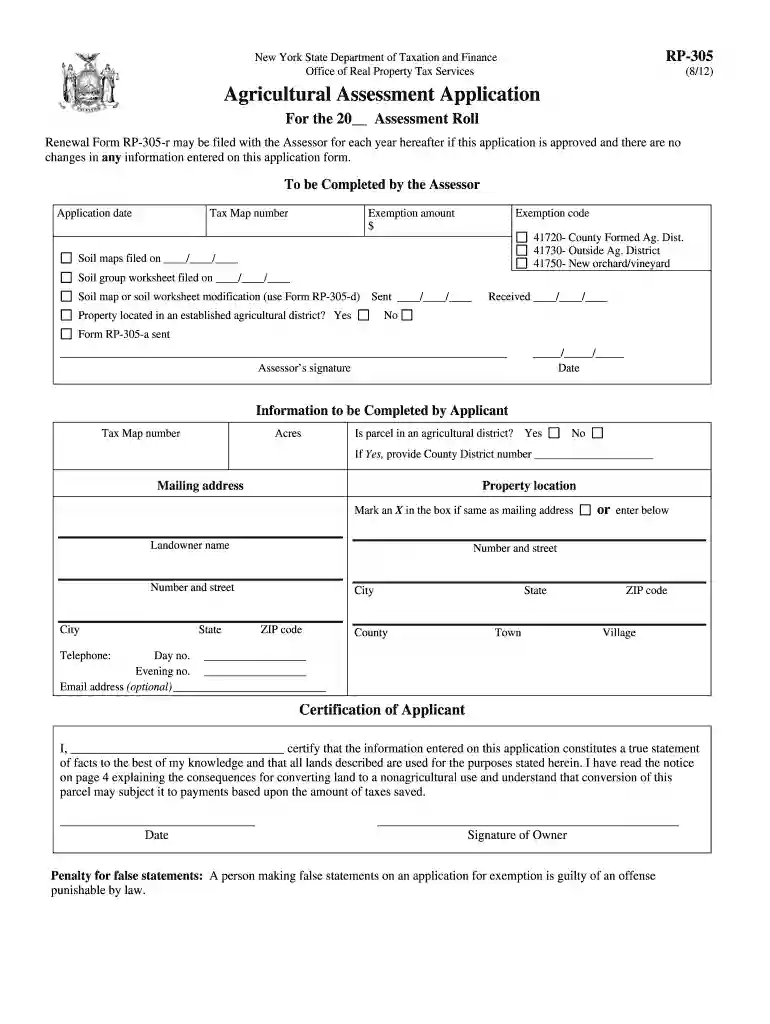
The Agricultural Assessment Program in New York is designed to provide tax benefits to landowners who actively use their land for agricultural purposes. This program allows eligible properties to be assessed based on their agricultural value rather than their market value, often resulting in significant tax reductions for farmers and landowners who qualify. The key objective of this initiative is to preserve agricultural land by making farming operations more financially viable.
Eligibility Requirements: The land must be used for agricultural purposes, and the owner needs to demonstrate a minimum gross sales value from agricultural production. This usually involves submitting detailed records of sales, production types, and acreage used for farming.
Filing Instructions: Applicants must complete the RP-305 form, which includes providing information about the land's current use, ownership details, and corroborating financial documents.
Utilizing the Agricultural Assessment Program Update involves understanding the updates or changes to current rules, requirements, and benefits associated with the program.
Review Updates: Regularly check for updates in state regulations or changes in assessment protocols that can affect your eligibility or tax savings.
Consult with an Expert: It might be beneficial to seek advice from agricultural tax professionals who can provide insights on how updates affect your specific situation.
Implement Changes: Adjust your documentation and compliance practices based on updated guidelines to maintain eligibility and maximize benefits.
Completing the RP-305 form is a structured process that requires attention to detail and accurate information.
Gather Required Documents: Ensure you have all necessary paperwork, including proof of land ownership, sales records, and any previous assessment notices.
Fill Out Land Details: Provide detailed information regarding the land's use, size, and production types. Include any historical data that supports the claim for agricultural use.
Financial Information: Enter your gross sales and any other financial details as specified. Ensure accuracy to avoid potential penalties for false reporting.
Submit the Form: Mail or submit the form electronically, if available, to the New York State Department of Taxation and Finance before the stipulated deadline.
Utilizing the Agricultural Assessment Program must align with legal statutes to prevent misuse and ensure compliance with state laws.
Compliance Checks: The state may conduct audits or field checks to verify that the land is being used as claimed. Proper documentation and records must be maintained and readily available.
Penalties for False Statements: Providing misleading or false information can result in retroactive tax liabilities, penalties, or legal consequences involving heavy fines.
Understanding the program's integral components is essential for successful participation.
Application Process: The application must be filed annually to continue receiving benefits. Missing a filing period may result in a lapse of the assessment.
Assessment Re-evaluation: The value assessment can change based on land use adjustments or modifications in the state’s valuation benchmarks.
State Regulations: Adherence to New York state rules is vital, including recognizing any jurisdictional differences within counties.
Landowners must meet specific criteria to qualify for the program:
Minimum Acreage: Generally, farms with at least seven acres in production are eligible if they have generated a minimum gross income from sales.
Duration of Use: The land should be consistently used for agricultural purposes for several years, reflecting stable farming or production activity.
Landowner's Intent: Some flexibility might be available for land changes if the owner maintains agricultural production’s primary focus.


New York has specific rules and requirements which differ from other states, focusing on preserving agricultural heritage while supporting economic sustainability for farmers.
Renewal Requirement: An annual renewal is required, and eligibility must be reassessed regularly.
Zoning Implications: Certain zoning laws may impact eligibility; therefore, staying informed about local zoning regulations is critical.
Timely submission of the necessary forms is crucial for securing tax benefits under the program.
Annual Deadline: Typically, forms should be submitted by March 1 of each tax year, allowing the New York State Department of Taxation and Finance time to process evaluations.
Late Submission Consequences: Missing the deadline may mean losing out on the tax benefits for that year and needing to wait until the following cycle.
Understanding real-world scenarios helps illustrate how the Agricultural Assessment Program impacts landowners.
Family Farms: Often use the program to ensure property taxes remain affordable, facilitating generational land transfer and continuous operation without incurring increased tax burdens.
Large-Scale Operations: May benefit significantly from tax reductions, which can be reinvested into sustainable farming practices or technological upgrades.
Through effective use and comprehension of the Agricultural Assessment Program, landowners can optimize their agricultural ventures’ financial aspects while contributing to preserving New York's agricultural landscape.
We've got more versions of the AGRICULTURAL ASSESSMENT PROGRAM UPDATE - tax ny form. Select the right AGRICULTURAL ASSESSMENT PROGRAM UPDATE - tax ny version from the list and start editing it straight away!
At DocHub, your data security is our priority. We follow HIPAA, SOC2, GDPR, and other standards, so you can work on your documents with confidence.
During the term of a plan, a bank may request the Board to approve an amendment to the plan on grounds that there has been a material change in circumstances.
Sep 3, 2025 The Agricultural Districts Law allows reduced property tax bills for land in agricultural production by limiting the property tax assessment of such land.
The consequence of a conversion is a payment based on five times the taxes saved in the most recent year of benefit. The payment also includes a six percent


