Instructions for south carolina sellers affidavit nonresident seller withholding code section 12 8 5 2026

Get Form
instructions for south carolina sellers affidavit nonresident seller withholding code section 12 8 5 Preview on Page 1

Here's how it works

01. Edit your form online
Type text, add images, blackout confidential details, add comments, highlights and more.

02. Sign it in a few clicks
Draw your signature, type it, upload its image, or use your mobile device as a signature pad.

03. Share your form with others
Send it via email, link, or fax. You can also download it, export it or print it out.

Definition and Purpose

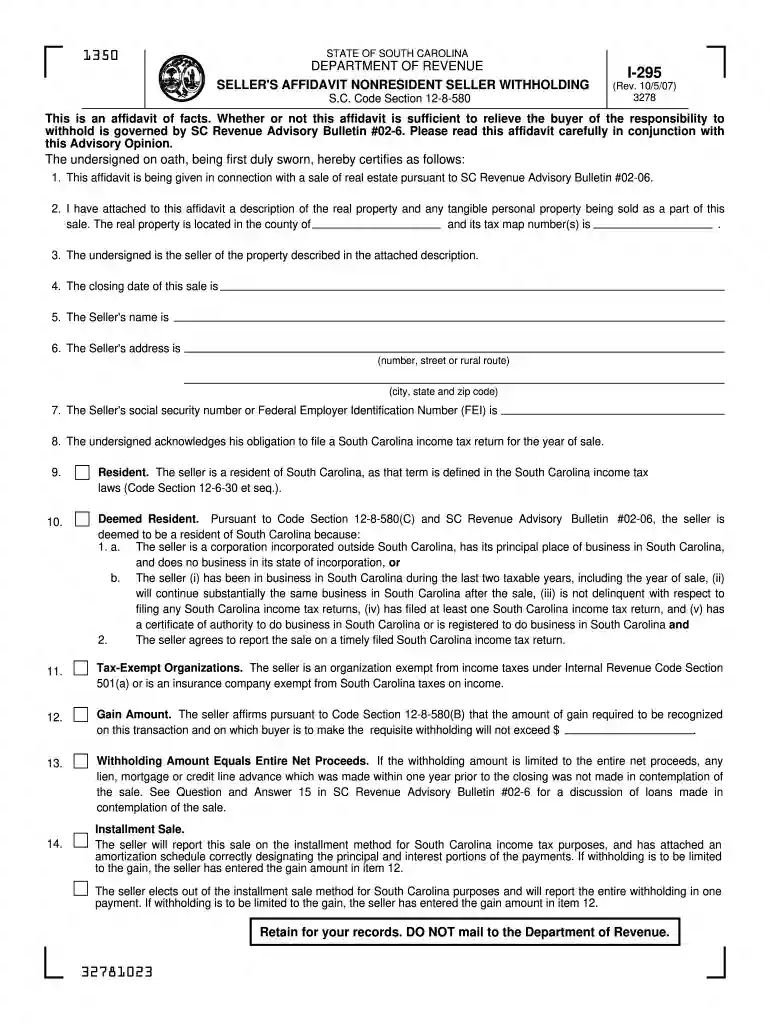
The Seller's Affidavit for Nonresident Seller Withholding is used in South Carolina to certify real estate sellers' tax obligations. It outlines the conditions under which sellers are subject to or exempt from withholding taxes under South Carolina Code Section 12-8-5. This affidavit ensures compliance with state tax laws by having nonresident sellers disclose necessary information about the sale of real estate. The document includes critical details such as property description, seller identification, and applicable declarations related to tax withholdings.

Steps to Complete the Seller's Affidavit

  1. Gather Required Information:

    • Collect details about the property being sold, including address and legal description.
    • Compile personal and contact information for all sellers involved in the transaction.
  2. Complete Seller Identification:

    • Fill in personal data fields for each nonresident seller. Ensure Social Security Numbers or Federal Employer Identification Numbers are accurate to avoid complications.
  3. Declare Exemptions:

    • Indicate if any exemptions apply under South Carolina law that might release you from withholding obligations. Provide documentation if applicable.
  4. Affirm Tax Obligations:

    • Clearly state whether withholding tax is to be applied according to code section 12-8-5. Include any calculations or references that justify the withholding amount.
  5. Sign and Notarize:

    • Ensure signatures from all sellers and secure notarization of the document to affirm its legitimacy.
  6. Submit the Completed Affidavit:

    • File the affidavit with the appropriate South Carolina tax authority or include it in the conveyance documents during the closing process for real estate transactions.

Key Legal Terms

  • Nonresident Seller: A seller who does not reside within South Carolina state boundaries but is involved in the sale of property located in the state.
  • Withholding Tax: The portion of the transaction proceeds withheld to cover the expected tax liabilities that the nonresident seller owes to South Carolina.
  • Exemption: A condition where withholding tax is not required, such as in cases where the sale amount is beneath a specified threshold or the seller is reporting a loss.

Important Dates and Deadlines

  • Filing Deadline: The affidavit should be filed promptly during the closing of the property transaction, as dictated by real estate and tax closing schedules.
  • Tax Payment Due Date: Any withholding tax determined to be due must also be submitted in a timely manner, as late compliance may result in penalties.

How to Obtain the Form

  • Online Access: The form can typically be downloaded from the South Carolina Department of Revenue's website or requested via email.
  • In-Person Pickup: Visit a local tax office or real estate documentation center for a physical copy if preferred.

Who Uses This Affidavit

  • Real Estate Agents: Facilitate the transaction and ensure compliance by guiding nonresident sellers through the legal requirements.
  • Nonresident Sellers: Individuals or entities selling South Carolina property who must certify their tax status.
  • Attorneys and Legal Advisors: Provide legal guidance on the completion and submission of the affidavit to ensure full compliance.

State-Specific Rules and Regulations

  • South Carolina Code Compliance: Familiarize yourself with local tax laws specifically governing nonresident sellers to understand which transactions trigger withholding obligations.
  • Exemptions and Thresholds: Pay attention to South Carolina-specific exemptions or financial thresholds that may alleviate withholding liabilities.

Penalties for Non-Compliance

  • Financial Penalties: Failure to submit the proper withholding or incorrect affidavit details may result in fines or legal actions, affecting both sellers and real estate facilitators.
  • Interest Accruals: Any withholding amounts unpaid or deferred due to non-compliance can accrue interest, leading to increased financial burdens.

Real-World Scenarios and Case Studies

  • Example 1: LLC Sale: A Limited Liability Company based out-of-state sells property in South Carolina and uses the affidavit to report all entity members' information for tax purposes.
  • Example 2: Property Inheritance: An out-of-state heir sells inherited property. Proper use of the affidavit ensures tax compliance without unnecessary withholding given the documented exemptions.

Eligibility and Compliance Guidelines

  • General Eligibility: Every nonresident seller involved in a South Carolina property sale must complete the affidavit unless entirely exempt.
  • Compliance Verification: Engaging a tax professional for a review can prevent errors and ensure all affidavit data complies with South Carolina tax statutes.

By following these detailed sections and guidance, sellers and facilitators can effectively navigate the requirements of the South Carolina Seller's Affidavit for Nonresident Seller Withholding.

See more instructions for south carolina sellers affidavit nonresident seller withholding code section 12 8 5 versions

We've got more versions of the instructions for south carolina sellers affidavit nonresident seller withholding code section 12 8 5 form. Select the right instructions for south carolina sellers affidavit nonresident seller withholding code section 12 8 5 version from the list and start editing it straight away!
Versions Form popularity Fillable & printable
2022 4.8 Satisfied (75 Votes)
2019 4.8 Satisfied (114 Votes)
2015 4.4 Satisfied (407 Votes)
2010 4 Satisfied (47 Votes)
2007 4 Satisfied (48 Votes)
2001 4 Satisfied (45 Votes)
be ready to get more

Complete this form in 5 minutes or less

Get form

Got questions?

We have answers to the most popular questions from our customers. If you can't find an answer to your question, please contact us.
Contact us
The IRS requires 15% of the sales price be withheld on the sale of United States real property interests by foreign persons (on sales above $1,000,000), and either 15% or 10% on sales between $300,001 and $1,000,0000, and either 15% or $0 for sales of $300,000 and under.
A nonresident individual receiving South Carolina income from wages, rental property, businesses, or other investments in South Carolina, must file an SC1040 South Carolina Individual Income Tax Return and Schedule NR Nonresident Schedule.
South Carolina Code Section 12-8-580 mandates that anyone purchasing real property in South Carolina from a nonresident Seller must withhold seven percent (7%) of the gain recognized on the sale by the nonresident Seller.
The withholding amount is 7% of the amount realized on the sale by a nonresident individual, partnership, trust, or estate, or 5% of the amount realized on the sale by a nonresident corporation or any other nonresident entity, if the seller does not provide the buyer with a Sellers Affidavit stating the amount of gain
(A) A person hiring or contracting with a nonresident conducting a business or performing personal services of a temporary nature within this State shall withhold two percent of each payment in which the South Carolina portion of the contract exceeds or could reasonably be expected to exceed ten thousand dollars.

Security and compliance

At DocHub, your data security is our priority. We follow HIPAA, SOC2, GDPR, and other standards, so you can work on your documents with confidence.

Learn more
ccpa2
pci-dss
gdpr-compliance
hipaa
soc-compliance

People also ask

How to fill out affidavit of sellers gain? To fill out an affidavit of sellers gain, the seller needs to provide details such as the sale price, purchase price, property details, and calculations of the gain realized.
Most types of U.S. source income received by a foreign person are subject to U.S. tax of 30%. A reduced rate, including exemption, may apply if an Internal Revenue Code Section provides for a lower rate, or there is a tax treaty between the foreign persons country of residence and the United States.
While the sales tax is imposed on retail sales in South Carolina, it is supplemented by the use tax which is imposed on all purchases of tangible personal property from out-of-state retailers for use, storage or consumption in South Carolina, and includes purchases made via the Internet, catalogs or while visiting

Related links