







Definition & Meaning
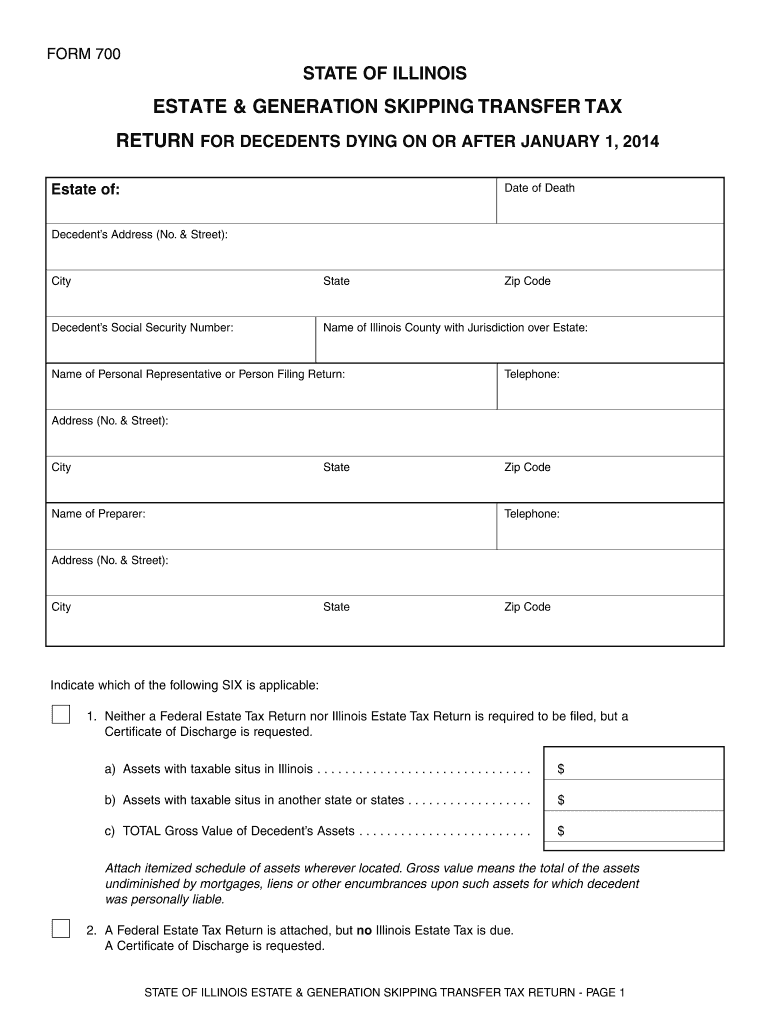
The Illinois Form 700 for 2014 is known as the Illinois Estate & Generation Skipping Transfer Tax Return. This document is used to report the estate's value and calculate taxes due for estates of decedents who passed away on or after January 1, 2014. It includes information on the decedent's assets, any applicable deductions, and credits that affect the taxable estate. This form is crucial for estate representatives to submit timely to comply with state tax obligations.
How to Obtain the Illinois Form
Estate executors can access Illinois Form 700 for 2014 through the Illinois Department of Revenue's website. The form is generally available for download in PDF format, ensuring ease of access and printability. If internet access is not an option, one might contact the department via phone to request a physical copy.
- Available from the Illinois Department of Revenue
- Downloadable as a PDF
- Alternative: physical copies via direct request from the department
Steps to Complete the Illinois Form
Completing Illinois Form 700 involves several steps that require careful attention to detail. The form must accurately reflect the total value of the estate and any associated liabilities.
-
Collect Necessary Information:
- Gather all documents related to the decedent's assets, liabilities, and prior tax returns.
-
Calculate the Gross Estate Value:
- Include all assets such as real estate, financial accounts, and personal property.
-
Determine Deductions and Credits:
- Identify applicable deductions that reduce the taxable estate, like liabilities, funeral expenses, and charitable contributions.
-
Complete the Form Sections:
- Fill out sections for resident or non-resident decedents and detail assets and liabilities.
-
Review and Submit:
- Double-check for accuracy, sign the form, and submit it according to the filing instructions provided.
Key Elements of the Illinois Form
Illinois Form 700 is composed of several key sections that must be filled out thoroughly and accurately.
-
Decedent Information:
- Name, address, date of death, and social security number.
-
Estate Computation:
- Detailed breakdown of all estate assets and liabilities.
-
Taxable Estate Calculation:
- Final calculation after applying deductions and credits.
-
Declaration and Signature:
- Certification of the form's accuracy by the person responsible for filing.
Filing Deadlines / Important Dates
Understanding the deadlines for filing Illinois Form 700 is critical to avoid penalties.
-
Standard Filing Deadline:
- The return is typically due within nine months following the decedent's date of death.
-
Extension Requests:
- Extensions may be filed if additional time is needed, but interest will accrue on any unpaid tax.
-
Payment of Taxes:
- Payment is due concurrently with the form to avoid interest and penalties.
Penalties for Non-Compliance
Failing to file Illinois Form 700 by the deadline, or making errors, can result in penalties.
-
Late Filing Penalty:
- A percentage of the tax due may be added to the liability for each month the return is late.
-
Interest on Unpaid Tax:
- Interest may accumulate from the due date until the tax is paid in full.
-
Accuracy Related Penalties:
- Substantial understatements or inaccuracies can result in additional fines.
Legal Use of the Illinois Form
Illinois Form 700 must be used in compliance with legal obligations surrounding estate tax calculations.
-
Compliance with State Laws:
- Adheres to the Illinois state requirements for estate tax reporting.
-
Ensures Accurate Tax Calculation:
- Proper use ensures the correct amount of tax is paid, based on true asset values.
Form Submission Methods
Illinois Form 700 offers several submission methods to accommodate diverse executor needs.
-
Mail:
- Traditional method requiring physical delivery of the form to the Illinois Department of Revenue.
-
In-Person:
- Delivery directly to a regional office, which may be preferred for those needing immediate confirmation of filing.
-
Online:
- May be available through the Illinois Department of Revenue's electronic filing system for ease and timeliness.
By understanding each of these aspects, executors can effectively complete and submit the Illinois Form 700 for 2014, ensuring compliance with state tax obligations and accurately representing the decedent's estate.




