
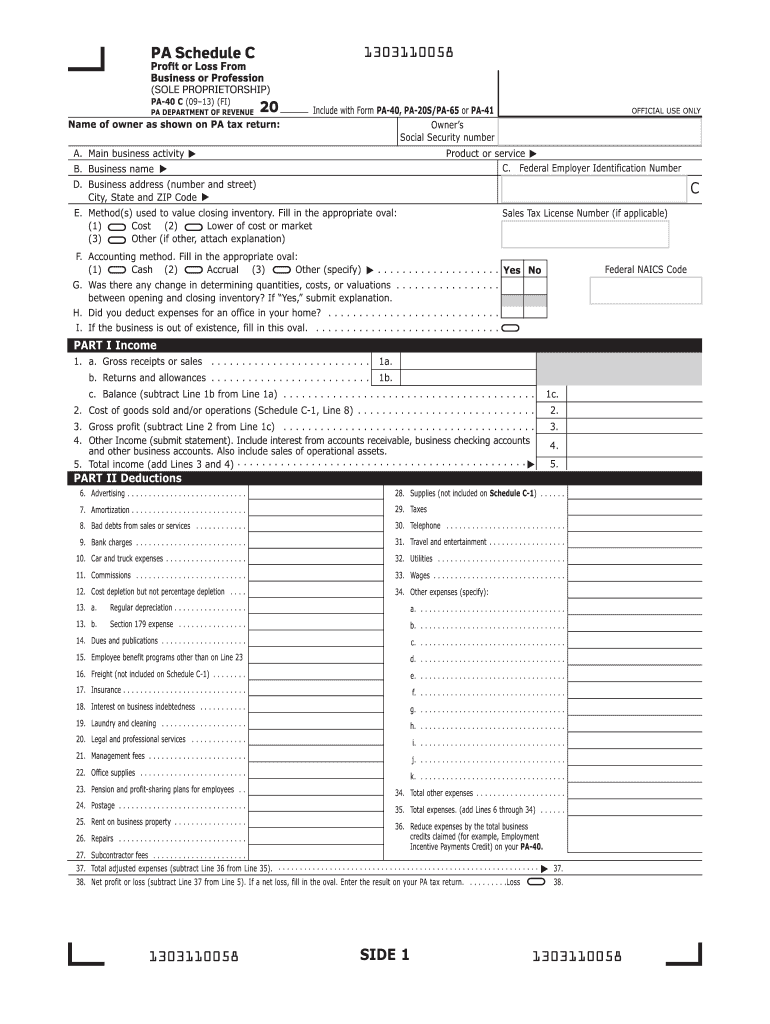







Definition & Meaning
The Schedule C form is primarily used by sole proprietors to report income and expenses from their own businesses. The form details the profit or loss from operating a business profession as a self-employed individual. The Schedule C Profit and Loss 2013 form specifically applies to the fiscal year 2013, adhering to the regulations and tax codes in effect during that year. It plays a crucial role in the IRS filing process for business earnings, requiring detailed accounts of income and deductions to determine net earnings.
Key Components
- Gross Receipts or Sales: The total income generated from goods sold or services provided.
- Cost of Goods Sold: Calculation of the cost related to the production of goods sold.
- Expenses: Includes a wide range of deductible business expenses like rent, wages, and utilities.
- Net Profit or Loss: The final figure comes after subtracting all deductible expenses from total sales.
How to Use the Schedule C Profit and Loss 2013 Form
Using the Schedule C form involves understanding its sections to correctly report business activities. The form provides a structured breakdown for recording income and deductible expenses to determine the profit or loss.
Step-by-Step Process
-
Start with Part I: Income
- Enter gross receipts or sales.
- Include returns and allowances if applicable.
-
Proceed to Part II: Expenses
- List business expenses like advertising, insurance, and repairs.
-
Calculate Part III: Cost of Goods Sold
- Detailed accounting of inventory and costs required to produce goods.
-
Determine Net Profit or Loss
- Subtract total expenses from gross income.
Steps to Complete the Schedule C Profit and Loss 2013 Form
Filing the Schedule C form requires careful attention to detail in documenting the business's financial transactions for the year.
Detailed Steps
-
Gather Necessary Records
- Collect records of sales, expenses, receipts, and previous year's return.
-
Complete Basic Information
- Fill in business name, employer ID, and accounting method used.
-
Enter Income Information
- Record all sources of business income under the 'Income' section.
-
Calculate Total Expenses
- Deductible business expenses need thorough documentation and entry.
-
Final Calculations
- Compute the profit or loss by subtracting total expenses from total income.
Important Terms Related to Schedule C Profit and Loss 2013 Form
Understanding the terminology used within Schedule C is pivotal for accurate completion.
Relevant Terms
- Self-Employment Tax: Tax imposed on self-employed individuals for Social Security and Medicare.
- Ordinary and Necessary Expenses: Costs that are typical and required for the business's operation.
- Depreciation: Deduction related to the gradual loss in value of business assets over time.
Required Documents
Compiling a comprehensive set of documents facilitates accurate and substantiated Schedule C filings.
Essential Documents
- Income Statements: To detail all business revenues.
- Expense Receipts: Proof of deductible business expenses.
- Bank Statements: For cross-verifying financial data.
Business Types that Benefit Most from Schedule C Profit and Loss 2013 Form
While the form can be used widely, it is particularly beneficial for certain business types.
Beneficiary Business Types
- Self-Employed Individuals: Typically include freelancers and independent contractors.
- Sole Proprietorships: Single-owner businesses without formal registration.
IRS Guidelines
The Schedule C form is governed by specific IRS guidelines to ensure compliance and accuracy.
Compliance Rules
- Accurate Record-Keeping: Must maintain reliable records throughout the year.
- Adherence to Filing Deadlines: The form should be submitted with Form 1040 by April 15th unless an extension is filed.
Penalties for Non-Compliance
Failure to adhere to Schedule C requirements can lead to significant penalties.
Potential Penalties
- Late Filing Fees: Assessed for submissions past the deadline without an approved extension.
- Interest on Unpaid Taxes: Accrues if tax payments are delayed.
Digital vs. Paper Version
Taxpayers can choose between digital and paper versions according to their preferences for Schedule C filings.
Advantages of Each
- Digital Version: Offers convenience and often includes built-in error-checking.
- Paper Version: Preferred by individuals who maintain physical records or lack digital access.
Software Compatibility
The Schedule C form is compatible with multiple software programs designed to facilitate tax filing.
Popular Software Options
- TurboTax: Guides users through the form with easy step-by-step instructions.
- QuickBooks: Integrates business accounting with tax filing for streamlined reporting.


