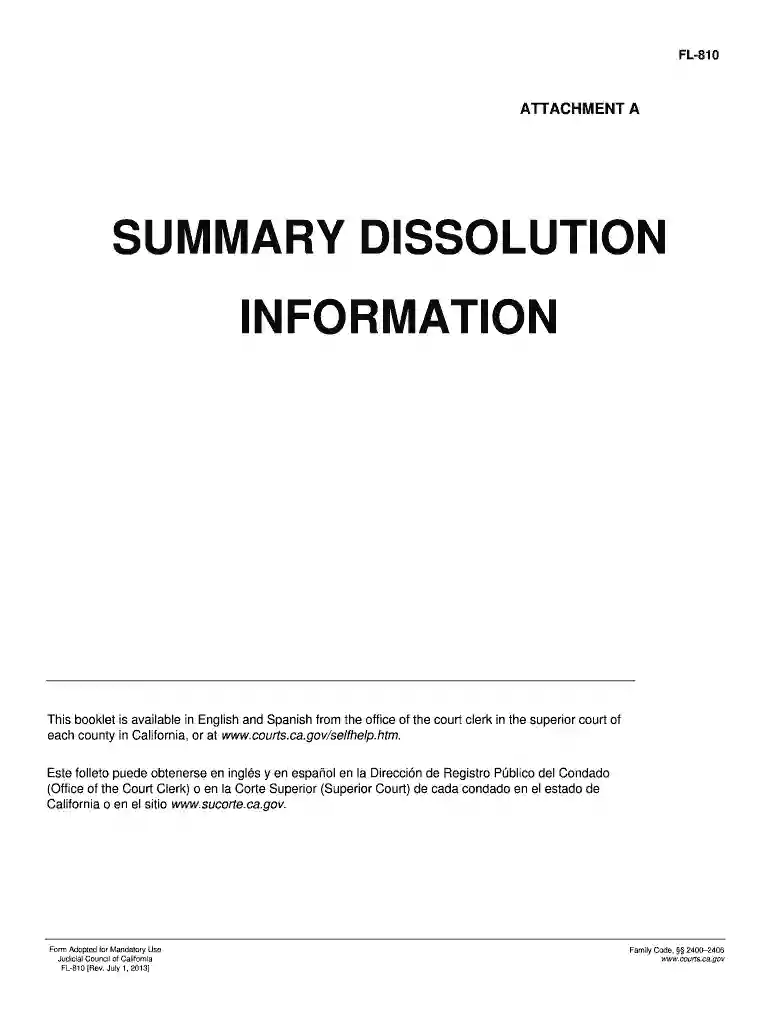
Fl 810 2013 form-2026

Get Form
fl 810 2013 form Preview on Page 1

Here's how it works

01. Edit your form online
Type text, add images, blackout confidential details, add comments, highlights and more.

02. Sign it in a few clicks
Draw your signature, type it, upload its image, or use your mobile device as a signature pad.

03. Share your form with others
Send it via email, link, or fax. You can also download it, export it or print it out.

Definition & Meaning

The FL form is specifically designed to assist individuals in California who are seeking to end their marriage or domestic partnership through a simplified legal process known as summary dissolution. This form is part of a larger framework of legal documents intended to streamline the dissolution process by providing clear eligibility criteria and procedural guidance. Summary dissolution is intended for couples who meet certain conditions, such as a short marriage duration and no dependent children, which simplifies legal proceedings by avoiding more complex litigation.

Key Elements of the FL Form

The FL form contains essential sections that gather critical information necessary for applying for summary dissolution. Important elements include:

  • Eligibility Criteria: This section requires the applicants to confirm specific conditions, such as the absence of children and a marriage duration of less than five years.
  • Acknowledgment of Agreement: Both parties must agree to terms including the division of property and debt.
  • Signature and Notarization: The form must be duly signed by both parties, often requiring notarization to verify authenticity.

Eligibility Criteria

Use of the FL form is subject to strict eligibility criteria to ensure that only qualified individuals can access the summary dissolution process. Important conditions include:


  • No Minor Children: Couples must not have any biological or adopted children together under the age of 18.
  • Marriage Duration: The marriage or domestic partnership must have lasted no longer than five years.
  • Property and Debt Limits: Community property and debt must fall within specific limits set by California law.
decoration image ratings of Dochub

How to Use the FL Form

Filing for summary dissolution using the FL form involves several steps. Here’s how you can effectively utilize the form:

  1. Obtain the Form: Download the FL-810 form from the California Courts website or obtain it from a local family law facilitator.
  2. Complete Personal Information: Enter details such as names, addresses, and dates of the marriage or domestic partnership.
  3. Verify Eligibility Criteria: Confirm that all eligibility requirements are met in accordance with laws outlined on the form.
  4. Acknowledge Agreement: Both parties should read and agree to the terms within the form, which should encompass aspects such as property division.
  5. Sign and Notarize: Have both parties sign the form in front of a notary.

Steps to Complete the FL Form

The completion of the FL form involves multiple sequential steps:

  1. Filling Out Personal Details: Provide full information of both parties involved, including legal names and contact information.
  2. Assess Property and Debts: Evaluate and declare any shared assets and debts, ensuring they fall within regulatory limits for summary dissolution.
  3. Agreement to the Terms: Confirm understanding and acceptance of terms regarding waiver of rights and responsibilities.
  4. Finalize with Signatures: Collect signatures of both applicants with necessary notarization to authenticate the form.

Legal Use of the FL Form

The FL form serves as a legal instrument under California law, facilitating a binding and legally recognized termination of a marriage or domestic partnership when processed successfully. It operates under the purview of family law and is an alternative to more traditional divorce proceedings. As it follows strict eligibility criteria and legal guidelines, correct adherence is crucial for the legal validity of the process.

Important Terms Related to FL Form

Understanding key legal concepts associated with the FL form is essential for proper usage. Some critical terms include:

  • Summary Dissolution: A simplified legal procedure for ending a marriage or domestic partnership that meets specific criteria.
  • Community Property: Assets acquired during the marriage that are considered jointly owned and subject to division.

State-Specific Rules for the FL Form

California imposes unique rules governing the use of the FL form for summary dissolution, reflecting its commitment to streamlining the dissolution process for qualifying couples. Examples of these rules include:

  • Residency Requirements: Applicants must be residents of California.
  • Financial Thresholds: Specific limits on the value of jointly owned property and debts are enforced to qualify for summary dissolution.

Form Submission Methods (Online / Mail / In-Person)

Submitting the completed FL form can be done through various channels:

  • In-Person: Deliver the form to the clerk’s office at your local family court.
  • Mail: Send the completed and signed form along with any applicable fees via postal service.
  • Online Filing: Depending on the court's capabilities, electronic submission may be available, providing a convenient and efficient alternative.

Who Typically Uses the FL Form

The FL form is primarily used by individuals in California who meet all eligibility requirements for summary dissolution. Typically, it is utilized by parties seeking a more straightforward dissolution process without the complexities of traditional divorce, often due to brief marriages, lack of children, and limited shared property. The form allows them to navigate legal dissolution without engaging in prolonged or contentious proceedings, offering a streamlined alternative that respects their legal rights while minimizing time and cost.

decoration image

See more fl 810 2013 form versions

We've got more versions of the fl 810 2013 form form. Select the right fl 810 2013 form version from the list and start editing it straight away!
Versions Form popularity Fillable & printable
2024 4.6 Satisfied (48 Votes)
2021 4.8 Satisfied (31 Votes)
2015 4.3 Satisfied (184 Votes)
2013 4.4 Satisfied (150 Votes)
be ready to get more

Complete this form in 5 minutes or less

Get form

Got questions?

We have answers to the most popular questions from our customers. If you can't find an answer to your question, please contact us.
Contact us
A summary dissolution is an easier way to get divorced or end a domestic partnership. Its less expensive and theres not as much paperwork as the standard divorce process. Not everyone can use this process, but if you qualify, it may be a simpler process for you to end your marriage or domestic partnership.
JOINT PETITION FOR SUMMARY DISSOLUTION. (Family LawSummary Dissolution) Family Code, 299, 2109, 2320, 2400-2406. FL-800.
The main difference Both divorce and dissolution are ways to end a legally binding relationship; however the key difference between the two is that where divorce is for legally married couples, dissolution is usually for those in a civil partnership.
Dissolution is generally a quicker and easier way to end a marriage legally. In dissolution, only the spouses make the decisions, not the court. Issues that need to be resolved include: Division of assets and debts.
You will need to pay a fee ($435-$450) to the clerk when you file your forms. If you cant afford the fee, you can ask the clerk for a fee waiver. You qualify for a fee waiver if: You receive public benefits.

Security and compliance

At DocHub, your data security is our priority. We follow HIPAA, SOC2, GDPR, and other standards, so you can work on your documents with confidence.

Learn more
ccpa2
pci-dss
gdpr-compliance
hipaa
soc-compliance

People also ask

A dissolution is faster and may be less expensive than divorce. You can end your marriage in about 1 to 3 months after filing. However, if you and your spouse start to disagree about any of the terms after you file, you must start over with a new dissolution or divorce.

Related links