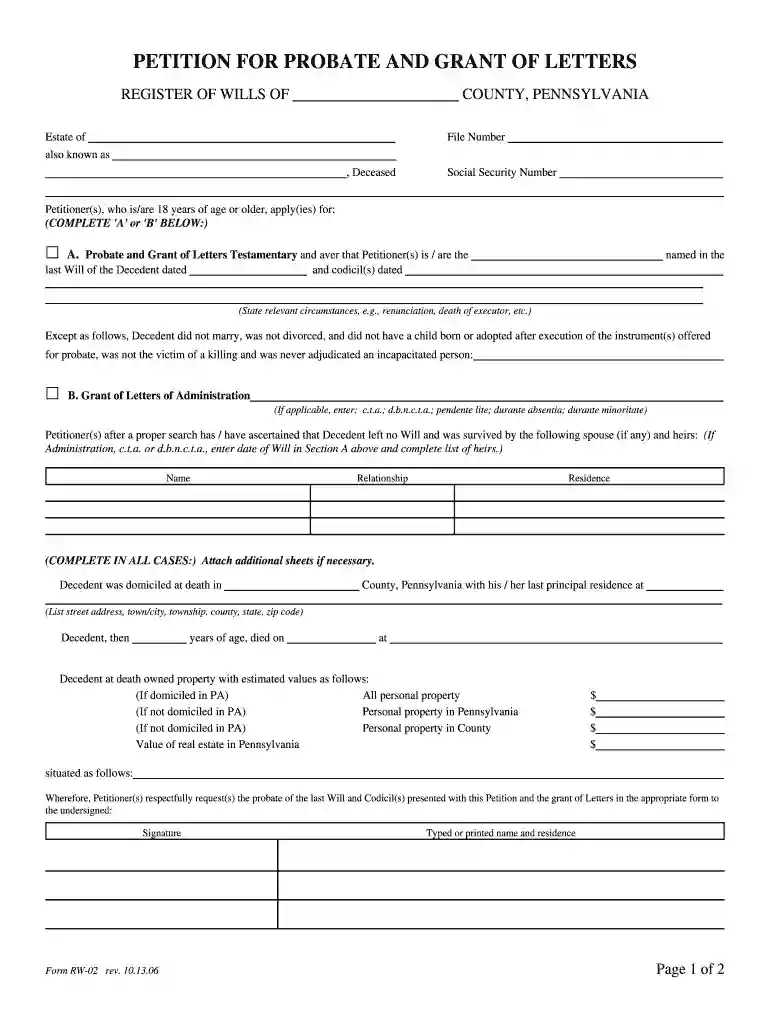
Form RW-02 - rev 10-13-06 - Petition for Probate and Grant of Letters 2026

Get Form
Form RW-02 - rev 10-13-06 - Petition for Probate and Grant of Letters Preview on Page 1

Here's how it works

01. Edit your form online
Type text, add images, blackout confidential details, add comments, highlights and more.

02. Sign it in a few clicks
Draw your signature, type it, upload its image, or use your mobile device as a signature pad.

03. Share your form with others
Send it via email, link, or fax. You can also download it, export it or print it out.

Definition and Meaning of Form RW-02

Form RW-02 - rev 10-13-06 - Petition for Probate and Grant of Letters is used primarily in the context of probate court proceedings within the state of Pennsylvania. This legal document serves a dual purpose. It petitions for the probate of the decedent's last will and codicils, or, if no will exists, requests the appointment of an administrator to oversee the estate. The form requires detailed information about the decedent such as marital status, heirs, property values, and personal representative responsibilities. This document plays a crucial role in ensuring that the estate is settled in accordance with state laws and the decedent's wishes where applicable.

How to Use the Form RW-02

Initiating Probate or Administration

When an individual passes away, Form RW-02 is essential for initiating probate if a will exists or for appointing an estate administrator in the absence of a will. Begin by collecting all necessary details about the decedent's estate and relationships. Carefully fill out the form to provide accurate information that the court will need to either validate a will or appoint an administrator.

Filling Instructions

  • Decedent Information: This includes the full name, date of death, and last known address.
  • Marital and Heir Status: Details about surviving spouses and any children or other heirs.
  • Estate Details: Estimated value and description of the estate’s assets.
  • Representative Information: The individual requesting to manage the estate must provide personal details and indicate their relationship to the decedent.

Steps to Complete the Form RW-02

Completing the Form RW-02 requires attention to detail and a methodical approach. The following steps can guide you through this process:

  1. Gather Required Information: Collect the decedent's personal and estate details, including a copy of the death certificate and any existing will.
  2. Complete Personal Sections: Fill in personal data regarding the decedent and potential heirs.
  3. Detail the Estate: Accurately estimate the value of the estate, including all properties and financial assets.
  4. Legal Affirmations: Ensure you meet any legal affirmations or notarizations required by Pennsylvania law—typically involving signatures by the petitioner.
  5. Review and Submit: Double-check all entries for accuracy. Submit the form to the probate court, along with any supporting documents.

Key Elements of the Form RW-02

Form RW-02 includes several key components that must be accurately completed:

  • Personal and Estate Information: Critical to establishing the identity of both the decedent and the estate.
  • Information on Heirs: Determining rightful heirs is crucial for both probate proceedings and estate administration.
  • Representative Facts: Identifying who will take responsibility for managing the estate, including their qualifications and relationship to the decedent.

Required Documents for Form RW-02

Submitting the Form RW-02 necessitates accompanying documentation:

  • Death Certificate: Confirms the date and authenticity of the decedent’s passing.
  • Last Will and Testament (if available): Original copy necessary for probate validation.
  • Identification for Petitioner: Proof of identity for the individual petitioning probate or administration, such as a state-issued ID.

Legal Use of the Form RW-02

Probate Validation

Form RW-02 serves as the primary legal tool for probate validation. It provides the court with information needed to authenticate the decedent's will and execute their stated wishes.

Estate Administration

In cases where no will exists, this form is indispensable in appointing an executor to manage and distribute the estate according to Pennsylvania state law, ensuring lawful settlement of assets.

State-specific Rules for Form RW-02

In Pennsylvania, specific procedural rules govern the submission and processing of Form RW-02:

  • Jurisdiction Requirements: The form must be filed in the appropriate county court where the decedent resided.
  • Time Frame Constraints: Filing deadlines may vary; promptly filing is necessary to avoid penalty periods or delays in estate management.

Form Submission Methods

Traditionally vs. Electronically

The Form RW-02 can be submitted through various methods, though traditional submission via mail or in-person at the local county courthouse remains most common. Some jurisdictions may offer digital submissions through dedicated electronic legal filing systems, but this is contingent on the specific county’s technological infrastructure.

Penalties for Non-Compliance with Form RW-02

Failure to properly submit Form RW-02 can result in several legal inconveniences:

  • Delayed Estate Settlement: Non-compliance can delay the legal processing of the estate, causing financial strains to beneficiaries.
  • Fines or Legal Proceedings: Incorrect or fraudulent filing might incur fines or lead to further legal action against the petitioner.

By understanding and accurately applying the guidelines for Form RW-02, individuals can ensure a smooth probate process, safeguarding the decedent's wishes and lawful estate distribution.

See more Form RW-02 - rev 10-13-06 - Petition for Probate and Grant of Letters versions

We've got more versions of the Form RW-02 - rev 10-13-06 - Petition for Probate and Grant of Letters form. Select the right Form RW-02 - rev 10-13-06 - Petition for Probate and Grant of Letters version from the list and start editing it straight away!
Versions Form popularity Fillable & printable
2011 4.9 Satisfied (354 Votes)
2006 4 Satisfied (30 Votes)
be ready to get more

Complete this form in 5 minutes or less

Get form

Got questions?

We have answers to the most popular questions from our customers. If you can't find an answer to your question, please contact us.
Contact us
In Pennsylvania, it is only necessary to probate if the decedent owned assets, whether financial or real estate holdings, solely in their name which did not already have a beneficiary designated.
The process of settling an estate in Pennsylvania involves naming a personal representative, collecting estate assets, filing appropriate forms with the Register of Wills, notifying heirs, providing public notice, paying all debts and taxes, and distributing the remaining assets to heirs named in the will or under the
Furthermore, the personal representative generally cannot distribute assets until an order for final distribution has been granted at the end of a probate administration. There are circumstances in which assets may be distributed early. This is generally due to the needs of the decedents spouse and dependents.
The Petition for Probate of Will and Letters Testamentary is requesting for the court to validate the Will and formally appoint the Executor. Once this is done, the court authorizes the Executor to oversee the process of distributing assets and property to beneficiaries per the instructions provided in the Will.
In Pennsylvania, an estate needs to go through probate if its worth more than $50,000.

Security and compliance

At DocHub, your data security is our priority. We follow HIPAA, SOC2, GDPR, and other standards, so you can work on your documents with confidence.

Learn more
ccpa2
pci-dss
gdpr-compliance
hipaa
soc-compliance

People also ask

In Pennsylvania, you are not required to hire a lawyer for probate, but the process can be complex and time-consuming. To ensure all your legal bases are covered and required petitions and forms are filed in a timely manner, seeking the counsel of experienced probate and estate lawyers can be extremely helpful.
In summary, the primary difference between Letters of Administration and Letters Testamentary in California lies in whether there is a valid will. Letters of Administration are issued when there is no will, and an administrator is appointed to handle the estate ing to intestacy laws.

Related links