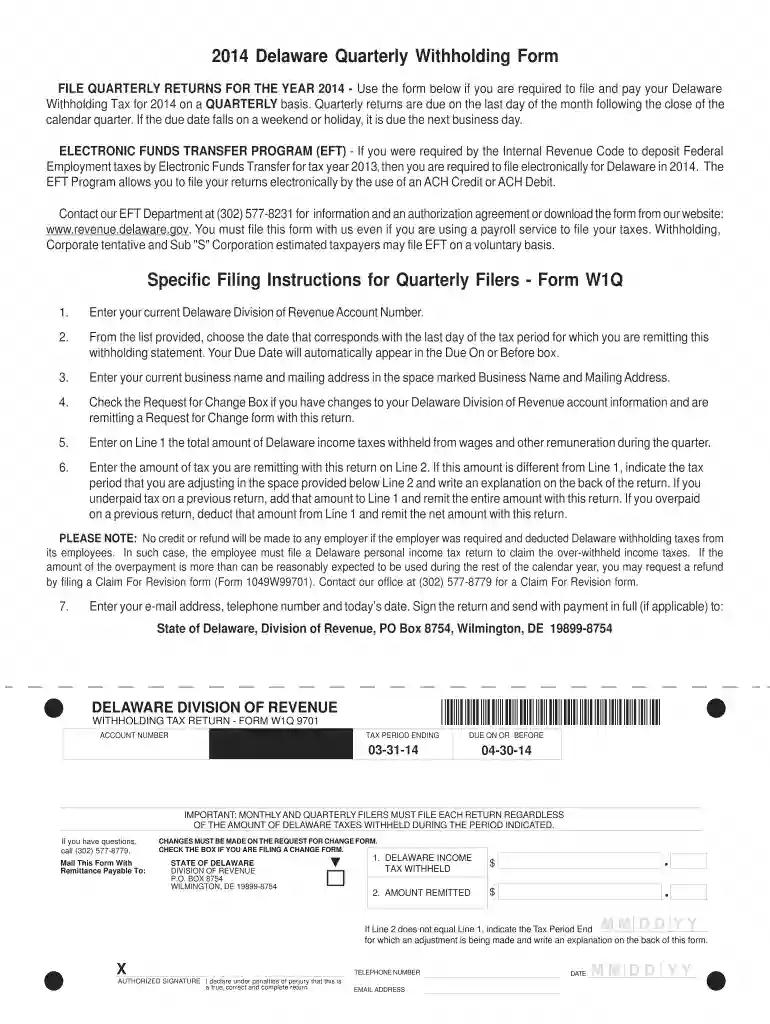
Definition and Purpose of the 2016 Delaware Quarterly Withholding Form W1Q 9701
The 2016 Delaware Quarterly Withholding Form W1Q 9701 is used by employers to report and remit Delaware state income tax withheld from employees' wages. This form helps ensure that the appropriate amount of tax is collected and submitted to the Delaware Division of Revenue. By accurately completing this form, employers fulfill their tax obligations and contribute to the state's revenue system, allowing for the proper allocation of state resources.
How It Works
- Employers must calculate the total state income tax withheld from employees' paychecks during the quarter.
- This information is summarized and reported on the form, along with any balance due remitted to the state.
- The form ensures that employers align with state regulations concerning taxation and payroll processing.
Steps to Complete the 2016 Delaware Quarterly Withholding Form W1Q 9701
- Gather Information: Collect all payroll records for the quarter, noting any state income tax withheld.
- Calculate Totals: Sum up the total amount of state tax withheld from employee wages.
- Enter Employer Details: Fill in the employer's name, address, federal EIN, and state withholding account number.
- Fill in Tax Information: Enter the calculated total of tax withheld on the designated line.
- Review and Submit: Carefully review all entries for accuracy before submitting the form and payment to the Delaware Division of Revenue.
Common Mistakes to Avoid
- Double-check calculations to prevent reporting errors that could result in penalties.
- Ensure that the employer’s details are current to avoid processing delays.
Filing Deadlines and Important Dates
Quarterly deadlines are crucial for timely submission of the W1Q 9701 form. For the 2016 tax year, the due dates are as follows:
- First Quarter: April 30
- Second Quarter: July 31
- Third Quarter: October 31
- Fourth Quarter: January 31 of the following year
Late Submission Consequences
- Late submissions can result in penalties or interest charges. Understanding these deadlines helps ensure compliance and minimizes potential fines.
Who Typically Uses the 2016 Delaware Quarterly Withholding Form W1Q 9701
This form is primarily used by Delaware-based employers who withhold state income tax from their employees. This includes:

- Small businesses
- Large corporations
- Nonprofits with payroll obligations in Delaware
Key Considerations
- Employers must be registered with the Delaware Division of Revenue to file this form.
- Employers with no tax to report must still file the form, indicating a zero balance, to maintain compliance records.
Legal Use of the 2016 Delaware Quarterly Withholding Form W1Q 9701
Compliance with withholding tax laws is crucial for businesses operating in Delaware. The W1Q 9701 is vital in:
- Ensuring timely and accurate payment of withheld taxes to the state.
- Preventing legal disputes or audits from the Delaware Division of Revenue for non-compliance.
Compliance Tips
- Maintain accurate payroll records to support figures reported on the form.
- Regularly update company payroll procedures to reflect any legislative changes affecting withholding taxes.
Key Elements of the Form
The W1Q 9701 includes several critical sections that employers must complete accurately:
- Employer Identification: Information specific to the business, such as the employer's name, state account number, and contact details.
- Total Withholding: Detailed reporting of tax amounts withheld from employees.
- Payment Details: Any additional payment or credit details that reconcile reported figures with amounts due.
Additional Considerations
- Review each section thoroughly to ensure compliance and accuracy of the submission.
Penalties for Non-Compliance
Failure to comply with the quarterly filing requirements can lead to significant penalties, including:
- Monetary fines based on the amount of tax owed and the duration of the delay.
- Interest charges on overdue tax amounts, which increase the longer the payment is outstanding.
Penalty Mitigation
- Submit forms and payments well ahead of deadlines.
- Utilize tax preparation services or accounting software to reduce errors.
Software Compatibility and Filing
To facilitate the filing process, many employers leverage compatible software solutions like TurboTax or QuickBooks. This increases efficiency by:
- Allowing the electronic entry of payroll data directly into forms.
- Supporting automatic calculations and error checking to prevent common mistakes.
Filing Methods
- Online: Allows for easy submission and immediate confirmation of receipt.
- Mail: Traditional method requiring submission by postal mail but is slower.
- Software Integration: Direct filing features are available through specific accounting platforms.
Employers need to select the filing method that best suits their operational needs, ensuring that reports are timely and accurate.
Important Terms Related to the Form
Key terminology associated with the W1Q 9701 form includes:
- Withholding Tax: The portion of an employee’s income withheld by the employer for tax purposes.
- EIN (Employer Identification Number): A unique identifier for businesses, necessary for tax reporting.
Understanding these terms is vital to effectively managing payroll and reporting responsibilities for the Delaware withholding tax form.