




01. Edit your form online
Type text, add images, blackout confidential details, add comments, highlights and more.

Type text, add images, blackout confidential details, add comments, highlights and more.

Draw your signature, type it, upload its image, or use your mobile device as a signature pad.

Send it via email, link, or fax. You can also download it, export it or print it out.
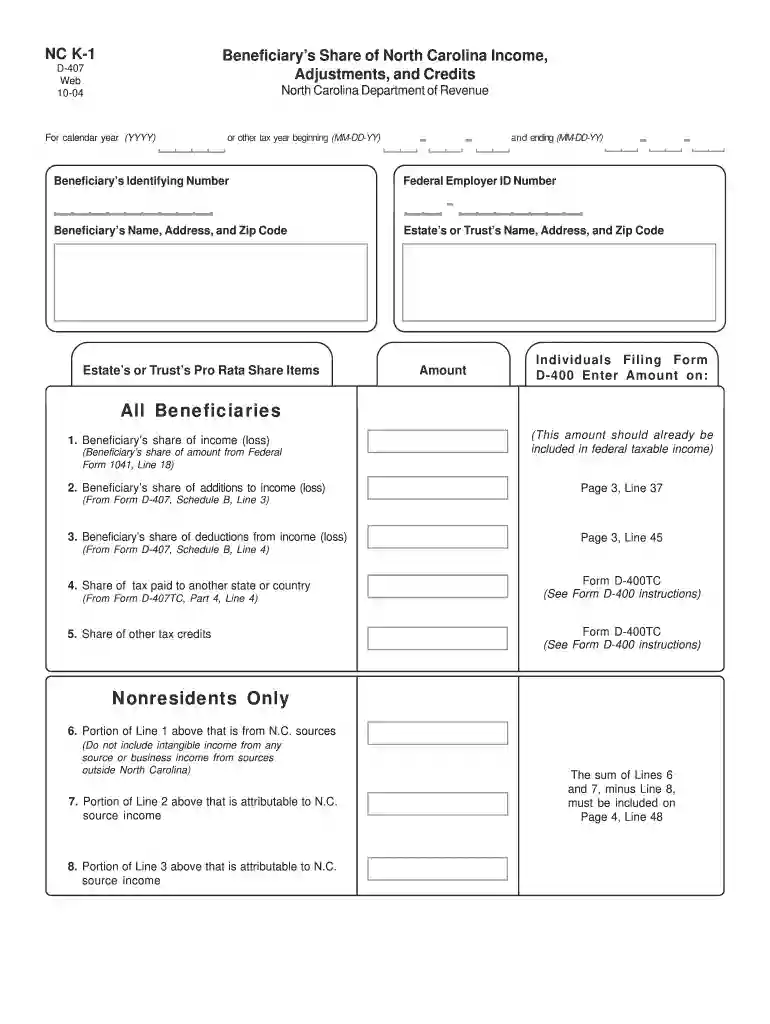
The "NC D407 K1 Form" is a tax document circulated by the North Carolina Department of Revenue, specifically catering to the requirements of beneficiaries receiving income from estates or trusts. It comprehensively outlines the beneficiary's share of income, adjustments, and tax credits relevant to a given tax year. The form is vital for beneficiaries in order to report their share of income, deductions, and credits, ensuring compliance with North Carolina tax regulations. This document is particularly essential for taxpayers, as it guides the reporting of state-specific income, thereby aligning with regional taxation laws.
Utilizing the NC D407 K1 Form involves several steps aimed at capturing detailed information about the beneficiary's income from an estate or trust. Recipients must diligently report:
Each section of the form must be completed accurately to ensure that the information filed is thorough and aligns with both state and federal tax reporting requirements. Errors or omissions can result in discrepancies, possibly leading to audits or penalties.
Gather Necessary Documents: Collect all relevant documents pertaining to your income from estates or trusts. This includes the original estate or trust paperwork, previous tax returns, and any correspondence from trustees.
Fill Out Personal Information: Provide your full name, address, and taxpayer identification number (TIN) to confirm your identity on the form.
Report Income and Credits: Clearly indicate all sources of income and eligible tax credits. Ensure that all data entered corresponds with information provided by the estate or trust manager.
Adjustments for Nonresidents: If applicable, nonresident beneficiaries should identify and report only the North Carolina-sourced income. It's important to follow specific state guidelines regarding this classification.
Review and Sign: Carefully review all entries for accuracy. Sign the form to certify the correctness of the disclosed information. Retain a copy for your records.
Submission: Submit the completed form in accordance with the instructions, whether by mail or electronically, ensuring timely delivery to the appropriate department.
Understanding key terms associated with the NC D407 K1 Form enhances one's ability to accurately complete and submit the form. Significant terminology includes:
Familiarity with these terms aids in navigating the form's requirements competently.
The NC D407 K1 Form serves a critical legal purpose by documenting income received through estates or trusts within North Carolina. The form ensures compliance with state tax laws, mandating full disclosure of income to provide a basis for calculating state taxes. Legal compliance also extends to:
The form also supports legal scrutiny by maintaining an official record of income, credits, and adjustments for beneficiaries.
Adherence to filing deadlines is mandatory to avoid penalties. The NC D407 K1 Form primarily coincides with personal tax filing deadlines, usually requiring submission by April 15, unless an extension is granted. Important dates include:
Ensuring submission by these dates keeps taxpayers compliant and avoids incurring additional fines or penalties.
North Carolina imposes specific rules for completing the NC D407 K1 Form. These include guidelines on determining taxable income, special instructions for nonresidents, and detailed provisions about eligible deductions and credits. Particular attention should be given to:
Comprehending state-specific rules is crucial for correctly completing and accurately filing the form.
Failure to comply with filing requirements associated with the NC D407 K1 Form can result in penalties. Non-compliance consequences include:
Ensuring timely and accurate submission is essential to avoid these repercussions and maintain good standing with the Department of Revenue.
We've got more versions of the nc d407 k1 form form. Select the right nc d407 k1 form version from the list and start editing it straight away!
| Versions | Form popularity | Fillable & printable |
|---|---|---|
| 2025 | 4.9 Satisfied (29 Votes) | |
| 2024 | 4.5 Satisfied (52 Votes) | |
| 2023 | 4.4 Satisfied (34 Votes) | |
| 2023 | 4.5 Satisfied (38 Votes) | |
| 2022 | 4.9 Satisfied (48 Votes) | |
| 2021 | 4.8 Satisfied (146 Votes) | |
| 2020 | 4.4 Satisfied (231 Votes) | |
| 2019 | 4.4 Satisfied (167 Votes) | |
| 2018 | 4.3 Satisfied (116 Votes) | |
| 2016 | 4 Satisfied (31 Votes) | |
| 2004 | 4.3 Satisfied (251 Votes) |
At DocHub, your data security is our priority. We follow HIPAA, SOC2, GDPR, and other standards, so you can work on your documents with confidence.
(1) corneal epithelium, (2) Bowmans layer, (3) Stroma, (4) Descemets membrane and (5) endothelium. Figure A represents the corneal histological image.
Range: K1 ~ K100. Default = K10. If the value exceeds K100, the value will be set to. K100; if the set value is lower than K1, it will be set to K1. CR#12
Use Form D-407 NC K-1 to report each beneficiarys share of the estates or trusts income (loss), N.C. adjustments, N.C. tax credits, etc.


