




01. Edit your form online
Type text, add images, blackout confidential details, add comments, highlights and more.

Type text, add images, blackout confidential details, add comments, highlights and more.

Draw your signature, type it, upload its image, or use your mobile device as a signature pad.

Send it via email, link, or fax. You can also download it, export it or print it out.
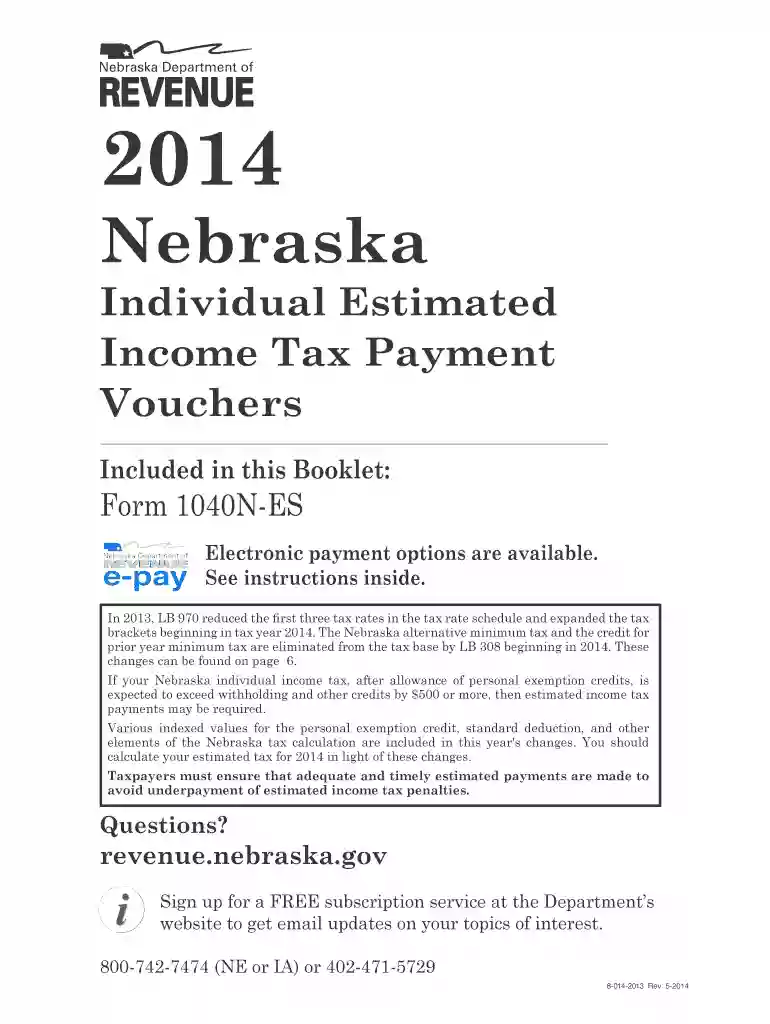
The 2014 Nebraska Form Tax primarily refers to the Nebraska Individual Estimated Income Tax Payment Vouchers for the year 2014. This form is critical for individuals who need to make estimated tax payments throughout the year to the state of Nebraska. Estimated tax payments are generally required when a taxpayer’s tax withholdings are insufficient to meet their tax liability. Ensuring compliance with this form is necessary to avoid potential penalties and ensure timely payments through the year.
Completing and submitting the 2014 Nebraska Form Tax is essential for taxpayers who anticipate owing at least $500 in state taxes after subtracting their tax credits and withholding. By using this form, taxpayers signal their intention to make periodic estimated payments, safeguarding themselves against late payment penalties and interest. For self-employed individuals, retirees, and any other party with sporadic or irregular income streams, this form is especially relevant, as it helps in managing their tax liabilities efficiently.
Determine Your Estimated Tax: First, calculate the estimated amount of income, deductions, and credits you expect for the year. Use this information to determine your expected tax liability.
Calculate Payments Required: Subtract withholding and credits from your expected tax liability to determine how much you need to pay in estimated payments.
Complete the Payment Voucher: Fill in the Nebraska Individual Estimated Tax Payment Vouchers with your personal information and the payment amount.
Submit and Pay: Mail the completed voucher with your payment. You may need to prepare payments at multiple intervals, typically quarterly, to ensure compliance.
The 2014 Nebraska Form Tax can be accessed through several channels:
Ensuring you have the correct version of the form is crucial, as using outdated or incorrect forms can lead to filing errors or missed payments.
Filling out the form correctly requires attention to several crucial sections:
While the Nebraska form focuses on state requirements, it’s essential to consider federal obligations:
For the 2014 tax year, there are key deadlines to remember:
Missing these deadlines can result in interest and penalties, making timely submission critical.
Failing to comply with estimated payment guidelines can result in financial consequences:
Understanding and adhering to these rules can mitigate these risks and ensure a smoother financial process.
The form can be submitted in either electronic or paper formats:
Choose the method that aligns best with your preferences and capabilities, keeping in mind that electronic submissions often offer enhanced accuracy and expedited processing.
We've got more versions of the 2014 ne form tax form. Select the right 2014 ne form tax version from the list and start editing it straight away!
| Versions | Form popularity | Fillable & printable |
|---|---|---|
| 2025 | 4.1 Satisfied (35 Votes) | |
| 2024 | 4.9 Satisfied (39 Votes) | |
| 2023 | 4.6 Satisfied (56 Votes) | |
| 2022 | 4.9 Satisfied (56 Votes) | |
| 2021 | 4.3 Satisfied (190 Votes) | |
| 2020 | 4.4 Satisfied (62 Votes) | |
| 2019 | 4.3 Satisfied (39 Votes) | |
| 2017 | 4.3 Satisfied (171 Votes) | |
| 2016 | 4.4 Satisfied (403 Votes) | |
| 2015 | 4.4 Satisfied (45 Votes) | |
| 2014 | 4.3 Satisfied (46 Votes) | |
| 2013 | 4 Satisfied (50 Votes) | |
| 2012 | 4 Satisfied (39 Votes) |
At DocHub, your data security is our priority. We follow HIPAA, SOC2, GDPR, and other standards, so you can work on your documents with confidence.
Purpose. Complete Form W-4 so that your employer can withhold the correct federal income tax from your pay. Consider completing a new Form W-4 each year.
2014 Individual Income Tax Booklet, with forms, tables, instructions, and additional information, Form ; 2014 Nebraska Tax Calculation Schedule for Individual
Apr 15, 2015 If advance payments of the premium tax credit were made, you must file a 2014 tax return and Form 8962.


