




01. Edit your form online
Type text, add images, blackout confidential details, add comments, highlights and more.

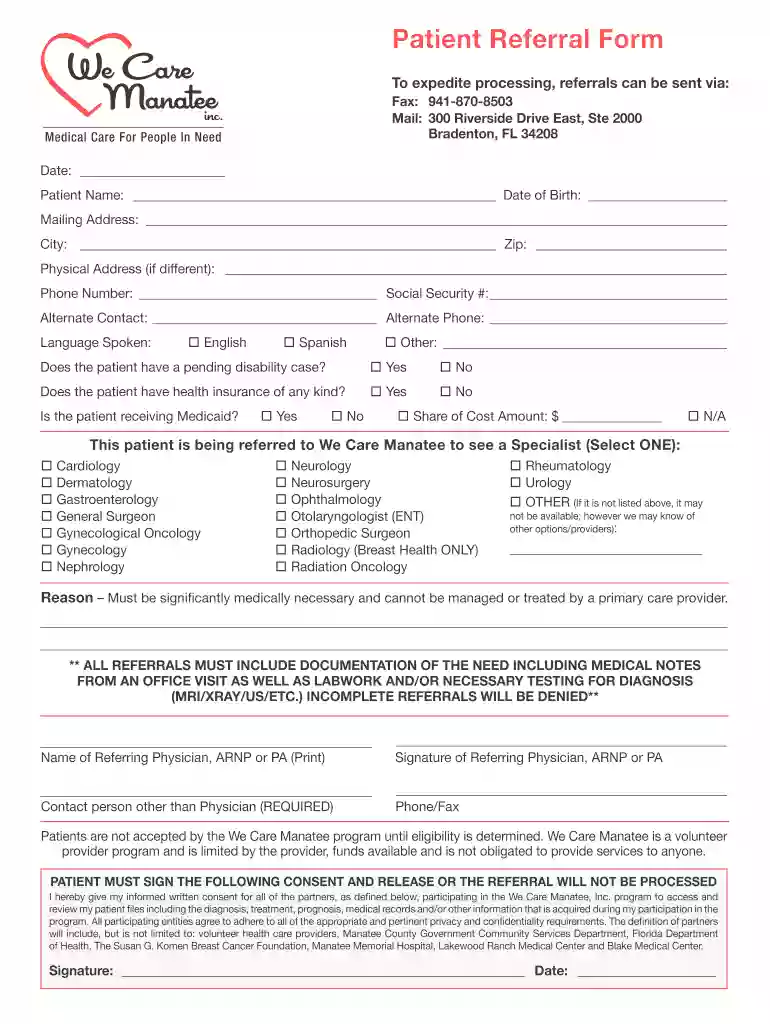
Type text, add images, blackout confidential details, add comments, highlights and more.

Draw your signature, type it, upload its image, or use your mobile device as a signature pad.

Send it via email, link, or fax. You can also download it, export it or print it out.
Referral forms are critical documents used in medical, educational, and professional settings to facilitate the transfer of information and requests from one party to another. Specifically, in a healthcare context, these forms enable a primary care physician to transfer a patient to a specialist or alternative care facility efficiently. The form outlines vital information about the patient, the type of services needed, and any pertinent medical history that can expedite accurate and timely care. The use of referral forms ensures coordinated care and communication among healthcare providers, ultimately enhancing patient outcomes and operational efficiency.
The phrase "To expedite processing, referrals can be sent via:" suggests using specific methods to speed up referral procedures. Expedited processing means accomplishing tasks more swiftly and efficiently, reducing delays in patient care or service delivery. In this context, the means by which referrals are sent, such as digitally through secure online platforms, directly impact the expediency of processing these documents. Leveraging electronic transfer methods over traditional mail not only minimizes processing time but also decreases the potential for misclassifications and improves security through encryption.
Electronic Mail (Email):
Online Platforms:
Fax:
Completing a referral form accurately is crucial for effective processing. Here’s a detailed breakdown of the steps involved:
Identify Patient Information:
Detail Medical or Service Needs:
Authorization and Consent:
Select a Submission Method:
Follow Up:
The rapid processing of referral forms is essential for seamless healthcare operations. Timeliness can significantly affect patient outcomes, particularly when specialists or specific treatments are needed urgently. Additionally, expedited processing helps health systems manage scheduling more effectively, reducing waiting times and improving operational efficiency. Modern technological solutions like DocHub facilitate faster submission and processing, promoting a streamlined approach to managing referrals.
Referral forms are utilized across various sectors, primarily in healthcare and educational settings:
Legal considerations play a vital role in how referrals are managed and sent:
Essential components of a referral form might include:
Referring Party Information:
Recipient Details:
Reason for Referral:
Patient or Client Information:
Instructions and Deadlines:
Despite national standards, state-specific regulations may influence how referrals are processed. Variations may exist in terms of:
Referrals are pivotal in numerous scenarios:
Examples highlight how referral forms are instrumental in bridging communication gaps, ensuring that patients receive necessary services without delays. Advanced systems like DocHub enhance this process by offering tools that integrate referral submission with other key document management capabilities, ultimately supporting better patient care and operational efficiency.
We've got more versions of the To expedite processing, referrals can be sent via: form. Select the right To expedite processing, referrals can be sent via: version from the list and start editing it straight away!
At DocHub, your data security is our priority. We follow HIPAA, SOC2, GDPR, and other standards, so you can work on your documents with confidence.
(4) A component shall notify the requester within 10 calendar days of the receipt of a request for expedited processing of its decision whether to grant or deny
Mar 31, 2025 You may request that USCIS expedite the adjudication of an application, petition, request, appeal, or motion that is under USCIS jurisdiction.
Urgent requests will be processed within seventy-two (72) hours of receipt of request. Prior Authorization requests can be submitted via: Fax. . . . . . .


