




01. Edit your form online
Type text, add images, blackout confidential details, add comments, highlights and more.

Type text, add images, blackout confidential details, add comments, highlights and more.

Draw your signature, type it, upload its image, or use your mobile device as a signature pad.

Send it via email, link, or fax. You can also download it, export it or print it out.
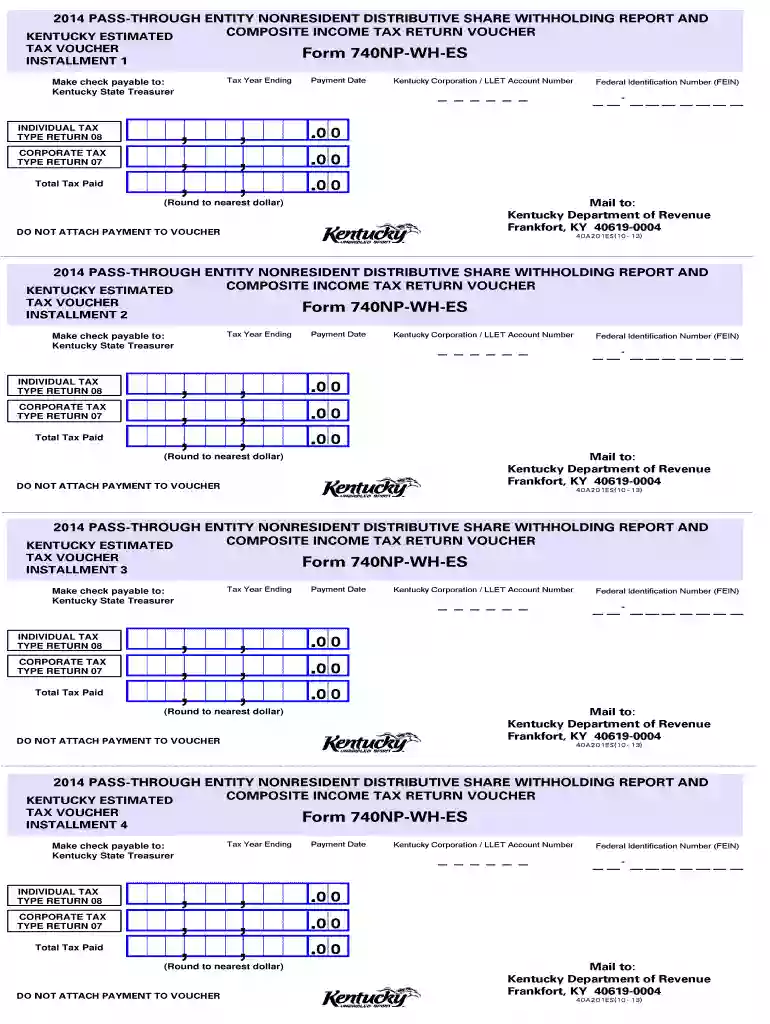
The 740NP-WH ES 2014 Form, formally known as the 2014 Pass-Through Entity Nonresident Distributive Share Withholding Report and Composite Income Tax Return Voucher for Kentucky, is used by pass-through entities such as partnerships and S corporations. This form serves to report and remit Kentucky income tax withheld from distributive shares allocated to nonresident partners, members, or shareholders. It facilitates compliance with state tax obligations by ensuring that nonresident beneficiaries contribute appropriately to the Kentucky revenue system.
To acquire the 740NP-WH ES 2014 Form, entities can visit the official website of the Kentucky Department of Revenue. The form is available for download as a PDF file, ensuring easy access for those who need it. Additionally, businesses may contact the department directly to request a physical copy if they prefer to work with paper documents. Tax software programs that cater to Kentucky filings may also offer digital access to this specific form, providing another convenient option for businesses.
Gather Necessary Information: Initiate the process by collecting essential details about all nonresident partners or members, including names, addresses, and social security numbers (or taxpayer identification numbers).
Calculate Withheld Taxes: Accurately determine the Kentucky income tax withheld for each nonresident member's distributive share. This requires a thorough review of KY estimated tax obligations and any applicable credits.
Complete Form Sections: Fill out each section of the form, inputting calculated amounts of tax withheld and overall totals. Ensure all fields are accurately completed to avoid processing errors.
Attach Required Documents: If applicable, append any supporting documentation, such as additional forms that provide clarification or additional tax calculations required for your entities' scenarios.
Review and Submit: Carefully review the form for any inaccuracies or omissions before submitting it to the Kentucky Department of Revenue by the appropriate deadline.
The primary users of the 740NP-WH ES 2014 Form are pass-through entities such as partnerships, S corporations, or limited liability companies that have nonresident members or partners. Because these entities do not pay income tax at the business level, they must ensure that nonresident stakeholders are fulfilling their Kentucky tax liabilities through proper withholding and reporting.


Nonresident Information: Critical details about nonresident partners or members, their distributive shares, and associated tax withholding.
Tax Withholding Calculations: Precise computations of withholding requirements based on the income attributed to nonresident stakeholders.
Submission Voucher: A section dedicated to remittance data, providing guidance for sending tax payments along with form submission.
Kentucky-specific legislation governs the use of the 740NP-WH ES 2014 Form. The state mandates that distributive income tax withholdings are in compliance with their tax code, which delineates requirements unique to Kentucky, such as composite filing guidelines and thresholds for withholding.
The 740NP-WH ES 2014 Form must be completed and submitted by the due date outlined by the Kentucky Department of Revenue. The deadlines usually align with the entity's fiscal year-end and the requirements for estimated quarterly payments. Missing these deadlines may attract interest and penalties, emphasizing the importance of timely filing.
Failure to correctly file or submit the 740NP-WH ES 2014 Form, including any omitted tax withholdings or late payments, can result in significant penalties. Fines, interest on unpaid taxes, and other repercussions can be imposed by the Kentucky Department of Revenue. Understanding and ensuring compliance with these rules is crucial to avoid adverse financial impacts on the business entity.
We've got more versions of the 740np wh es 2014 form form. Select the right 740np wh es 2014 form version from the list and start editing it straight away!
| Versions | Form popularity | Fillable & printable |
|---|---|---|
| 2025 | 4.3 Satisfied (50 Votes) | |
| 2024 | 4.8 Satisfied (51 Votes) | |
| 2023 | 4.5 Satisfied (41 Votes) | |
| 2022 | 4.8 Satisfied (67 Votes) | |
| 2020 | 4.4 Satisfied (129 Votes) | |
| 2019 | 4.2 Satisfied (72 Votes) | |
| 2018 | 4.2 Satisfied (121 Votes) | |
| 2016 | 4.4 Satisfied (653 Votes) | |
| 2016 | 3.8 Satisfied (42 Votes) | |
| 2015 | 4.4 Satisfied (305 Votes) | |
| 2014 | 4 Satisfied (47 Votes) | |
| 2013 | 4.3 Satisfied (44 Votes) |
At DocHub, your data security is our priority. We follow HIPAA, SOC2, GDPR, and other standards, so you can work on your documents with confidence.
Line 30(a), Tax WithheldEnter the amount of 2014 Kentucky income tax withheld by your employer(s). This amount is shown on wage and tax statements, including
This paper introduces a new metric for the quantitative assessment of the similarity of speakers accents. The ACCDIST metric is based on the correlation of


