







Definition & Meaning
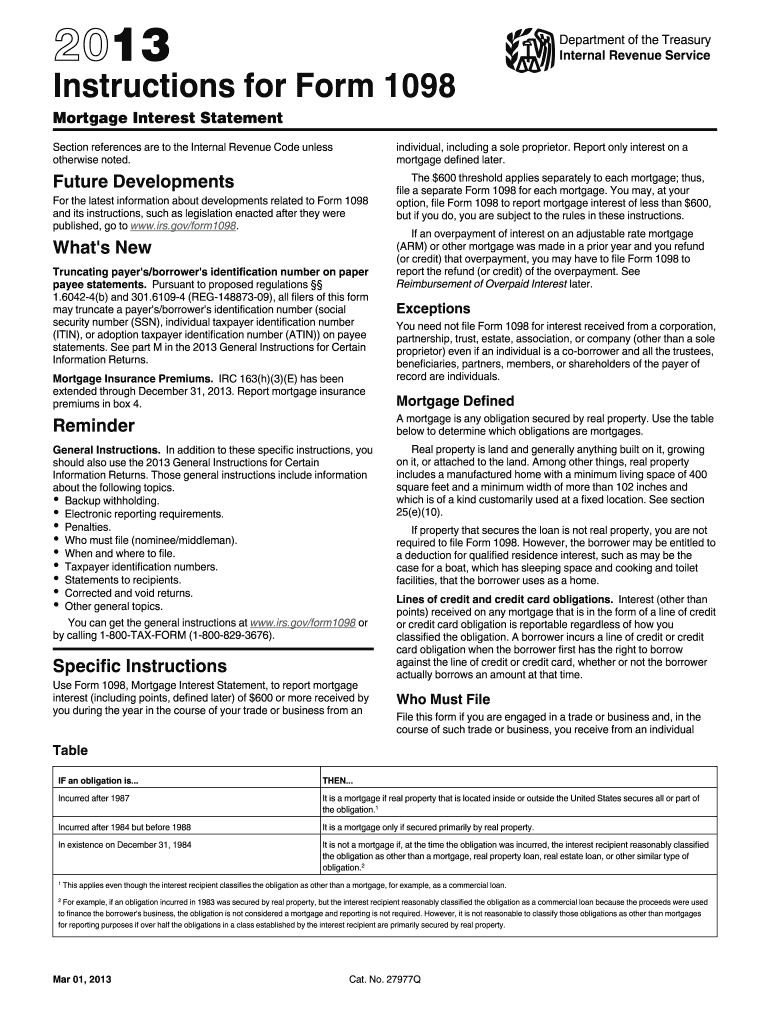
Form 1098, specifically titled "Mortgage Interest Statement," is an IRS form used by lenders to report mortgage interest received from borrowers throughout the tax year. For the year 2013, this form is crucial for both lenders and borrowers to ensure accurate reporting of paid and received interest. It captures essential information such as the amount of mortgage interest paid, points paid on a mortgage, and other adjustments critical for tax calculations.
- Purpose: Identify the interest payments received by lenders.
- Recipient: Typically issued to borrowers to assist in their tax filings.
- Key Components: Includes details of the lender, mortgage interest, points, and other payment adjustments.
How to Use the IRS Form 1098 Mortgage Interest Statement 2013
The primary use of Form 1098 is to provide taxpayers with the information they need to claim deductions related to mortgage interest on their tax returns. Here's how to effectively utilize this document:
- Verify Information: Ensure all details on the form are correct, including the lender’s information and mortgage interest amounts.
- Deduction Calculation: Use the interest amounts reported to claim deductions on Schedule A of your Form 1040.
- Includes Points: If you paid points to obtain your mortgage, these might also be deductible, either in full or over the life of the loan.
Practical Example
Suppose you paid $10,000 in mortgage interest and $2,000 in points in 2013. This would be reported on Form 1098, allowing you to claim these amounts when itemizing your deductions on your tax return.
Steps to Complete the IRS Form 1098 Mortgage Interest Statement 2013
Although borrowers do not complete Form 1098 themselves, understanding how lenders prepare it can be beneficial:
- Gather Required Information: Lenders need details about the borrower and mortgage.
- Accurate Entry: Enter the total mortgage interest received, including points if applicable.
- Filing: Submit the completed form to the IRS and provide a copy to the borrower.
Key Details
- Box 1: Interest received from the borrower in 2013.
- Box 2: Outstanding mortgage principal as of January 1, 2013.
- Box 3: Date of mortgage origination.
Important Terms Related to IRS Form 1098 Mortgage Interest Statement 2013
Understanding specific terminology is essential for using Form 1098 effectively:
- Mortgage Interest: The cost borrowers pay for borrowing to purchase or construct a home.
- Points: Prepaid interest or fees sometimes deductible immediately.
- Principal: The original loan amount, excluding interest and other charges.
Examples
- If a borrower’s loan was $200,000 and paid $5,000 in interest and $1,000 in points, this impacts their deduction eligibility.
Legal Use of the IRS Form 1098 Mortgage Interest Statement 2013
The correct use of Form 1098 is crucial for both compliance and maximizing tax benefits:
- Tax Deduction Compliance: Ensure that the amounts reported align with IRS guidelines for mortgage interest deductions.
- Documentation: Keep copies of the form and any related mortgage records for at least seven years for legal and verification purposes.
IRS Guidelines
The IRS provides specific regulations and instructions surrounding Form 1098 to guide both issuers and receivers:
- Reporting Criterion: Any entity that receives $600 or more in mortgage interest must file Form 1098.
- Exclusions: Interest on loans made to corporations, partnerships, or trusts isn't reported on Form 1098.
Filing Deadlines / Important Dates
Adhering to the deadlines for providing and filing Form 1098 is critical:
- Issuance Deadline: Lenders must furnish borrowers with the form by January 31 of the year following receipt of the interest.
- IRS Filing Deadline: The form should be filed with the IRS by February 28 for paper filings, or March 31 if filing electronically.
Required Documents
For accurate completion and filing of Form 1098, certain documents are necessary:
- Loan Agreement: Details of the original loan terms.
- Payment Records: Proof of interest paid and received during the tax year.
- Year-End Summary: Some lenders provide a complete summary useful for verification.
With strict adherence to these guidelines and an understanding of key elements, using the IRS Form 1098 Mortgage Interest Statement 2013 ensures compliance and maximizes potential tax benefits for borrowers.




