
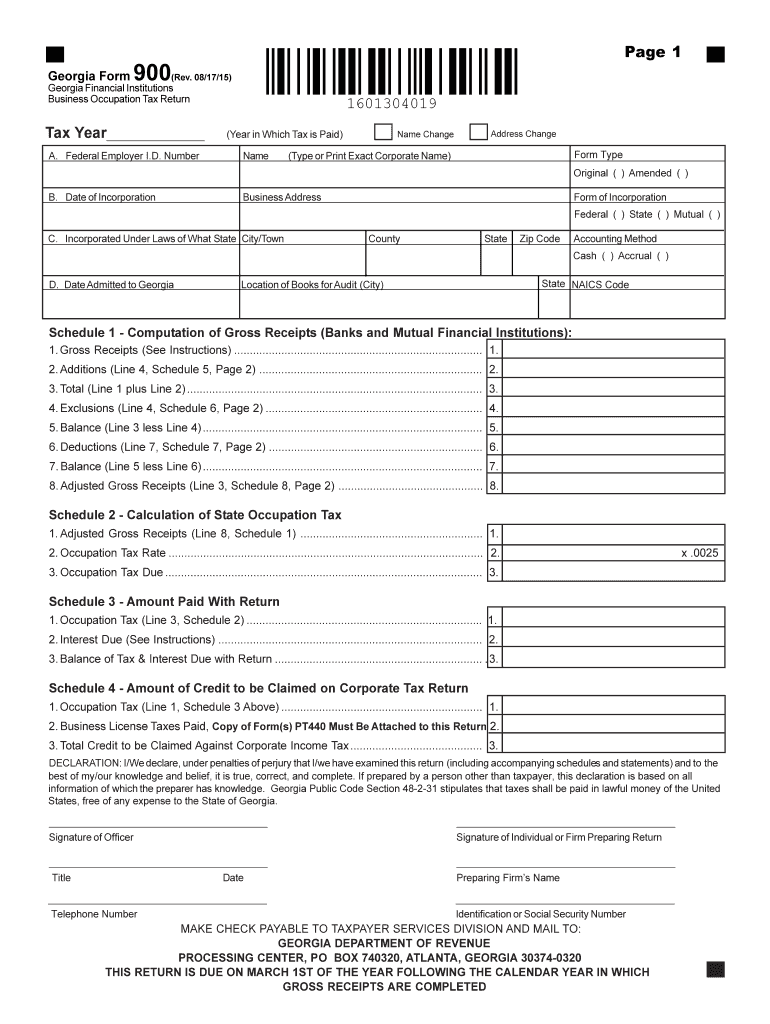







Definition and Purpose of GA Form 900
The Georgia Financial Institutions Business Occupation Tax Return, referred to as Form 900, is a mandatory filing document for financial institutions operating within the state of Georgia. This form is designed to assess and report the gross receipts of financial activities, ensuring that the correct amount of state occupation tax is calculated and paid. This requirement is in place to maintain compliance with state tax obligations while providing a standardized method for financial institutions to disclose their taxable activities.
Key Elements of GA Form 900
- Gross Receipts Computation: The form requires detailed calculations of gross receipts, which form the basis for determining the occupation tax liability.
- Tax Additions and Deductions: Financial institutions must document allowable additions and deductions that affect the taxable amount.
- Apportionment Details: For institutions operating across state lines, there is a section to apportion receipts accurately, ensuring only Georgia-sourced income is taxed.
- Filing Requirements: Specific instructions on how to complete and file the form help institutions comply with state mandates.
How to Use GA Form 900
Filing the GA Form 900 involves several critical steps to ensure accurate reporting and tax liability calculation. The process generally includes collecting all required financial documents, accurately calculating gross receipts, and properly allocating deductions and additions.
Steps to Complete GA Form 900
- Gather Financial Documentation: Collect all necessary financial records, including receipts, invoices, and previous tax documents.
- Calculate Gross Receipts: Use records to compute the total gross receipts from Georgia-based operations.
- Apply Deductions and Additions: Identify and document any allowable deductions or mandatory additions.
- Complete the Apportionment Section: If applicable, correctly apportion receipts for multi-state operations.
- Review and Submit: Double-check the form for accuracy and completeness, then submit it by the filing deadline through your chosen method.
Filing Deadlines and Submission Methods
- Deadlines: The GA Form 900 must be filed annually by the specified due date to avoid late penalties.
- Submission Options: The form can be submitted online through the state’s tax portal, or mailed physically to the relevant department. Ensure any paper submissions are postmarked by the deadline.
Who Typically Uses GA Form 900
The primary users of GA Form 900 are financial institutions operating within the state of Georgia. This includes:
- Banks and Credit Unions: Entities offering traditional banking services and products.
- Fintech Companies: Businesses providing online financial services must comply if operating within Georgia.
- Investment Firms: Companies involved in managing investment portfolios and related financial services.
Business Entity Types
- Corporations: Both C-corporations and S-corporations engaged in financial activities are required to file.
- Limited Liability Companies (LLCs): LLCs with financial service operations in Georgia must comply.
- Partnerships: Partnerships centered around financial services must also report using this form.
Legal Use and Compliance
Compliance with the GA Form 900 is legally mandated for all applicable financial institutions operating within Georgia. Non-compliance can result in legal repercussions and financial penalties.
Penalties for Non-Compliance
- Monetary Fines: Late filing or underreporting can result in financial penalties.
- Legal Action: Chronic non-compliance may lead to further legal actions and audits.
State-Specific Rules for GA Form 900
Georgia has unique tax laws that financial institutions must adhere to, influencing how the GA Form 900 is completed. Understanding these specifics is crucial for accurate filing.
Important Terms Related to GA Form 900
- Apportionment: The process of allocating income across different jurisdictions.
- Gross Receipts: Total revenue received, subject to tax.
- Deductions: Specific reductions allowed by law in the taxable income calculation.
Digital vs. Paper Version
Filing the GA Form 900 can be performed using either digital or paper formats, each offering distinct advantages based on user preference and organizational needs.
Advantages of Digital Submission
- Efficiency: Online submissions are faster and often have built-in error-checking.
- Environmental Impact: Reduces paper usage and is aligned with sustainable practices.
Paper Submissions
- Traditional Approach: Some institutions prefer the tangibility of paper filing.
- No Tech Requirements: Suitable for those with limited internet access or digital literacy.
Important Dates and Documentation
Adhering to the correct filing deadlines and maintaining thorough record-keeping are cornerstone practices for ensuring compliance with GA Form 900 requirements.
Required Documents
- Financial Statements: Comprehensive records of income and expenses.
- Previous Tax Filings: Past submissions to aid in accurate current reporting.
- Specific Receipts and Invoices: Documents supporting additions, deductions, and apportionments.


