






Definition and Meaning
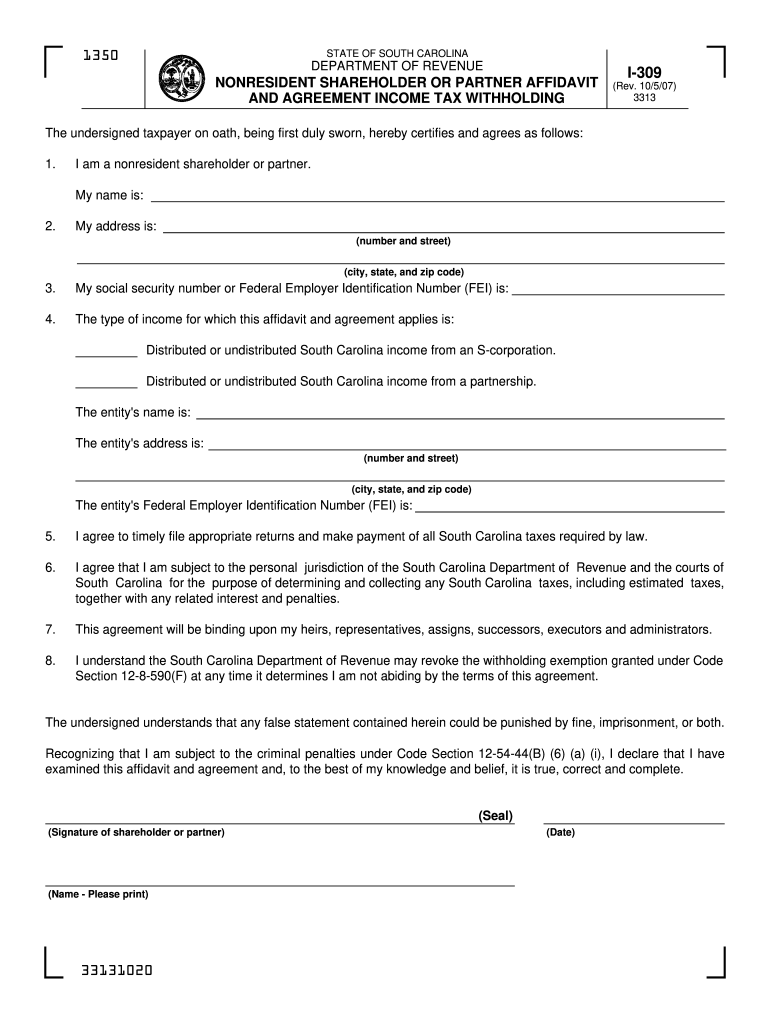
The Form I-309, known as the Nonresident Shareholder or Partner Affidavit and Agreement, is a critical tax document administered by the South Carolina Department of Revenue. It is primarily used by nonresident shareholders or partners in S-corporations or partnerships who seek to establish their nonresident status and request an exemption from withholding taxes on income earned from these entities. By completing this affidavit, individuals certify their non-residency and outline their eligibility to avoid withholding on South Carolina-sourced income. This form plays an essential role in ensuring compliance with state tax laws and facilitates the accurate administration of tax responsibilities for nonresident stakeholders.
How to Use the Form I-309
Using the Form I-309 involves several key steps aimed at securing tax withholding exemptions. It all begins with the nonresident shareholder or partner obtaining the form from the South Carolina Department of Revenue. After obtaining the form, they need to carefully read and fill out all sections, ensuring the accurate representation of their nonresident status. Signatures are mandatory, as they affirm the truthfulness of the provided information. Once completed, the form must be submitted to the respective S-corporation or partnership, which assumes responsibility for forwarding the document to the Department of Revenue. This sequential process guarantees that nonresident taxpayers correctly apply for withholding exemptions.
Steps to Complete the Form I-309
- Obtain the Form: Download from the South Carolina Department of Revenue's website or obtain it from your business entity.
- Enter Personal Details: Include name, address, Social Security Number or tax identification number.
- Confirm Nonresidency: Mark the affidavit section that confirms your nonresident status.
- Request Withholding Exemption: Certify the request for an exemption from South Carolina withholding tax.
- Signature Requirement: Sign and date the form to verify all information is accurate.
- Submit the Form: Forward it to the S-corporation or partnership, who will then submit it to the Department of Revenue.
Key Elements of the Form I-309
The Form I-309 contains essential sections that must be accurately completed to ensure legitimate tax exemption claims. Key elements include:
- Personal Identification: Information like name, address, and taxpayer identification number are crucial for identity verification.
- Certification of Nonresidency: A statement where the individual attests to their nonresident status.
- Exemption Request: A clause requesting exemption from withholding on South Carolina income.
- Signature and Date: The form must be signed and dated to affirm the authenticity of the provided information.
Legal Use of the Form I-309
The primary legal use of the Form I-309 is to serve as evidence of a nonresident’s status for tax purposes. By completing and submitting this affidavit, nonresidents legally justify their claim to an exemption from South Carolina tax withholding on their income from S-corporations or partnerships. Understanding and adhering to the legal requirements and implications of providing false information on this form is vital. Nonresidents must ensure that their submission aligns with state tax regulations to avoid potential penalties or legal repercussions.
State-Specific Rules for the Form I-309
In South Carolina, the Form I-309 must reflect certain state-specific rules. Nonresident shareholders or partners need to demonstrate compliance with South Carolina's tax statutes governing income sources attributed to partnerships or S-corporations. The affidavit ensures that the correct procedures are followed to benefit legally from withholding tax exemptions. Familiarity with South Carolina’s specific regulations is crucial for ensuring compliance and successfully navigating the state's tax system.
Who Typically Uses the Form I-309
The primary users of the Form I-309 are nonresident shareholders or partners in S-corporations or partnerships operating in South Carolina. This group includes individuals who do not reside in South Carolina but derive income from a business entity located in the state. By filing the Form I-309, these nonresidents can legally request the exemption from mandatory withholding tax on their South Carolina income, simplifying their tax obligations with the South Carolina Department of Revenue.


Required Documents
To complete the Form I-309 accurately, preparers should gather necessary documents, which may include:
- Proof of Nonresidency: Personal identification and documents verifying your primary residence outside of South Carolina.
- Partnership or Corporation Documentation: Evidence of your affiliation with the relevant S-corporation or partnership.
- Tax Identification Numbers: Ensure all necessary taxpayer identification numbers are available for verification.
Comprehensive documentation supports the claims made on the Form I-309 and ensures the filing process is smooth and correctly executed.
Penalties for Non-Compliance
Non-compliance with Form I-309 filing requirements can lead to significant repercussions. If a nonresident falsely claims an exemption or fails to file the form, they may face penalties, including fines or additional tax liabilities. Furthermore, providing inaccurate information can result in an audit or legal inquiry by tax authorities. Thus, a thorough understanding of the form's requirements and vigilant adherence to proper filing procedures are essential to avoiding negative consequences.
By providing these in-depth insights, nonresidents and entities can navigate the intricacies associated with the Form I-309 effectively and ensure they remain compliant with South Carolina's tax regulations.