




01. Edit your form online
Type text, add images, blackout confidential details, add comments, highlights and more.

Type text, add images, blackout confidential details, add comments, highlights and more.

Draw your signature, type it, upload its image, or use your mobile device as a signature pad.

Send it via email, link, or fax. You can also download it, export it or print it out.
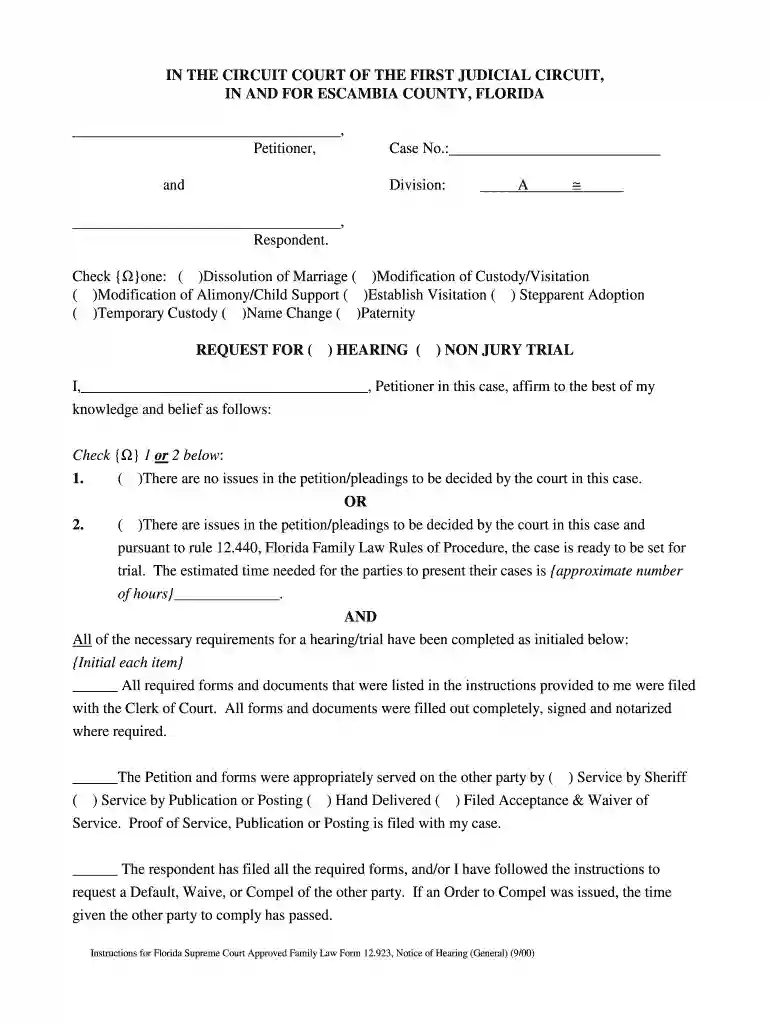
The form "19 - Request Hearing or Trial Escambia doc Florida Supreme Court Approved Family Law Form 12.902(d)" is a legal document primarily used in family law cases within Florida, particularly in Escambia County. This form is specifically utilized when a petitioner or respondent seeks to request a hearing or a non-jury trial for matters such as dissolution of marriage, custody modifications, or other family-related legal concerns. Its completion signifies that the involved party is ready to proceed with the case after ensuring that all necessary preliminary forms are filed and served to the counterparty.
Using the 19 - Request Hearing or Trial form requires a clear understanding of the legal process. Users must fill out personal details, case information, and the request for a hearing or a trial date. This form should be completed after essential documents related to the case, such as financial affidavits or child support guidelines, have been prepared and submitted. The form acts as an official request to the court, indicating readiness to move forward with the formal legal proceedings.
The 19 - Request Hearing or Trial form can be acquired through multiple channels:
Familiarity with key legal terms is vital when completing the form:
This form serves as an official document within the Florida legal system and is primarily used for:
The use and submission of the 19 - Request Hearing or Trial form are subject to Florida's state laws:
To ensure the form's validity, a series of supporting documents must typically accompany the submission:
Filing the form can be done through various approved channels:
Failure to properly submit or comply with the form's requirements can lead to several repercussions:
We've got more versions of the 19 - Request Hearing orTrial Escambia doc Florida Supreme Court Approved Family Law Form 12 902(d) form. Select the right 19 - Request Hearing orTrial Escambia doc Florida Supreme Court Approved Family Law Form 12 902(d) version from the list and start editing it straight away!
At DocHub, your data security is our priority. We follow HIPAA, SOC2, GDPR, and other standards, so you can work on your documents with confidence.
This form should be typed or printed in black ink. Both parties must sign the agreement and have their signatures witnessed by a notary public or deputy
request the instruction out of ignorance of the prevailing law. (IB at 88). Primarily,. Hall failed to establish that trial counsel Phillips was ignorant of


