




01. Edit your form online
Type text, add images, blackout confidential details, add comments, highlights and more.

Type text, add images, blackout confidential details, add comments, highlights and more.

Draw your signature, type it, upload its image, or use your mobile device as a signature pad.

Send it via email, link, or fax. You can also download it, export it or print it out.
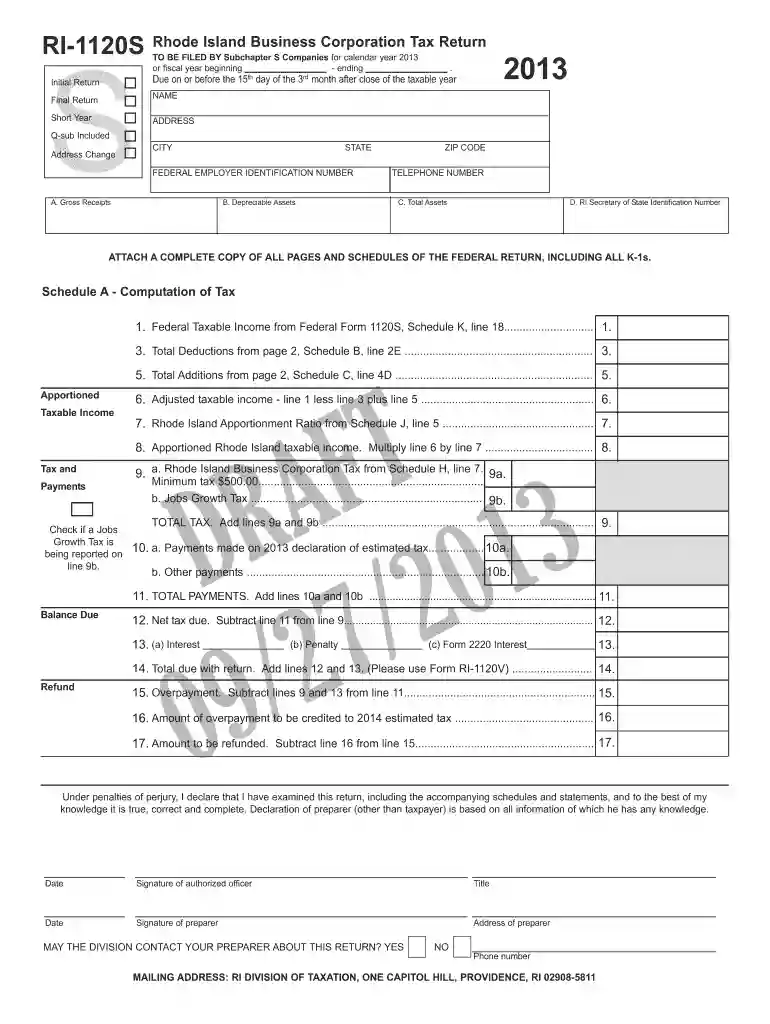
The 2013 RI-1120S form is a tax return document used specifically by Subchapter S corporations operating in Rhode Island. The form is compulsory for the calendar year 2013 and is utilized to report various financial aspects such as gross receipts, deductions, and additions. It is pivotal for calculating the Rhode Island Business Corporation Tax. This form encompasses sections that deal with the apportionment of taxable income, tax credits, and payment details, ensuring that every financial aspect is accurately reported and compliant with state tax laws.
Using the 2013 RI-1120S form involves a systematic process of reporting the financial data of S corporations. Business owners or their accountants need to gather all relevant financial documents, such as income statements and balance sheets, to complete the form. Key tasks include:
The form is primarily used by Subchapter S corporations in Rhode Island. These businesses choose this tax designation to pass corporate income, losses, credits, and deductions through to shareholders. Typically, small to medium-sized businesses that meet the IRS eligibility criteria for S corporations would utilize this form, which allows income to be taxed at the shareholder level rather than at the corporate level, potentially reducing the overall tax burden.


In 2013, the filing deadline for the RI-1120S form typically aligned with the federal tax year, requiring submission by March 15 for calendar year filers. If the due date falls on a weekend or holiday, the deadline shifts to the next business day. Extensions may be filed if additional time is needed, but businesses must ensure that at least 90% of the tax liability is paid to avoid interest charges on any overdue amounts.
Failure to file the 2013 RI-1120S form by the deadline or inaccuracies in the information provided can result in penalties imposed by the Rhode Island Division of Taxation. Penalties might include monetary fines, interest on outstanding taxes, and possible audits that add administrative burdens on the business. Non-compliance can disrupt business operations and lead to further scrutiny by taxation authorities, underscoring the importance of accurate and timely filing.
We've got more versions of the 2013 ri 1120s form form. Select the right 2013 ri 1120s form version from the list and start editing it straight away!
At DocHub, your data security is our priority. We follow HIPAA, SOC2, GDPR, and other standards, so you can work on your documents with confidence.
Jan 18, 2016 ter S corporation filing on. Form RI-1120S, the original due date this year will be. March 15, 2017, and the ex- tended due date will be Sep-.
by TJ Mathews 2015 Cited by 1250 Abstract. ResultsThe U.S. infant mortality rate was 5.96 infant deaths per 1,000 live births in 2013, similar to the rate of 5.98 in 2012.
Address Change. RI-1120S Rhode Island Business Corporation Tax Return. TO BE FILED BY Subchapter S Companies for calendar year 2013 or fiscal year beginning


