




01. Edit your form online
Type text, add images, blackout confidential details, add comments, highlights and more.

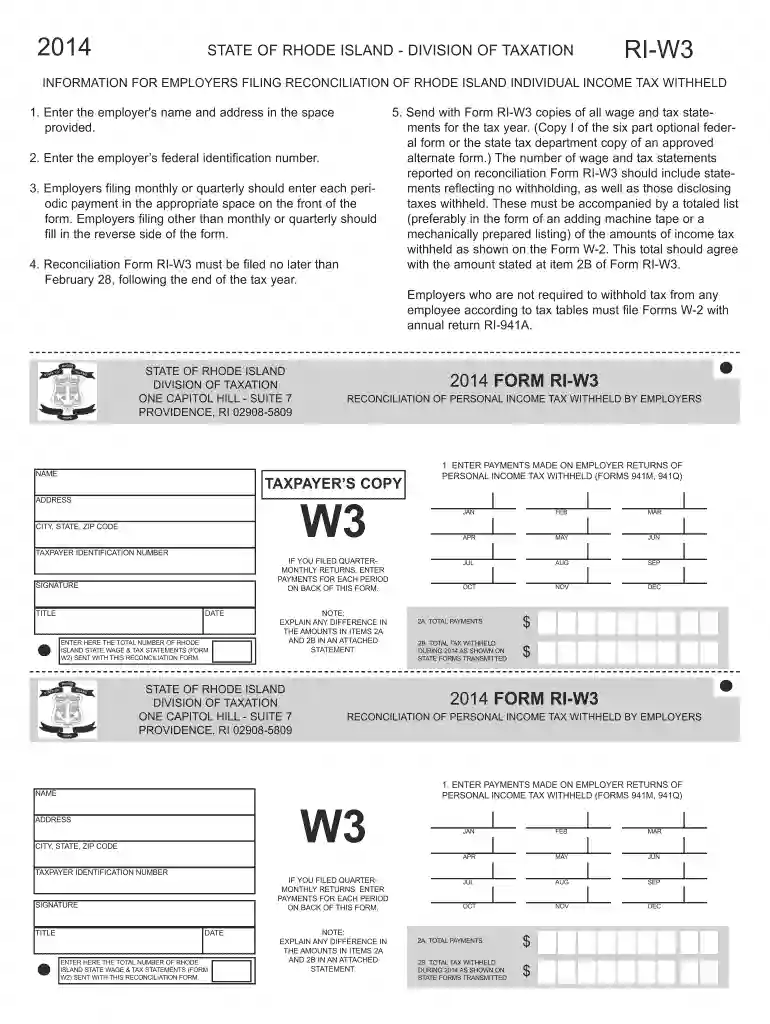
Type text, add images, blackout confidential details, add comments, highlights and more.

Draw your signature, type it, upload its image, or use your mobile device as a signature pad.

Send it via email, link, or fax. You can also download it, export it or print it out.
The W-3 Form, particularly the 2014 version, serves as a transmittal document that summarizes the total earnings and the taxes withheld as reported on the W-2 forms submitted by an employer. This form is essential for the Internal Revenue Service (IRS) to verify the accuracy of individual employee's tax submissions. The W-3 essentially aggregates the information provided on all of the W-2 forms a company files for a given year, ensuring the totals align before submission to the IRS.
Employers utilize the W-3 Form as a summary document. Once all employee W-2 forms are completed, the totals of all wages, withheld taxes, and other compensation-related figures need to be transcribed onto the W-3 Form. It acts as a cover sheet for the batch of W-2 forms submitted to the Social Security Administration (SSA). Correctly completing the W-3 ensures that all employee earnings and taxes are appropriately reported to maintain compliance with federal tax regulations.
Understanding these terms is crucial for accurate form completion, as they reflect both the employee and employer contributions and withholdings.
For the 2014 tax year, the W-3 Form, alongside W-2 forms, had to be submitted to the Social Security Administration by the end of February 28, 2015, or March 31, 2015, if filed electronically. Employers also needed to provide employees with their W-2 forms by January 31, following the tax year.
The W-3 Form is legally binding and mandatory for businesses to file annually if they have issued W-2 forms to employees. This documentation forms part of the official record of taxable earnings and contributions for the IRS. Employers must ensure the data on the W-3 accurately reflects the collective information of all W-2 forms, and discrepancies can result in penalties or audits.
Failing to file a W-3 Form, filing it late, or submitting incorrect data can result in fines and penalties. The IRS imposes fines based on the tardiness of the submission and the number of forms affected. Enforcing compliance is a legal obligation for employers, aiming to maintain the integrity of the tax reporting system.
The 2014 W-3 Form could be filed both electronically and via mail. The digital submission is encouraged by the IRS and SSA for it reduces paperwork and the potential for errors and allows for quicker processing. Businesses using the digital method benefit from built-in data verification checks. Nonetheless, whether filing electronically or by paper, ensuring complete accuracy is paramount to avoid complications or penalties.
Each of these elements must accurately match the data on corresponding W-2 forms to ensure compliance. The SSA and IRS use the W-3 to cross-verify individual W-2s, maintaining consistency and accuracy in tax records.
We've got more versions of the w3 form 2014 form. Select the right w3 form 2014 version from the list and start editing it straight away!
At DocHub, your data security is our priority. We follow HIPAA, SOC2, GDPR, and other standards, so you can work on your documents with confidence.
Jan 26, 2024 Notice 2014-7 provides that certain Medicaid waiver payments may be excluded from gross income for federal income tax purposes. See. Notice 2014
A Form W-3 Transmittal is completed only when paper Copy A of. Form(s) W-2, Wage and Tax Statement, is being filed. Do not file Form. W-3 alone. All paper forms


